pillar
Web Analytics Software in 2026: The Complete Guide
The pillar guide to web analytics software in 2026. Which tool fits your site, what you'll pay, what the free tiers hide, and how to choose.
 By Manu A. · · 9 min read ·
Updated
By Manu A. · · 9 min read ·
Updated 
This is the pillar guide to web analytics software in 2026. If you’ve Googled “best web analytics tool” and ended up on listicles that recommend Google Analytics for everyone without acknowledging that the EU’s privacy stance and Google’s switch to GA4 broke a lot of the old assumptions, this page is meant to be the antidote.
Reading this end-to-end takes about 12 minutes. If you only have 30 seconds, skip to the stack recommendations by site type.
The state of web analytics in 2026
Three shifts since 2022 changed the analytics landscape:
Universal Analytics died, GA4 replaced it. The transition was rough. GA4’s data model, reporting interface, and conventions are meaningfully different from Universal Analytics. Many small businesses that limped through the migration ended up with worse insight than they had on UA — at which point lighter-weight alternatives started looking attractive.
Privacy regulations went mainstream. GDPR in EU, similar laws in California, Brazil, and increasingly elsewhere. Consent banners became table stakes. The compliance overhead pushed many small businesses toward privacy-first analytics tools that don’t require consent banners.
Product analytics split off as a category. PostHog, Mixpanel, Amplitude — tools that treat customer behavior as event streams rather than pageview reports — became their own category, distinct from “marketing analytics.” SaaS teams stopped trying to bend GA4 into product analytics.
The decision today isn’t “which generic web analytics tool” — it’s “what’s my privacy posture, and how deep do I need to go?”
Stack recommendations by site type
Six common situations covering most readers:
| Site type | Use… | Cost at typical traffic |
|---|---|---|
| Small business / blog under 100k pageviews | Plausible | $9-19/month |
| Cloudflare-hosted site | Cloudflare Web Analytics | Free |
| Ecommerce store needing attribution | GA4 + Plausible | Free + $9-19/month |
| SaaS needing product behavior data | PostHog | Free up to 1M events |
| Privacy-critical (medical, legal, EU-focused) | Plausible or Fathom | $9-44/month |
| Heavy customization, self-hosted preference | Matomo | Free self-hosted |
Plausible is the default recommendation for businesses that don’t fit a more specific situation. It’s the tool we’d hand a friend who asked “just give me one answer that respects privacy and is easy to read.” We’ll go deeper on the GA4 vs Plausible decision in our GA4 vs Plausible comparison.
The seven decisions that determine the right tool
Working through these in order will lead you to the right tool faster than any “Top 10” listicle.
1. What’s your privacy posture?
The single most important question in 2026.
- Privacy-first (no consent banners, no PII). Plausible, Fathom, Pirsch, Cloudflare Web Analytics. Cookieless. No consent banner needed in most jurisdictions.
- Balanced (consent banner OK, want some depth). GA4 with consent mode, Matomo with anonymization, PostHog with privacy mode.
- Depth-first (PII OK with consent, want full behavior tracking). GA4 default, Mixpanel, PostHog default, Adobe Analytics.
Picking the wrong privacy posture means either over-collecting (legal risk) or under-collecting (insight gap). Be deliberate.
2. What’s your traffic volume?
Pricing scales with pageviews on most tools.
- Under 10k/month: Most tools have generous free tiers. Choice driven by privacy posture.
- 10k-100k/month: Plausible at $9-19/month, Fathom at $14-29/month, GA4 free. Sweet spot for budget-friendly paid options.
- 100k-1M/month: Plausible $29-69/month, GA4 still free, PostHog free up to 1M events.
- 1M+/month: GA4 still free. Paid alternatives get expensive — Plausible $109+, Fathom $84+, PostHog ~$450+.
The traffic volume threshold where paid alternatives stop being competitive vs free GA4 is around 5M pageviews/month. Below that, the privacy + simplicity premium of paid tools is justified for most sites.
3. Do you run an ecommerce store?
If yes, this is the strongest case for keeping GA4 in your stack:
- GA4 has the deepest ecommerce reporting at no cost. Revenue attribution, conversion paths, audience segmentation by purchase behavior.
- Shopify Analytics + Plausible is a viable simpler alternative for stores under $1M ARR.
- Klaviyo handles much of the ecommerce attribution natively — see our Klaviyo vs Mailchimp coverage.
For most ecommerce stores, the answer is “GA4 for depth + Plausible for simple read-outs.”
4. Do you need event-driven product analytics?
If you’re a SaaS measuring user behavior in your product:
- GA4 can do this but the data model fights you. Funnels, retention cohorts, custom event tracking — all possible but painful.
- PostHog is built for this. Free up to 1M events. Self-hostable. The default for product-led SaaS.
- Mixpanel is the polished commercial alternative. Better UI, faster to set up, more expensive at scale.
- Amplitude is the enterprise tier. Worth the cost only at meaningful scale.
If you’re building a product, you need both web analytics (for marketing site) AND product analytics (for in-product behavior). They’re different jobs.
5. Where is your site hosted?
Specific case worth calling out:
- Cloudflare-hosted sites: Cloudflare Web Analytics is genuinely free, privacy-friendly, and good. Use it instead of paying for Plausible if you’re already on Cloudflare.
- Vercel-hosted sites: Vercel Analytics is decent, included on most plans. Fine as a baseline.
- Self-hosted/owned infrastructure: Matomo or self-hosted PostHog are realistic.
- WordPress.com or hosted Shopify: GA4 or Plausible are the easiest paths.
6. What’s your team’s analytics literacy?
Honest assessment:
- Marketing manager, founder, generalist → Plausible. Reports are scannable in 30 seconds.
- Marketing analyst with GA experience → GA4 makes sense; the learning curve is amortized over your career.
- Data team / dedicated analyst → GA4 + BigQuery integration unlocks real depth.
- No analytics background, want it to “just tell me what’s working” → Plausible.
Most small businesses massively overestimate their team’s analytics literacy when picking tools. Pick for the actual use, not the aspirational use.
7. What integrations do you require?
List what you actually need:
- Your CMS (WordPress, Webflow, Astro, etc.)
- Your email platform — for cross-attribution
- Your CRM — for closed-loop reporting
- Your ad platforms — Google Ads, Meta Ads, LinkedIn
- Your data warehouse — BigQuery, Snowflake (mostly enterprise)
GA4’s integration with Google Ads is a meaningful advantage if you run paid Google ads. Plausible’s integration ecosystem is smaller but covers the basics.
The tools by category, one paragraph each
Privacy-first
Plausible ($9-69/month). Default recommendation for most small businesses. Cookieless, no consent banner, scannable reports. Open source with a hosted option. Detailed GA4 vs Plausible comparison.
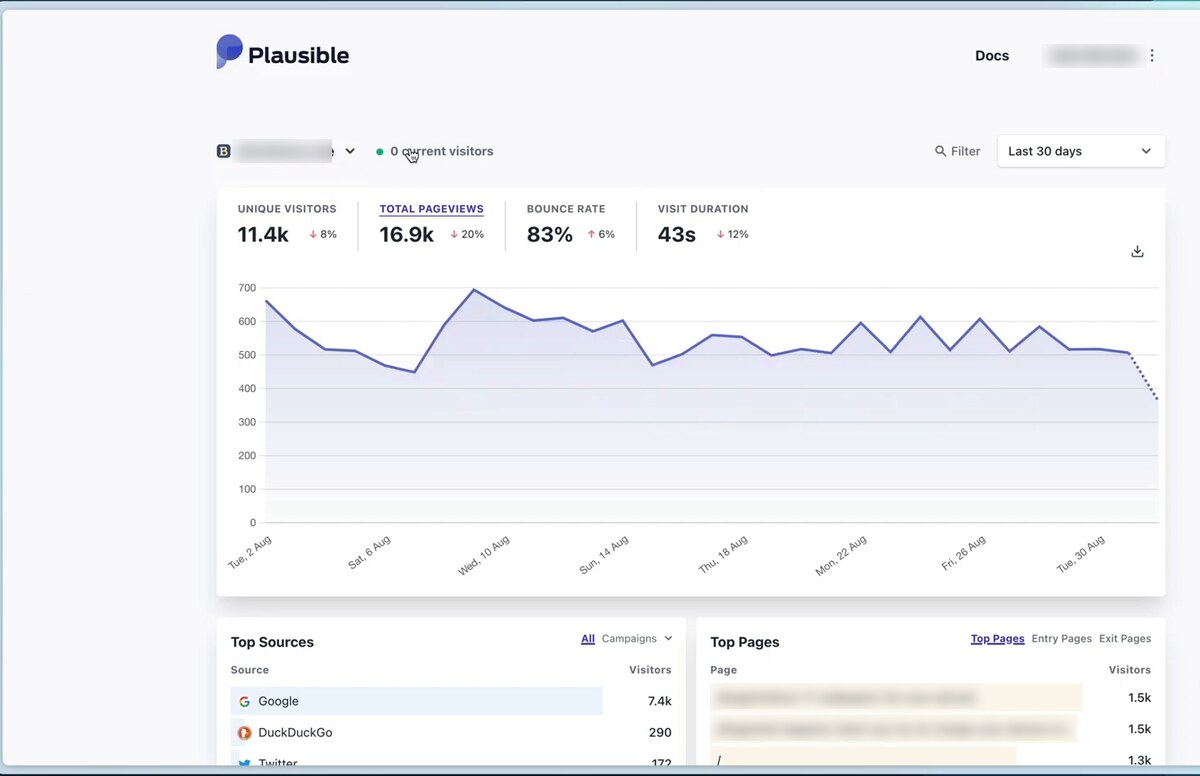
The Plausible dashboard is the entire product — one screen, scannable in seconds. Compare to GA4 below, where the equivalent information lives across multiple Reports menus. Site name and page paths blurred for the publisher’s privacy.
Fathom ($14-84/month). Similar positioning to Plausible — slightly more polished UI, slightly more expensive. Strong choice for design-conscious sites.
Pirsch ($6-19/month). Lesser-known German alternative. Cheapest paid option in this tier.
Cloudflare Web Analytics (free). Best value if you’re already on Cloudflare. No consent banner needed, real-time data.
Depth-first
Google Analytics 4 (free). Deep, free, works with Google Ads. Privacy posture is poor. Reporting interface is harder than GA Universal was. Still the default for ecommerce attribution.
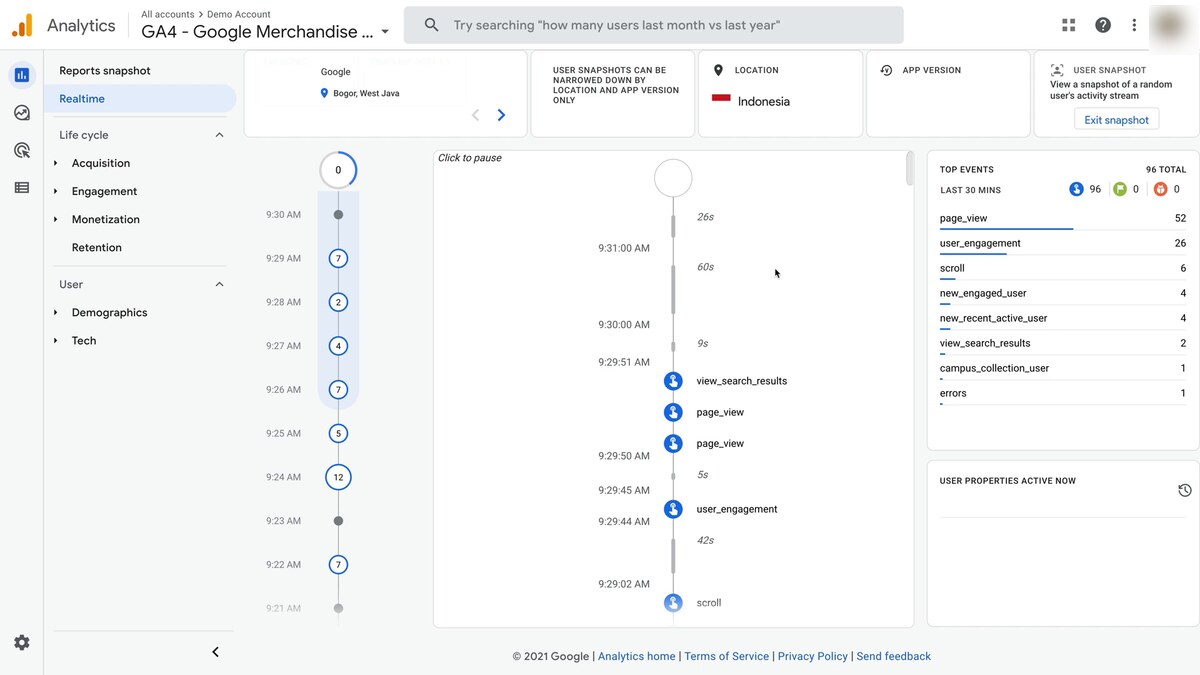
GA4’s Realtime → User Snapshot view is the depth Plausible can’t match — per-user event streams with second-by-second activity. This is captured against Google’s public Demo Account property; for your own site the data shows real visitors with the same granularity.
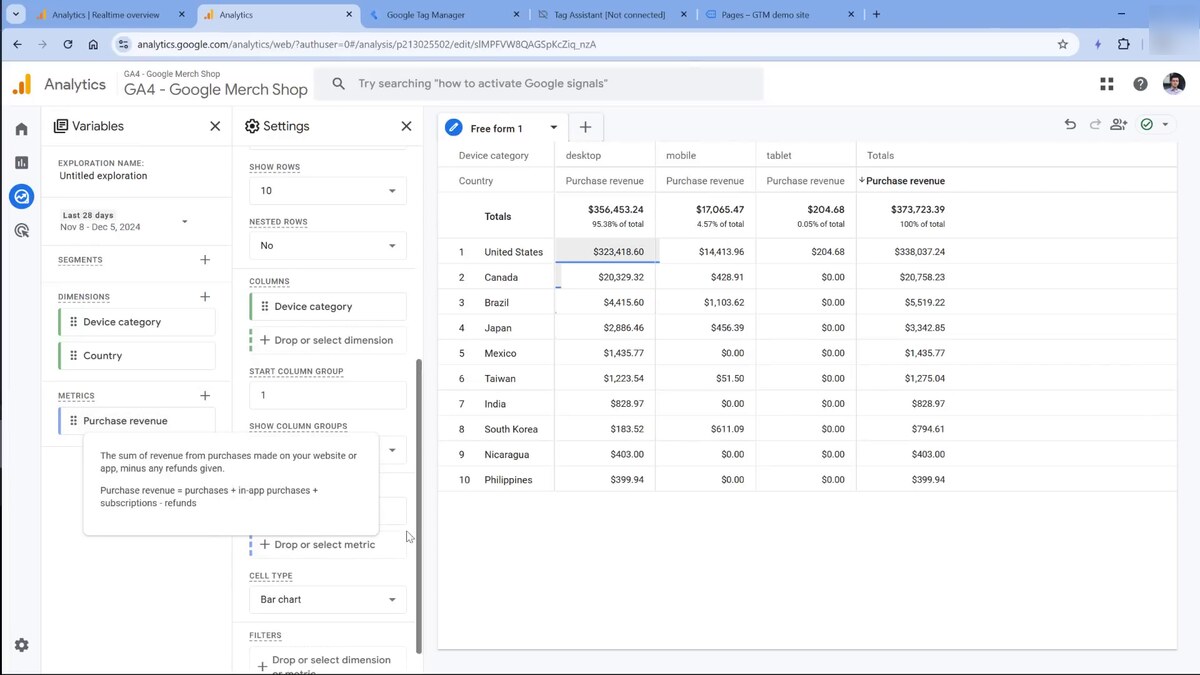
GA4’s Explore → Free-form is the second axis of GA4 depth: build any cross-tab against any custom dimensions and metrics. Plausible (and Fathom, and Cloudflare Web Analytics) can’t replicate this — they’re optimized for one-screen readability, not custom analysis. The trade-off is the entire decision.
Adobe Analytics ($30k+/year). Enterprise-only. Real depth + governance. Don’t even consider it under 50 FTE.
Product analytics
PostHog (free to 1M events; ~$450/month at scale). Open source, self-hostable, event-driven. The default for product-led SaaS in 2026.
Mixpanel ($25-833/month). Polished commercial product analytics. Faster to set up than PostHog. Less customizable.
Amplitude (custom pricing, ~$50k+/year for serious use). Enterprise product analytics.
Self-hosted / open source
Matomo (free self-hosted, $19-499/month cloud). Most powerful open-source web analytics. Self-hosting requires devops bandwidth.
Umami (free self-hosted). Lightweight Plausible-style tool. Best for developer-managed sites.
What to skip
A few tools that show up in “Top 10” lists that we don’t recommend:
Hotjar / Microsoft Clarity as primary analytics. They’re heatmap and session replay tools, not full analytics. Useful as add-ons; not replacements for the tools above.
Adobe Analytics unless you’re 50+ FTE with a dedicated analytics team. Massive overkill otherwise.
Yandex Metrica. Russian-owned. Compliance and trust issues for most Western sites in 2026.
Statcounter, Open Web Analytics, Piwik (legacy). Aging tools. Modern alternatives are better in every dimension.
Decision flow: pick the right tool in three minutes
Work through these in order:
- Are you running an ecommerce store needing revenue attribution? → GA4 (free) + optionally Plausible for simple readouts.
- Are you a SaaS needing event-driven product behavior? → PostHog.
- Are you on Cloudflare hosting? → Cloudflare Web Analytics (free).
- Are you privacy-critical (medical, legal, EU-heavy)? → Plausible or Fathom.
- Are you a small business / blog wanting simple traffic data? → Plausible is the default.
- Do you have a dedicated data team and run paid Google Ads? → GA4 with their full ecosystem.
If you’ve made it through and you’re still unsure, Plausible is the safe default — privacy-friendly, simple, easy to migrate away from later if you outgrow it.
What to do next
If you’re choosing between GA4 and Plausible specifically, our GA4 vs Plausible comparison walks through the head-to-head decision most small businesses face.
If you’re setting up Google Search Console alongside your analytics, our Google Search Console tutorial covers the foundation every site needs.
For the broader stack picture, our email marketing software guide, SEO tools for small business guide, and CRM software guide cover the adjacent decisions.
We re-test platforms every 90 days. Last updated: April 16, 2026.
Frequently asked questions
What's the best web analytics tool in 2026?
Depends on your priorities. For most small business sites prioritizing privacy and simplicity: Plausible or Fathom. For ecommerce stores needing depth: Google Analytics 4 paired with Shopify analytics. For SaaS needing event-driven product analytics: PostHog or Mixpanel. For Cloudflare-hosted sites: Cloudflare Web Analytics is genuinely free and good. For heavy customization: self-hosted Matomo. There's no single best answer — privacy posture and depth needs determine the pick.
Should I still use Google Analytics 4?
Conditional yes. GA4 is genuinely powerful and free, but the data model is harder to use than Universal Analytics was, the privacy posture is poor, and many EU/UK users now require consent banners that suppress data collection. If you're an ecommerce store needing the depth, GA4 still wins. If you're a content site or SaaS where simple traffic data is enough, Plausible or Fathom are easier and more privacy-respectful.
Is Plausible really good enough vs Google Analytics?
For most small businesses, yes. Plausible captures pageviews, sources, devices, locations, and basic conversions cleanly. What it doesn't do: deep ecommerce attribution, predictive analytics, custom user-level event tracking. If those features matter to your business, GA4 or Mixpanel is the right answer. If not — and 80% of small business sites don't need them — Plausible's simplicity is a feature, not a limitation.
What's the privacy difference between these tools?
Major. GA4 sends IP addresses and behavioral data to Google by default and requires GDPR consent banners in EU. Plausible, Fathom, Pirsch, and Cloudflare Web Analytics use cookieless tracking and don't collect personal data — typically no consent banner needed. PostHog and Mixpanel are configurable but identify users by default. The privacy posture isn't just regulatory — it directly affects what percentage of your real traffic shows up in your reports.
How much do these tools actually cost?
GA4 is free. Cloudflare Web Analytics is free. Plausible: $9-19/month for small sites. Fathom: $14-44/month. PostHog: free up to 1M events, then ~$450/month at typical SaaS scale. Mixpanel: free up to 100k events, then $25-833/month. Matomo: free if self-hosted (compute cost only); $19-499/month for cloud. Pricing scales by traffic, events, or features depending on the tool.
Can I use multiple analytics tools at the same time?
Yes, and many sites do. Common combinations: GA4 + Plausible (depth + simplicity), Cloudflare Web Analytics + Mixpanel (privacy + product analytics), Plausible + PostHog (simple traffic + event-driven product). Running two tools costs little extra effort and gives you cross-validation. Don't run three — diminishing returns.
Do I need consent banners with these tools?
GA4: yes, in EU/UK and increasingly elsewhere. Plausible, Fathom, Pirsch, Cloudflare Web Analytics: no, in most jurisdictions. PostHog and Mixpanel: depends on configuration; usually yes. The consent banner question is actually a meaningful business decision — banners suppress 20-40% of data collection from EU users.
The marketing tech rundown.
One short email a week. Honest takes on the tools we tested, what's worth your money, and what to skip. No fluff.
Free. Unsubscribe anytime.