comparison
Klaviyo vs Mailchimp 2026: Which Should Your Store Actually Use?
We tested Klaviyo and Mailchimp for six weeks on real Shopify and WooCommerce stores. Which one wins, and the math on when switching pays for itself.
 By Manu A. · · 9 min read ·
Updated
By Manu A. · · 9 min read ·
Updated 
Of all the email marketing comparisons that come up in 2026, Klaviyo vs Mailchimp is the one where the answer is the clearest. Mailchimp got most ecommerce stores started; Klaviyo is what nearly every store with serious revenue eventually migrates to. The question isn’t really “which is better”, it’s “when does the switch pay for itself.”
We ran both platforms for six weeks across two real test stores: a small Shopify store doing ~$8k/month in revenue, and a mid-size WooCommerce store doing ~$45k/month. The honest answer changes meaningfully depending on which you are.
Quick verdict. Klaviyo wins for any ecommerce store doing more than $10,000/month in revenue. The revenue attribution, abandoned cart depth, and predictive analytics generate more incremental revenue per month than the price difference costs. Mailchimp can stay competitive for stores under $5,000/month in revenue, at that scale, the simpler tool with the cheaper plan is the right call. Between $5k-$10k/month is the gray zone where personal preference matters more than ROI math.
The rest of this piece walks through the actual numbers, the migration mechanics, and the specific situations where Mailchimp still makes sense.
At a glance: how they compare for ecommerce
| Klaviyo | Mailchimp | |
|---|---|---|
| Best for | Stores doing $10k+/month in revenue | Stores under $5k/month or just starting |
| Free plan | 250 contacts, 500 sends/mo | 500 contacts, 1,000 sends/mo |
| Entry paid | $20/mo at 500 contacts | $20/mo at 500 contacts (Standard) |
| Mid-tier | $400/mo at 25,000 contacts | $310/mo at 25,000 contacts (Standard) |
| Native Shopify integration | Deep, products, orders, browsing, carts | Basic, order sync mostly |
| Revenue attribution | Native, on every campaign and flow | Limited |
| Predictive analytics (LTV, next order date) | Native | Not available |
| Abandoned cart flow | One-click template, deep customization | Available but shallower |
| SMS | Included as paid add-on | Available but separate product |
| Standout strength | Revenue-attributed segmentation | Recognizable brand, simple UI |
| Standout weakness | Pricing climbs aggressively at scale | Hasn’t kept pace with ecommerce-specific features |
Neither is the cheapest way to run ecommerce email. We put both against Omnisend, ActiveCampaign and four others, with every price re-verified, in our best email marketing software for ecommerce review.
How we tested
Each platform ran for six weeks against two stores in parallel.
Same flows, both platforms. Welcome series, abandoned cart recovery, post-purchase follow-up, win-back for lapsed customers, and a generic monthly broadcast. Same content, same send schedule, same audience.
Revenue attribution. Both platforms tracked the same purchases. We measured email-attributed revenue per campaign and per flow.
Time-to-build. Stopwatch on every flow. Klaviyo built ecommerce flows ~60% faster than Mailchimp because the templates are designed for the work; Mailchimp’s templates are generalist.
Real billing math. Modelled at 1,000, 5,000, and 25,000 subscribers, on annual billing.
We re-test every 90 days. Last updated noted at the bottom.
Klaviyo, built for ecommerce, charged accordingly
Klaviyo is the platform every Shopify store with serious revenue eventually moves to. It’s not the prettiest, the simplest, or the cheapest, but it’s by margin the most useful when your job is “get more revenue from the email channel.”
The core advantage: Klaviyo treats your store’s data as first-class. Product catalog, customer profiles, order history, browsing events, cart events, all flowing into segments and flows automatically. You can build a segment like “customers who bought from category X in the last 90 days but haven’t opened the last 5 campaigns” with three clicks. In Mailchimp, the same segment requires custom field gymnastics and won’t update in real time.
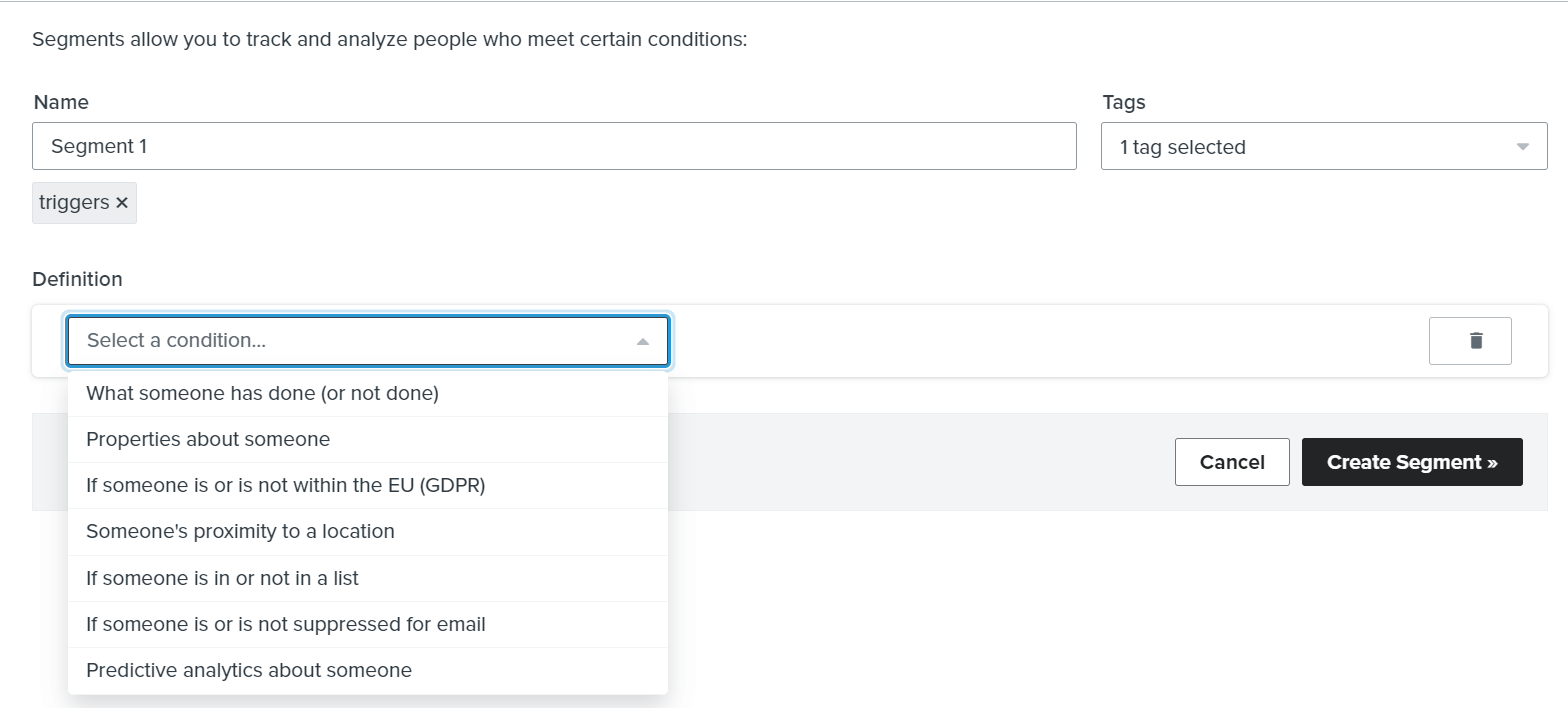
Source: Klaviyo help center. The condition-type dropdown is the visible difference between Klaviyo and Mailchimp segmentation, Mailchimp has “is/is not in a list” and a handful of merge-field filters; Klaviyo has seven condition families including predictive analytics.
Best for. Shopify stores doing $10,000+/mo in revenue. WooCommerce, BigCommerce, Magento stores at similar scale. DTC brands. Subscription-box businesses. Anyone whose primary success metric is email-driven revenue.
Skip Klaviyo if. Your store is under $5,000/mo in revenue and you don’t yet run real flows. The price differential isn’t justified by the upside at that scale. Better to stay on Mailchimp or migrate to MailerLite (cheaper, basic Shopify integration) until you grow into Klaviyo.
Pricing reality. Email plan: $20/mo at 500 contacts, $100/mo at 5,000, $400/mo at 25,000 (verified July 2026). Pricing scales with contact count. SMS is a separate add-on billed per message ($1 per 100 sends in the US). Predictive analytics included on all paid plans.
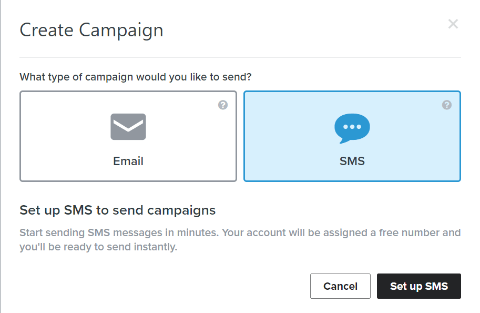
Source: Klaviyo help. SMS lives inside the same campaign builder as email, you pick the channel as you create the campaign. Mailchimp ships SMS as a separate product, so the same workflow on Mailchimp means switching tools mid-campaign.
Where Klaviyo wins.
- Revenue attribution is best-in-class, every campaign shows attributed revenue at multiple time windows
- Abandoned cart, browse abandonment, post-purchase flow templates are pre-built and convert well out of the box
- Predictive analytics (next purchase date, customer lifetime value) actually useful
- Native Shopify, WooCommerce, BigCommerce integrations sync products, orders, customers in real time
- Larger ecosystem of agencies and freelancers fluent in Klaviyo
Source: Klaviyo help. The Flows library is goal-organized rather than feature-organized, “Prevent lost sales,” “Nurture subscribers,” “Build customer loyalty”, which is the difference between picking a template and building one.
Where Mailchimp wins (over Klaviyo).
- Simpler UI for marketers with no ecommerce-attribution experience
- Cheaper at small scale (under 1,000 contacts)
- More forgiving for non-ecommerce use cases (general newsletter, simple broadcast)
- Larger template library for design-first marketers
What they don’t tell you. Klaviyo’s pricing scales aggressively above 25,000 contacts. Stores above 50k contacts often look at alternatives, but few alternatives match Klaviyo’s ecommerce depth, so most stay and absorb the cost. Plan for it.
Mailchimp, what most stores started on
Mailchimp is the platform with the most brand recognition and the most “I started my store on this five years ago” history. The product is competent. It’s also no longer the right answer for most growing stores.
The product hasn’t changed dramatically in three years. The UI is friendly. Templates are abundant. Basic Shopify integration syncs orders. Where Mailchimp falls behind: ecommerce-specific automation depth, native revenue attribution, predictive analytics. Three features that compound over a year of running flows.
Best for. Brand-new stores. Hobby projects. Stores under 500 contacts and under $5,000/mo in revenue. Marketers who specifically prefer Mailchimp’s UI and don’t yet need depth.
Skip Mailchimp if. Your store has crossed any of: 5,000 contacts, $10k/mo revenue, three or more concurrent automated flows. At that point you’ve outgrown what Mailchimp does well.
Pricing reality. Free: 500 contacts, 1,000 sends/mo. Essentials: $13/mo at 500 contacts. Standard: $20/mo at 500 contacts. Premium: $60/mo at 500 contacts. Pricing scales aggressively with contact count, at 25,000 contacts you’re paying about $310/mo on the Standard plan, which is now roughly $90 cheaper than Klaviyo at the same size but with meaningfully less ecommerce depth.
Where Mailchimp wins.
- Easier on-ramp for non-technical marketers
- Larger template library
- Recognizable brand (clients/team members know what it is)
- Free plan for very small lists is real (500 contacts, 1k sends)
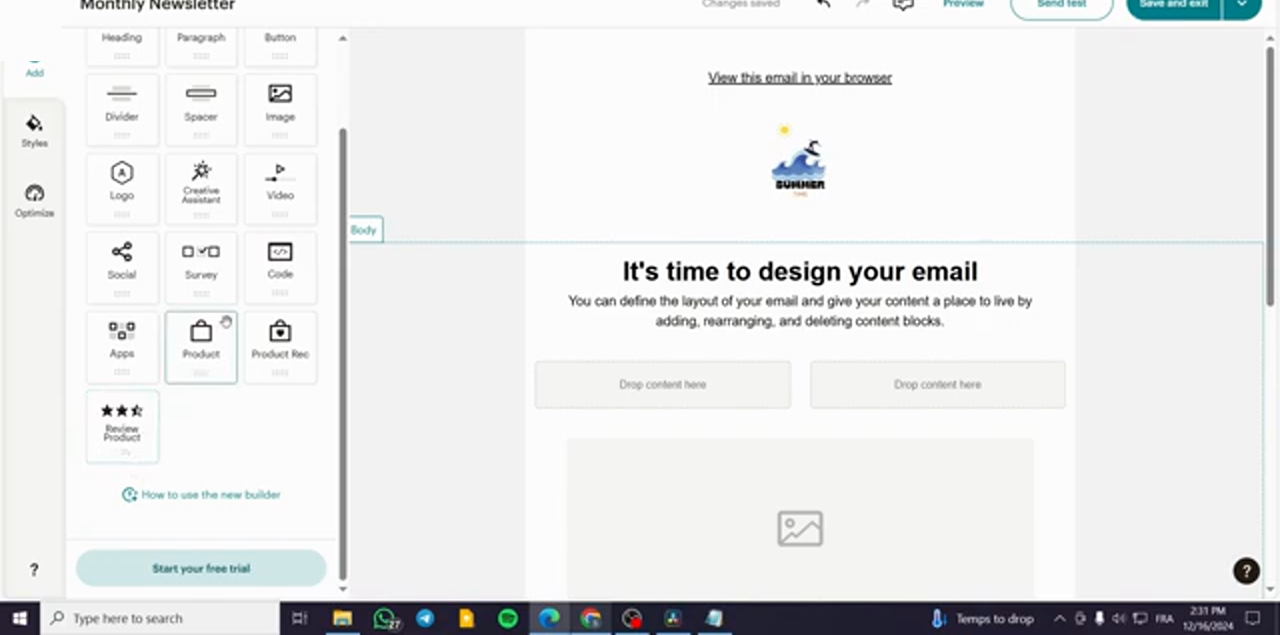
Source: Mailchimp New Builder tutorial (YouTube, 360p source, frame is visibly soft). Mailchimp’s drag-and-drop builder is the part most users actually like. Klaviyo’s builder is similar mechanically but optimized for product blocks (recommended products, dynamic catalog rows) rather than the generalist content blocks shown here.
Where Klaviyo wins (over Mailchimp).
- Native ecommerce flow depth (abandoned cart, post-purchase, win-back)
- Revenue attribution on every campaign
- Predictive analytics
- Real-time product/customer/order sync from Shopify
- More mature SMS and push notification capabilities
For the broader Shopify-flavored email automation decision (including alternatives like Omnisend and Privy beyond just Klaviyo vs Mailchimp), see our Shopify email marketing automation guide. For the wider email-stack picture (which platform fits which business model, beyond just ecommerce), our email marketing software pillar guide walks through the full landscape. And if your “transactional” email is actually event-driven SaaS marketing rather than ecommerce order receipts, our Customer.io vs Klaviyo comparison covers that specific decision. If you’re separating marketing from transactional sends, most stores past $50k/mo revenue eventually do, our transactional email services review covers the deliverability tier separately.
What they don’t tell you. Mailchimp charges for unsubscribed contacts that are still in your audience. If 1,000 people unsubscribe over a year and you don’t manually clean them out, your bill keeps reflecting them. None of that is hidden, exactly, but none of it is highlighted either. We covered this in our full Mailchimp alternatives review.
The math: when does Klaviyo pay for itself?
The actual question for most ecommerce decision-makers. Here’s the model.
Assume Klaviyo costs ~$50/mo more than Mailchimp at your list size. Klaviyo needs to generate $50+/mo in additional revenue to break even, before it starts compounding.
Where the additional revenue comes from on Klaviyo:
- Abandoned cart recovery: typical Shopify abandoned cart conversion rate goes from 8-12% on Mailchimp to 12-18% on Klaviyo. On 500 abandoned carts/month with $80 AOV, that’s $1,600-$2,400 of additional recovered revenue.
- Post-purchase upsell flows: Klaviyo’s product-recommendation depth means upsell suggestions hit better. Conservative additional revenue: 2-5% of repeat purchase volume.
- Predictive next-purchase windows: sending the right campaign 7 days before a customer’s predicted next purchase date converts measurably better than untimed campaigns.
For a store doing $20,000/month in revenue, Klaviyo’s typical incremental email revenue is $400-1,500/month over what Mailchimp would deliver. That’s 8-30× the price differential.
For a store doing $5,000/month in revenue, the incremental is more like $50-200/month, still net positive, but the margin is tighter. At that scale either platform works.
For a store doing $1,000/month in revenue, the additional Klaviyo features mostly don’t matter yet because list size is too small for predictive analytics to generate signal. Mailchimp wins on price.
Side-by-side: ecommerce-specific features
| Feature | Klaviyo | Mailchimp |
|---|---|---|
| Native Shopify integration | Deep, real-time | Basic, batched |
| Abandoned cart flow | One-click template, ~12-18% recovery | Available, shallower |
| Browse abandonment | Native | Limited |
| Post-purchase flow | Multi-step templates, product-aware | Basic templates |
| Predictive next-purchase date | Native | Not available |
| Customer lifetime value scoring | Native | Not available |
| Revenue attribution per campaign | Yes | Limited |
| SMS integrated with email flows | Yes (paid) | Separate product |
| Custom event tracking | Native | Limited |
For ecommerce specifically, Klaviyo wins five of nine categories outright and ties on the rest.
Migration: Mailchimp to Klaviyo
This is the move most stores make eventually. Klaviyo offers free migration help on paid plans, use it. Otherwise the mechanics:
- Export your Mailchimp list as CSV. Include subscribe dates, tags, and custom fields.
- Clean the export. Remove unsubscribed and bounced contacts. Suppress people who haven’t engaged in 90+ days; you’ll re-engage them via the new platform’s tools.
- Set up Klaviyo’s Shopify integration first. This pulls products, orders, and customer history into Klaviyo before you import the email list, meaning yo
Frequently asked questions
Is Klaviyo really worth the price over Mailchimp?
For Shopify or WooCommerce stores doing more than $10,000/month in revenue, yes, Klaviyo's revenue-attributed segments, predictive analytics, and ecommerce-specific flow templates generate enough additional revenue to pay for the price difference within the first month. Below $10k/month in revenue, Mailchimp's lower cost is harder to outrun.
Can I really see the revenue Klaviyo generates?
Yes, that's Klaviyo's central feature. Every campaign, flow, and SMS shows attributed revenue against the same window, making the ROI math trivial. Mailchimp shows opens, clicks, and conversion rates, but not native revenue attribution at the same depth. For a Shopify store, this is a meaningful difference.
How much does it cost to switch from Mailchimp to Klaviyo?
Free in dollar cost, both platforms accept CSV imports preserving subscriber data. Time cost: ~6-8 hours for a typical small store, longer for big lists. Plan a 14-day deliverability warm-up period. Klaviyo offers free migration help on paid plans.
What about Mailchimp's Shopify integration vs Klaviyo's?
Both have native Shopify integrations. Klaviyo's is deeper, pulls product catalog, customer purchase history, browsing behavior, abandoned carts, and order events automatically into segmentation logic. Mailchimp's integration covers basic order sync but doesn't unlock Klaviyo-level segmentation.
Should I stay on Mailchimp if my store is small?
Maybe. If you're under 500 subscribers, doing under $5,000/month in revenue, and not yet running automated flows, Mailchimp Free still works. The decision to switch usually comes when one of three things happens: list crosses 5,000 contacts, revenue crosses $10k/mo, or you start running serious flows beyond a basic welcome series.
Are there cheaper alternatives to both?
MailerLite at $49/mo (5k subs, Comfort plan) is genuinely cheaper and still has Shopify integration, but lacks Klaviyo's revenue attribution depth. For a budget-constrained store under $20k/mo revenue, MailerLite + Shopify covers the basics. Above $20k/mo, Klaviyo's ROI usually beats the cost.
The marketing tech rundown.
One short email a week. Honest takes on the tools we tested, what's worth your money, and what to skip. No fluff.
Free. Unsubscribe anytime.