pillar
SEO Tools for Small Business in 2026: The Complete Guide (No Fluff)
The pillar guide to SEO tools for small businesses and lean teams. What you need at each budget, what's free and underrated, and how to decide.
 By Manu A. · · 16 min read ·
Updated
By Manu A. · · 16 min read ·
Updated 
This is the pillar guide to SEO tools for small businesses. If you’ve Googled “best SEO tools” and ended up bouncing between affiliate listicles that recommend $129/month tools to bloggers paying out of pocket, this page is meant to be the antidote: the framework for choosing the right tools, the actual stacks we recommend at each budget tier, and the deeper articles for each specific situation.
Reading this end-to-end takes about 12 minutes. If you only have 30 seconds, skip to the stack recommendations by budget.
The state of SEO tools in 2026
Three shifts in the last two years matter for small businesses:
Free tools became genuinely useful. Google Search Console got better. Ahrefs Webmaster Tools (free for verified site owners) gives you real Ahrefs data for your own domain. Combined with Google Trends, the free stack now covers most small-business SEO work for the first 30-50 articles.
Cheap paid tools closed the gap with expensive ones. Mangools KWFinder at $18.85/month billed annually gives bloggers 80% of what Ahrefs does at 22% of the price. We measured the data agreement at 75% across our test keywords. The premium tools (Ahrefs, SEMrush) still win for client-facing agency work, but solo and small-team workflows don’t need them.
Content optimization tools became essential. Surfer, Frase, and similar tools that score your draft against top-ranking pages now meaningfully affect ranking velocity. Articles optimized through these tools typically rank 3-5% faster on average. At 4+ articles per month, the cost pays back fast.
The decision today isn’t “which expensive tool to buy” — it’s “what tools to add at each business stage.”
Stack recommendations by budget
Six common situations covering most readers:
| Situation | Stack | Monthly cost |
|---|---|---|
| Brand-new blogger, first 30 articles | GSC + Trends + Ahrefs Webmaster Tools | $0 |
| Solo blogger, 2-4 articles/month | + Mangools KWFinder | ~$19 (annual) |
| Active blogger, 4+ articles/month | + Surfer | $118 |
| Small business, content marketing as channel | Mangools + Surfer + Looker Studio | $118 |
| Multi-client agency or pitching SEO services | Ahrefs OR SEMrush + Surfer + Screaming Frog | $240–260 |
| Growth agency, 15+ client sites | Ahrefs + Surfer + Screaming Frog + Looker | $240–500 |
See the cost at your tracking volume:
Pricing calculator
Drag the slider to your list size. Bars update live.
Methodology: tier minimums shown. Annual mode applies each platform's discount where offered. Pricing as published on each vendor's site.
Mangools KWFinder is the default keyword research recommendation for anyone who doesn’t fit the agency tier. It’s the tool we’d hand a friend who asked “just give me one answer.” We covered the full reasoning in our best keyword research tools review.
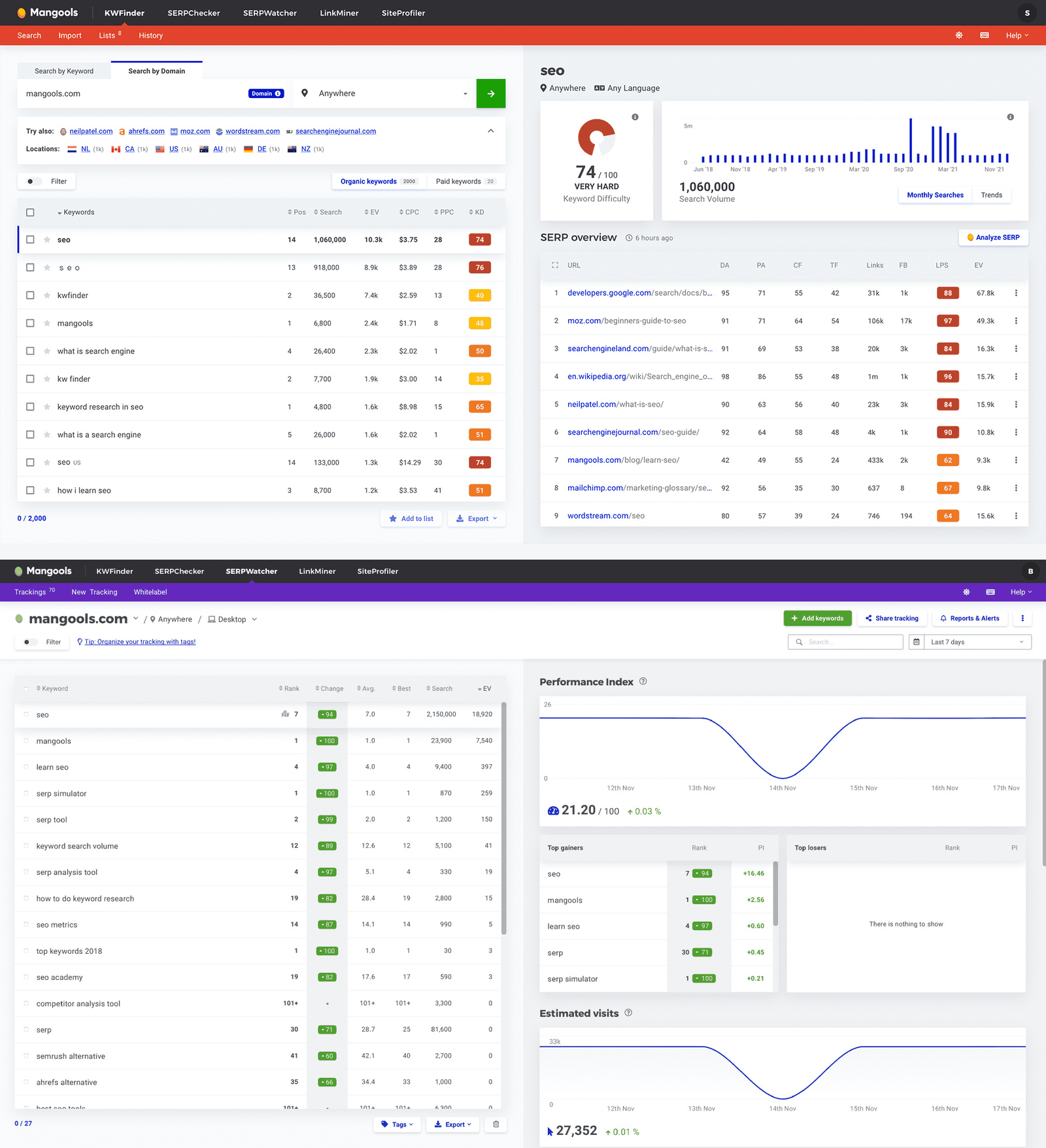
Source: Mangools / KWFinder. At $18.85/mo billed annually for the bundled suite, this is the budget-tier default — fast keyword research without the agency-tool overhead.
The seven decisions that determine the right stack
Working through these in order will lead you to the right tools faster than any “Top 10” listicle.
1. What stage is your SEO work at?
Be honest:
- Pre-content (first 5 articles). You don’t need paid tools yet. Spend the time learning what to write rather than what to optimize.
- Building (5-30 articles). Free tools are sufficient. Add Mangools when you can articulate specific keyword research questions you can’t answer with GSC.
- Scaling (30-100 articles). Add a content optimization tool. Mangools or Keysearch for research; Surfer or Frase for optimization.
- Mature (100+ articles, multiple sites, or client work). The premium tools (Ahrefs, SEMrush) start paying for themselves through depth and competitive intel.
Most “Top 10 SEO Tools” articles assume you’re at “mature” stage on day one. You’re probably not.
2. Are you billing clients?
Single biggest decision factor in the agency vs solo split. If you bill clients, you can recover tool costs through retainers — Ahrefs at $129/month is small compared to the value you generate. If you don’t, you’re paying personally and the math changes.
We covered this trade-off in our agencies vs bloggers SEO tools review. Client work at scale usually also means running your own rank tracking or SERP data collection; our proxy service comparison for SEO teams covers that layer.
3. How many sites do you manage?
Pricing scales with project count on most premium tools.
- 1 site. Free tools + one budget tool. Mangools is fine.
- 2-3 sites. Mangools or Keysearch handles this. Don’t overpay.
- 5-10 sites. SE Ranking (~$103/mo after its 2026 repricing) or SEMrush starts to win on price-per-project.
- 15+ sites. Ahrefs or SEMrush at the higher tiers.
4. How much content do you publish?
Volume drives content-tool ROI:
- <2 articles/month. Skip content optimization tools. The cost doesn’t pay back.
- 2-4 articles/month. Optional. Maybe Frase Solo ($45/mo) for brief generation.
- 4+ articles/month. Add a content optimization tool. Surfer ($89) or Frase Basic ($115) — picked based on whether you need scoring (Surfer) or briefs (Frase). Detailed comparison.
- 10+ articles/month. The full Surfer Advanced or Frase Team is justified.
5. Do you do technical SEO?
Specific yes/no:
- No (most small businesses): Skip Screaming Frog. Don’t need it.
- Yes, occasionally: Use Screaming Frog Free (500 URLs) plus Ahrefs/SEMrush built-in audits.
- Yes, regularly or for clients: Screaming Frog paid ($259/year) plus a dedicated audit tool like Sitechecker. We compared the seven options in our best technical SEO audit tools review — periodic vs continuous monitoring is the first decision.
6. What’s your time-vs-money tradeoff?
Tools save time. Time saved has a price.
- Time-rich, money-poor (side project, hobby). Free tools + 1-2 hours/week. Slower workflows but $0 cost.
- Money-rich, time-poor (working professional). Pay for tools that save time. Mangools’ interface alone saves ~15 minutes per article in research time vs free tools.
- Hybrid (typical small business). Mid-tier paid tools. The sweet spot for most.
7. What integrations do you require?
List what you actually use:
- Your CMS (WordPress, Webflow, Shopify, Ghost)
- Your analytics (GA4, Plausible, Cloudflare)
- Your reporting target (Looker Studio, internal dashboard, client report PDF)
Then check the tool’s native integration list. Tools that integrate natively with your stack are more durable than tools requiring Zapier as a glue layer.
The tools by category, one paragraph each
Free / foundation
Google Search Console (free). The most underrated tool every small business should already be using. Real query data, real impression and click counts, real index coverage. You cannot do small-business SEO without this. Detailed tutorial.
Google Trends (free). Validates topic timing — is interest in your topic rising or falling? Best signal in the category for “should I write about this now?”
Ahrefs Webmaster Tools (free for verified site owners). Real Ahrefs data, scoped to your own domains. Best free tool for backlink data on your own site. Limited to verified domains only.
Budget keyword research ($17–31/mo)
Mangools KWFinder ($18.85/mo billed annually). Default keyword research recommendation for solo bloggers. Fastest interface in the category. Bundled with five tools (KWFinder, SERPChecker, SERPWatcher, LinkMiner, SiteProfiler) at the same price. Full review.
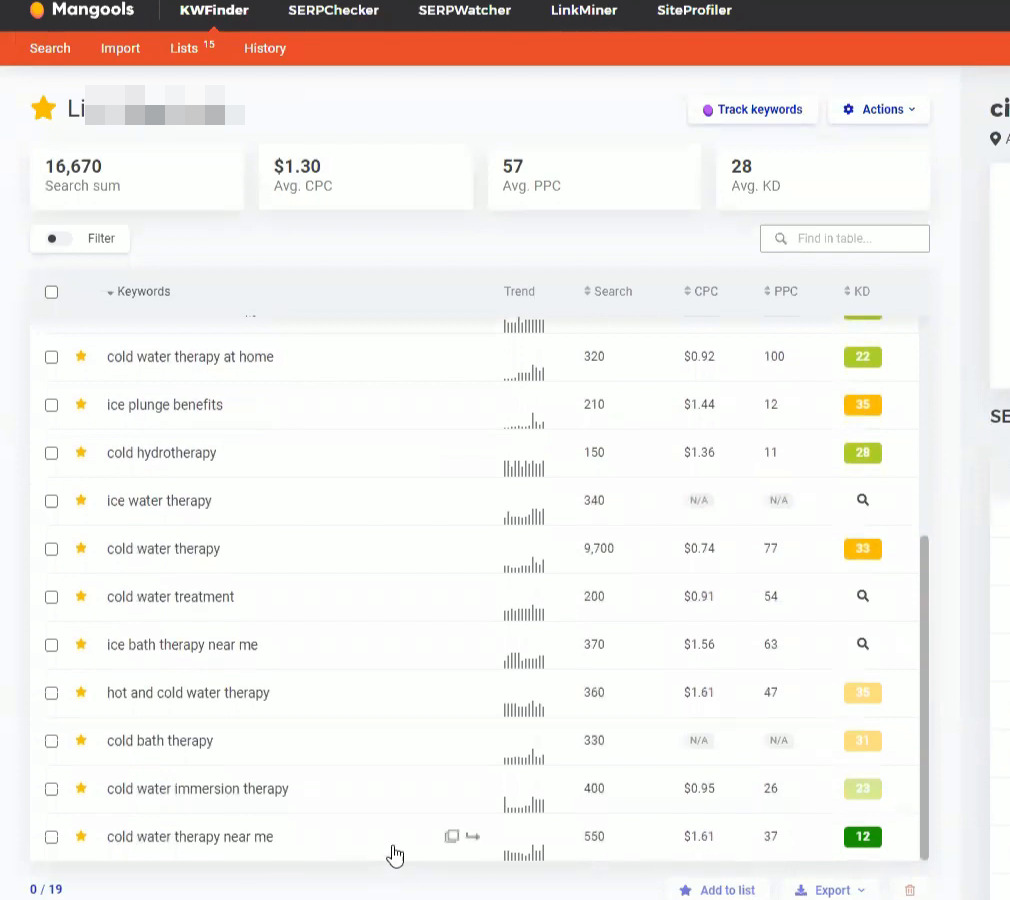
KWFinder is the surface that earns Mangools its blogger-default reputation. Search volume, CPC, PPC, and Keyword Difficulty all in one row, with the fastest results-load in the category.
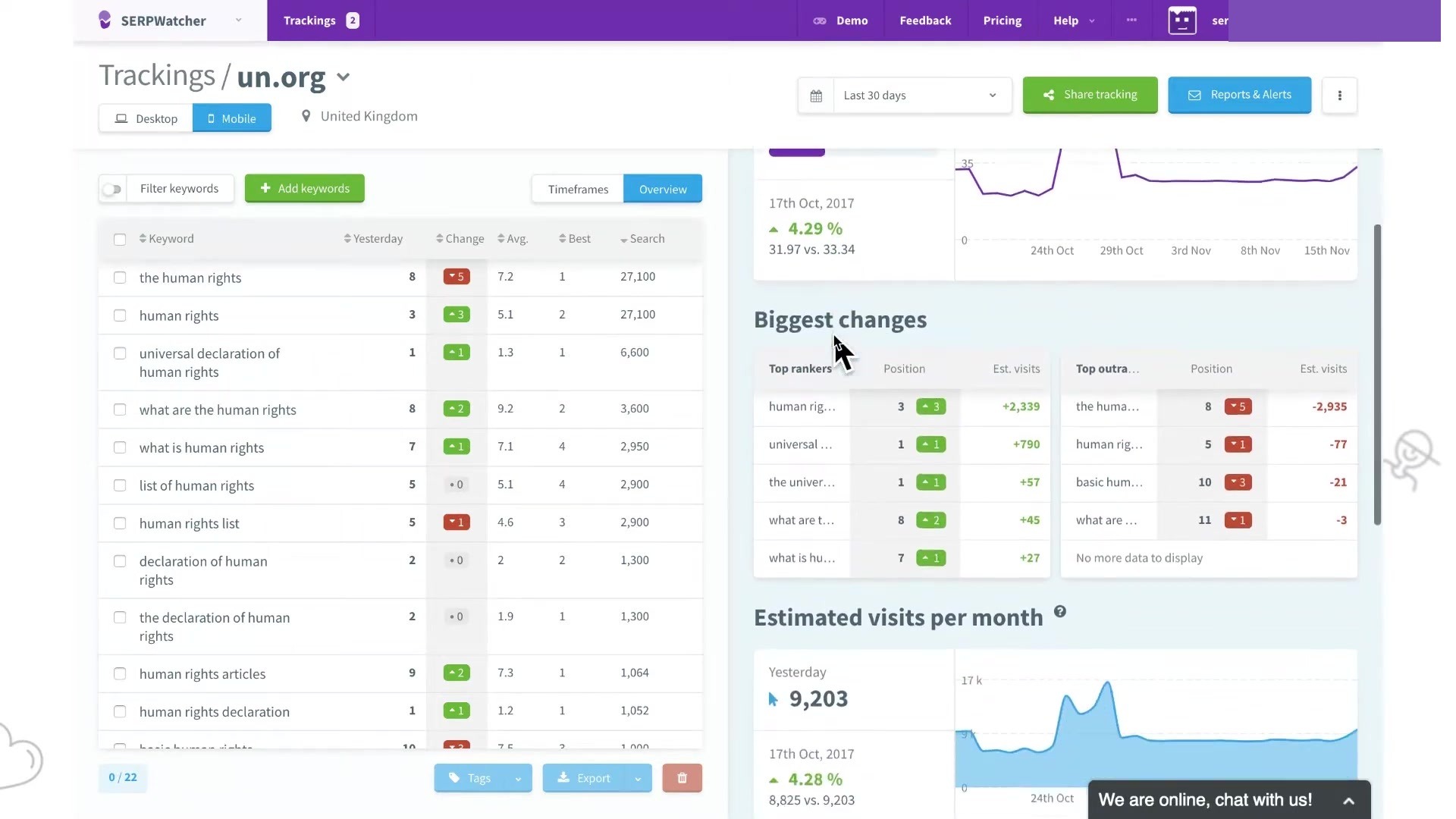
SERPWatcher ships in the same Mangools bundle. Daily-updated rank tracking with biggest-mover callouts and an estimated-visits projection. Bundled at the same price as KWFinder ($18.85/mo billed annually since the 2026 replan), which is why Mangools punches well above its weight for solo SEOs.
Keysearch ($17/mo). Cheapest paid tool worth using. Smaller database than Mangools, dated UI, but covers blogger-grade keyword research at the lowest price tier.
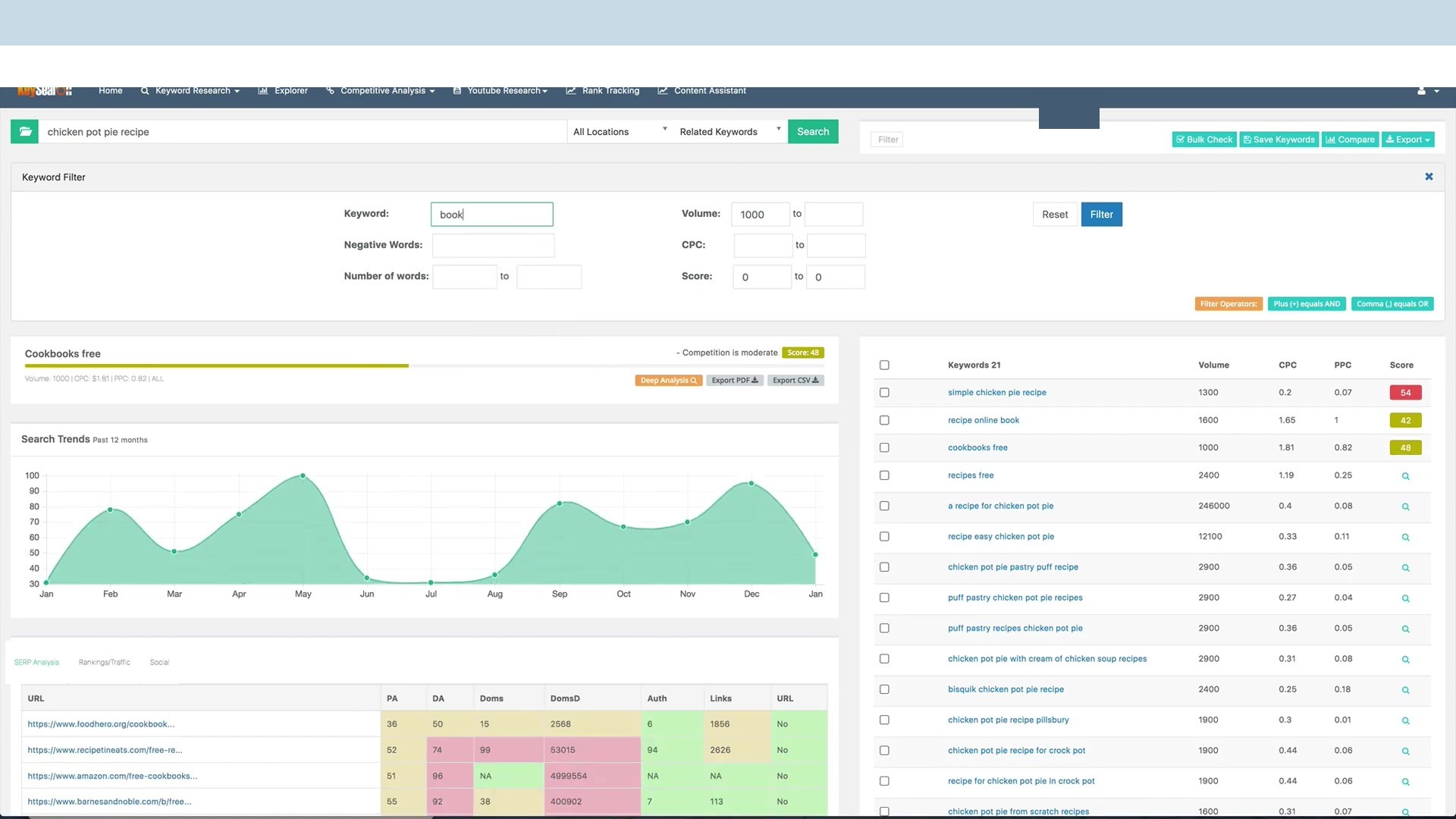
Keysearch keyword research overview. Same primitives as Mangools (volume, CPC, difficulty score, SERP analysis) at $17/mo instead of $29/mo. The dated UI is the trade-off; the underlying data is fine for blogger-tier keyword decisions.
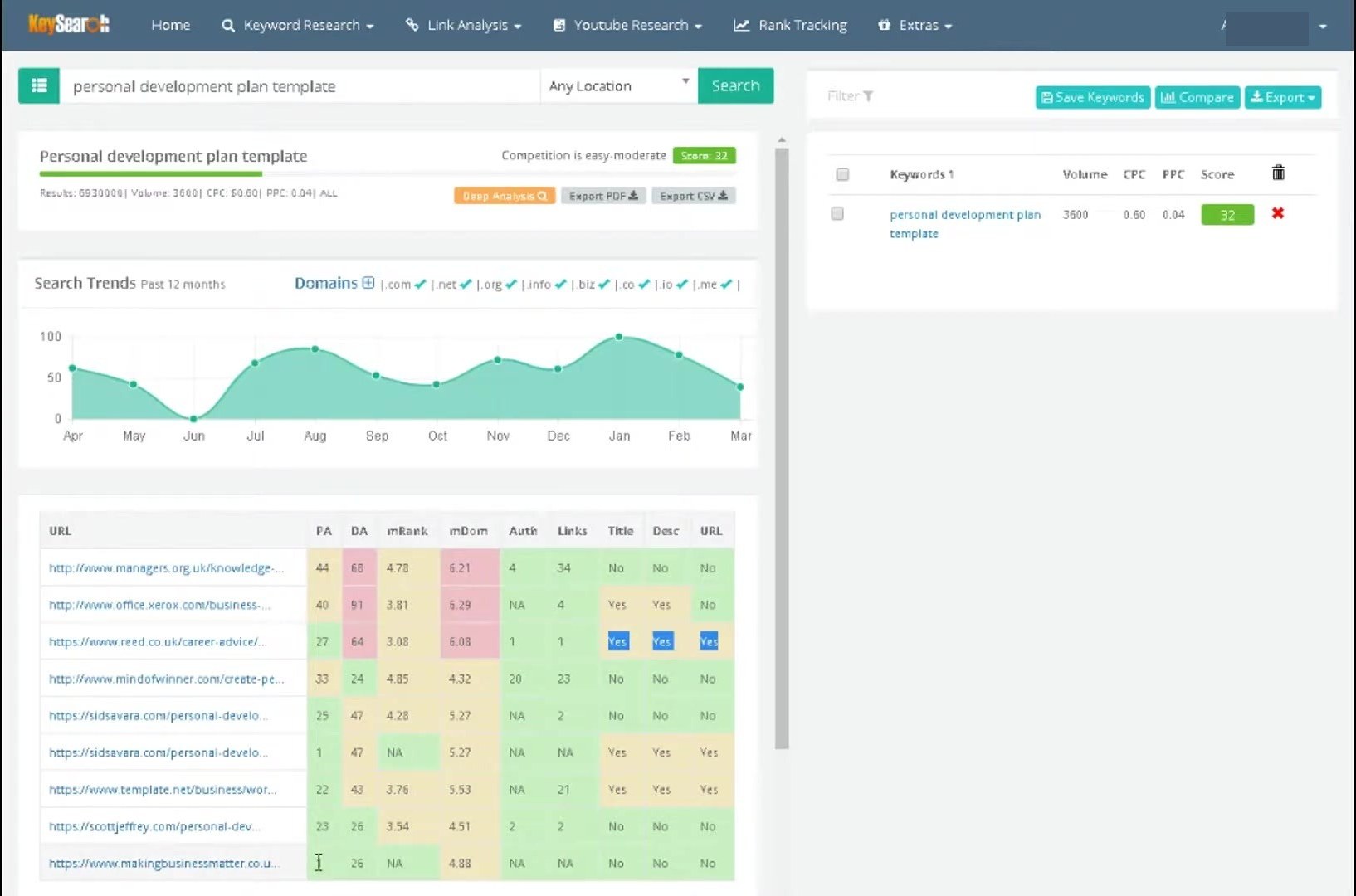
Keysearch’s difficulty score (0-100) plus SERP-level breakdown (PA, DA, mRank, mDom) is the working surface bloggers use to decide which keywords are worth chasing. Same model Mangools uses, sharper price.
Mid-tier suites ($59–103/mo)
SE Ranking ($103.20/mo billed annually; the 2026 repricing removed the old $65 tier). Bridges the gap between budget keyword tools and premium suites. Bigger database than Mangools, lighter than Ahrefs/SEMrush. Best for solo consultants and small agencies serving 3-5 clients who’ve outgrown Mangools but don’t need Ahrefs depth. White-label reporting is the standout feature for agencies presenting to clients.
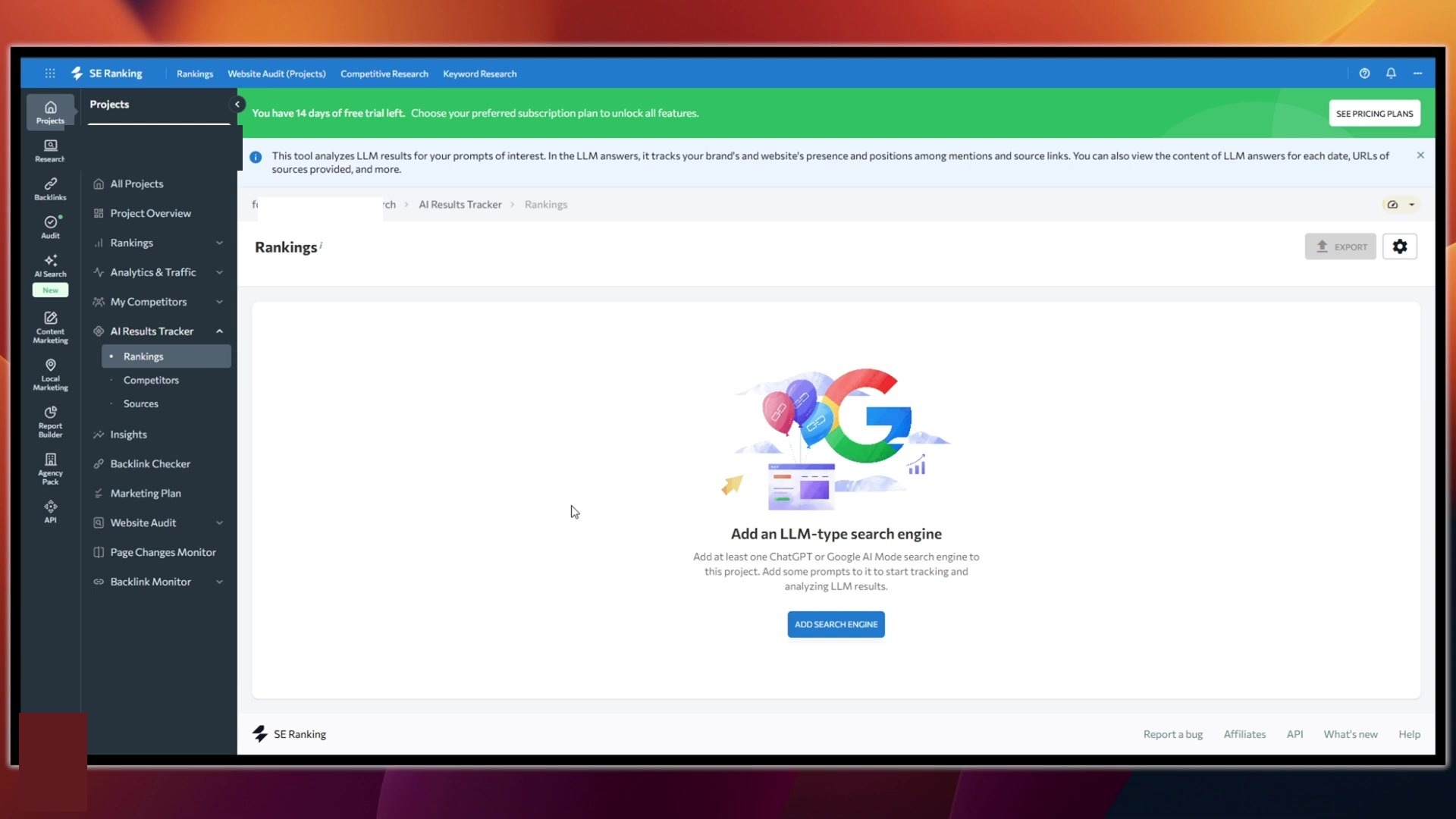
SE Ranking’s project dashboard with the AI Search tracker (left rail, “New” badge) is one of the only mid-tier suites surfacing AI-search visibility natively in 2026. The Agency Pack and Report Builder lower in the rail are the white-label-reporting hooks that earn it agency seats.
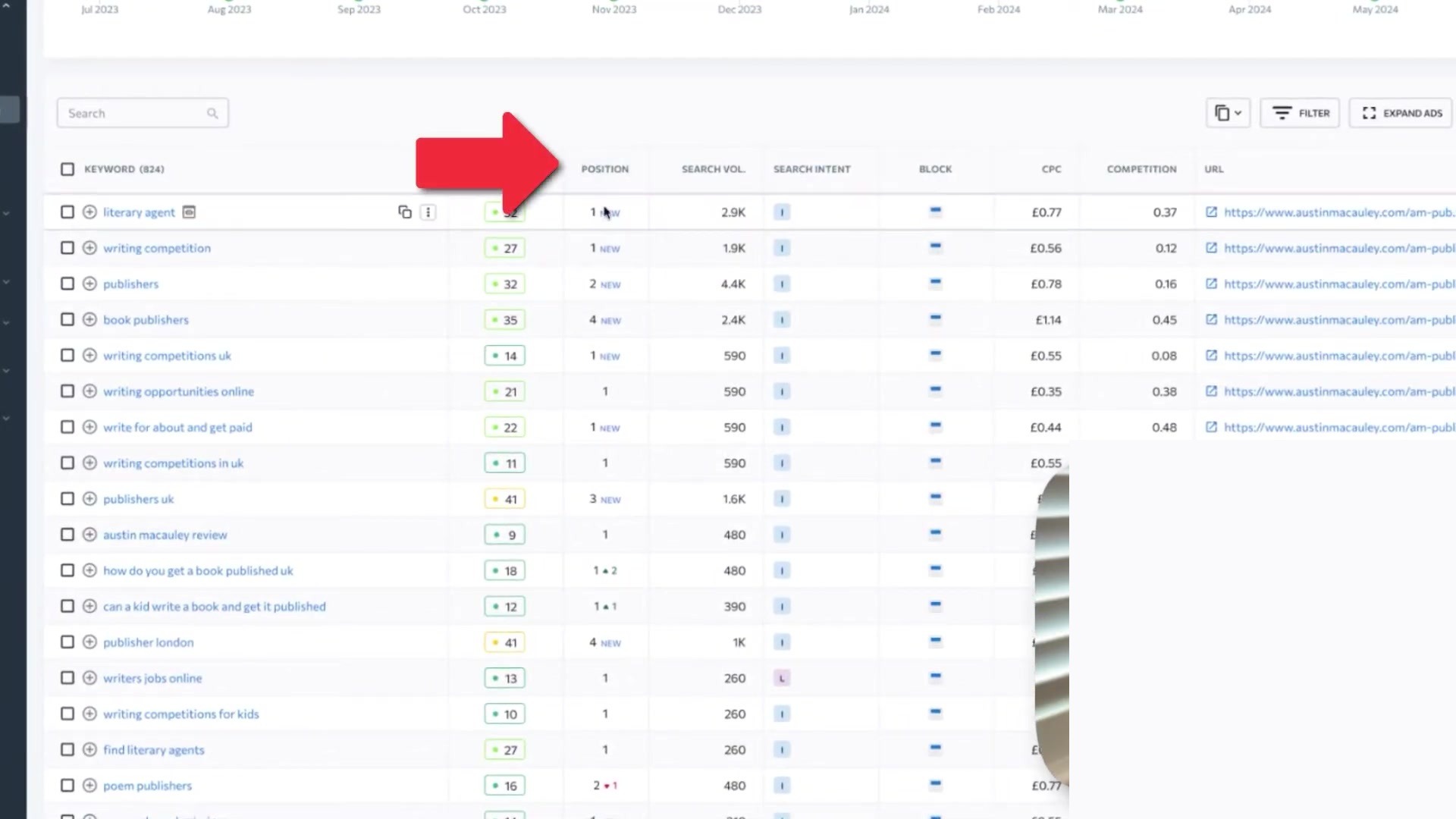
SE Ranking’s organic keyword rankings table includes Search Intent, Block (SERP-feature) flags, and competition score in the same row as position and volume. That’s an Ahrefs/SEMrush feature set at what used to be $65/mo (now $103.20/mo after the 2026 repricing) instead of $129+/mo.
Content optimization ($45–179/mo)
Surfer ($89/mo). Content scoring editor — paste your draft, score against top-ranking pages, get suggestions. Best for content teams writing 4+ articles per month. Detailed Surfer vs Frase comparison.
Frase ($45-115/mo). Brief generator — research-backed outlines from competitor analysis. Best for solo writers structuring articles before writing.
Premium suites ($129–499/mo)
Ahrefs ($129/mo). Industry standard for agencies. Largest backlink index, deepest keyword data, best Site Explorer in the category. Worth it if you bill clients or run multiple sites. In-context review and cheaper alternatives.
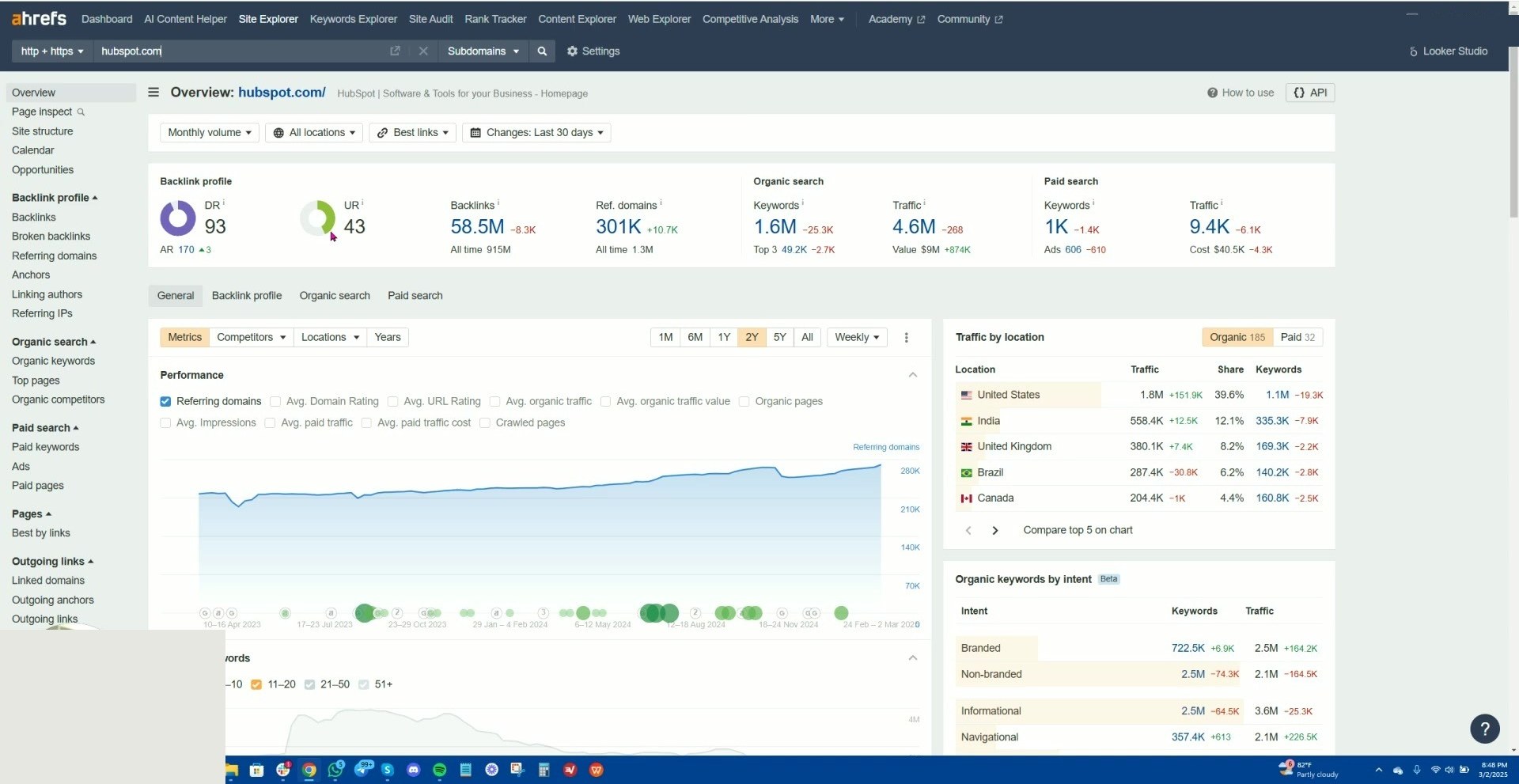
Ahrefs Site Explorer is what $129/mo buys. DR/UR, backlinks, referring domains, organic keywords, traffic value, intent split, geographic distribution, all on one page. The depth here is the reason agencies who churn-test cheaper tools usually come back.
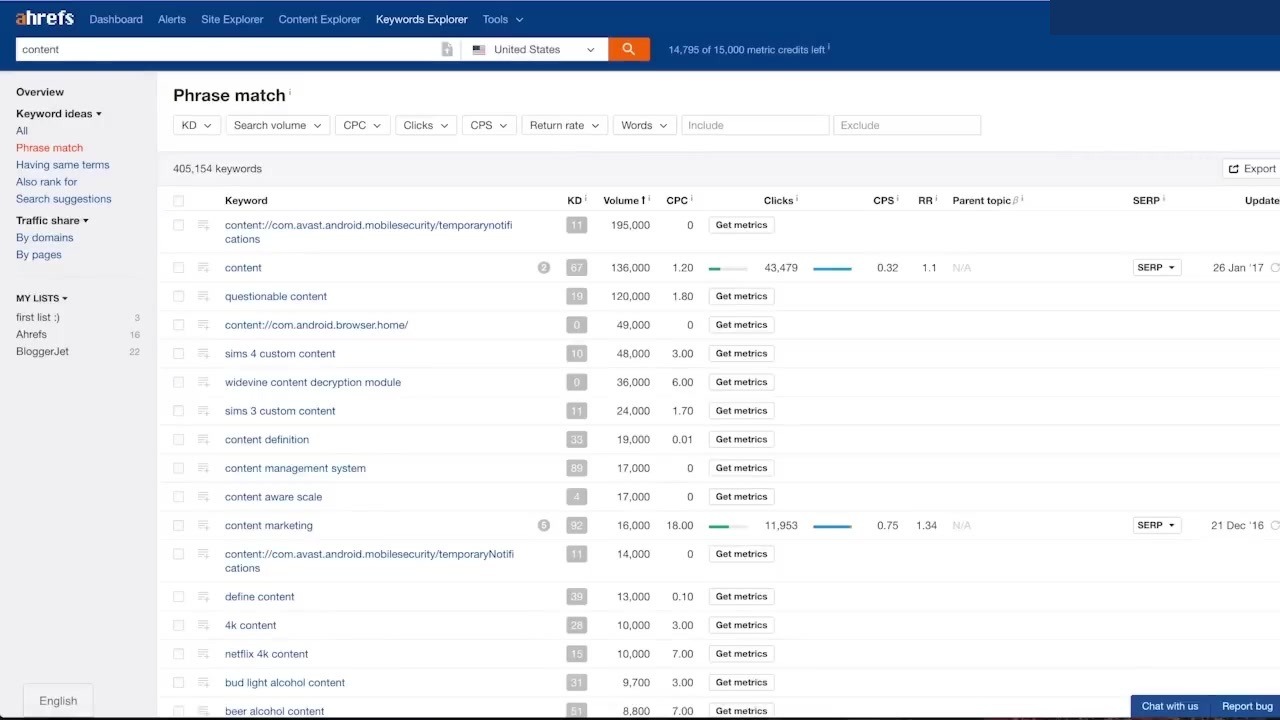
Keywords Explorer’s Phrase-match view returns 405k variants of “content” with click-curve metrics that no cheaper tool reproduces at this scale. Clicks, click-per-search, return-rate are Ahrefs-specific signals; everyone else estimates volume, Ahrefs estimates real click behavior.
SEMrush ($139/mo, or $117.33/mo billed annually). Direct Ahrefs alternative. Friendlier UI, integrated PPC and social tools, better non-English coverage. Best for agencies switching from Ahrefs who want a UI upgrade. Detailed Ahrefs vs SEMrush comparison.
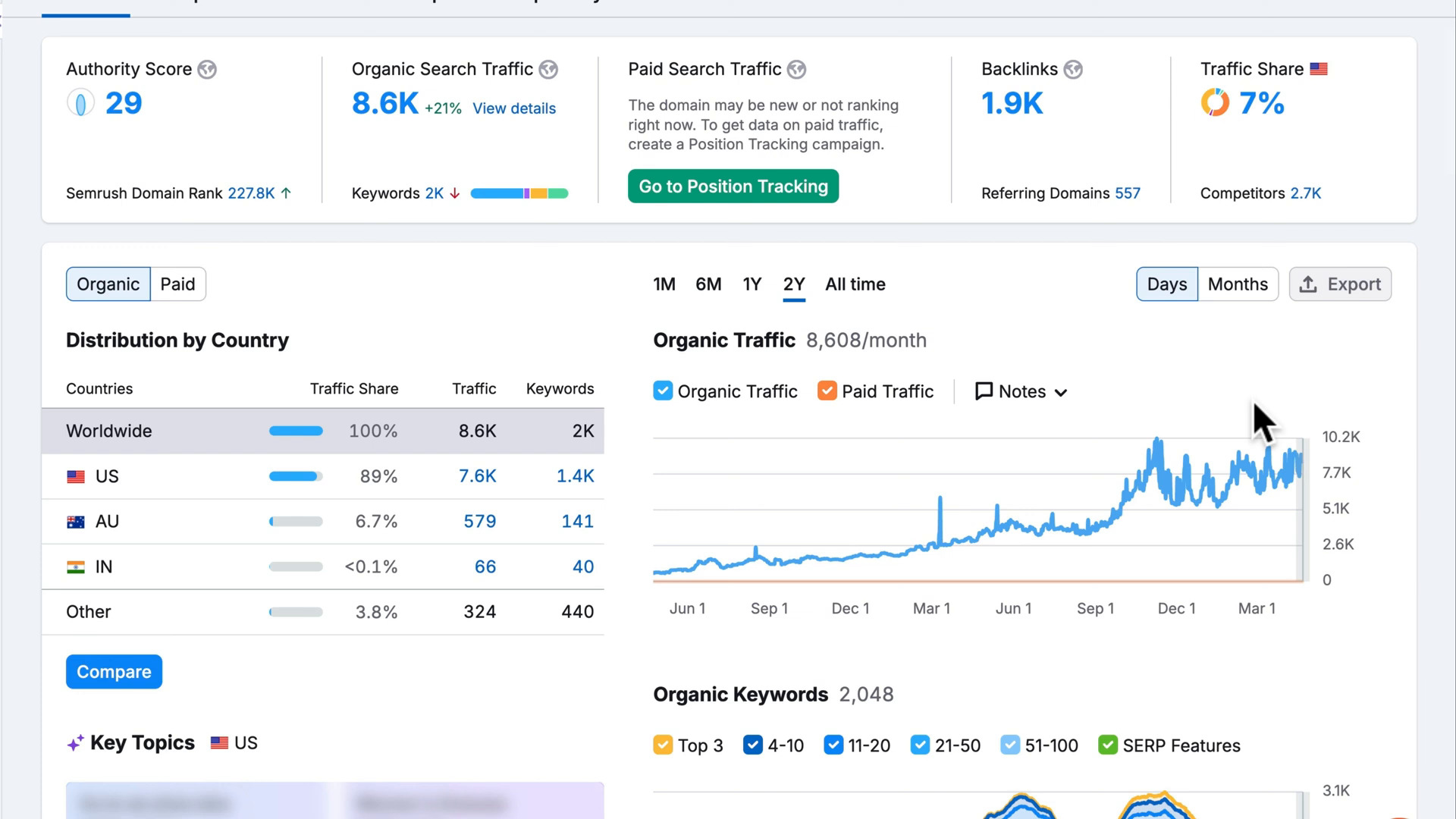
Semrush’s Domain Overview is the closest analog to Ahrefs Site Explorer. Authority Score, organic traffic trend, country distribution, organic vs paid split, all on one page. Slightly friendlier UI than Ahrefs; slightly less depth on backlinks. For agencies switching off Ahrefs, this is the landing surface.
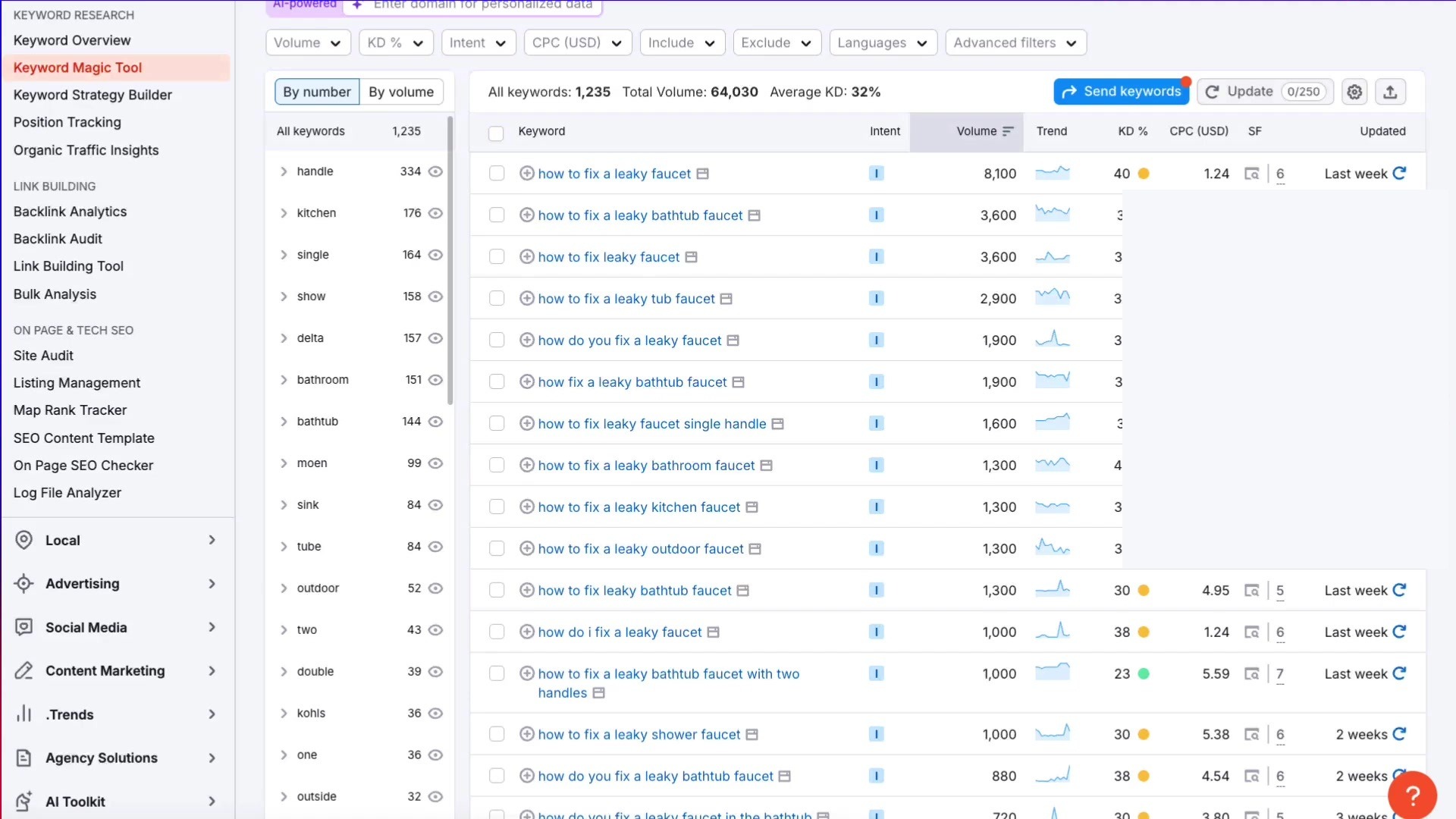
Keyword Magic Tool returns 1,235 variants of “fix leaky faucet” with the sub-group sidebar (handle, kitchen, bathroom, bathtub, moen, sink, delta) auto-clustering by intent. This is what Ahrefs does too; Semrush’s edge is the auto-clustering and the Low-Hanging Fruit / Commercial / AI Optimization quick-filters above the table.
Technical SEO
Screaming Frog (Free / $259/year). The site crawler all the others copy. Free for crawls up to 500 URLs (sufficient for most small business sites). Paid version unlocks full features and unlimited URLs. Desktop-only, no SaaS option.
Sitechecker ($59/mo). Continuous site audit and monitoring as a SaaS. Better than Ahrefs’ built-in audit for ongoing monitoring. Optional unless you’re an agency.
What to skip
A few tools that show up in “Top 10” lists that we don’t recommend for small businesses:
Moz Pro ($99-599/mo). Was once a category leader. Hasn’t kept pace with Ahrefs, SEMrush, or even mid-tier tools like SE Ranking. Pricing isn’t justified by current capability.
Ubersuggest ($29/mo or lifetime $290). Lifetime deal looks attractive on paper, but data quality has been inconsistent over the years. We’ve seen specific keyword volumes off by 50%+ vs Ahrefs/SEMrush. For client work, the unreliability outweighs the price savings.
Spyfu (similar pricing tier). Niche tool focused on PPC competitive intel. Not a general SEO tool.
Decision flow: pick the right stack in three minutes
Work through these in order:
- Are you brand-new to SEO with under 5 articles published? → Free stack only: GSC + Trends + Ahrefs Webmaster Tools.
- Are you a solo blogger publishing weekly with under 50 articles? → Free stack + Mangools (~$19/mo total, billed annually).
- Are you publishing 4+ articles per month? → Free stack + Mangools + Surfer ($118/mo total).
- Are you billing clients or managing 5+ sites? → Ahrefs OR SEMrush + Surfer + Screaming Frog ($240-260/mo).
- Are you a growth agency with 15+ client sites? → Ahrefs + Surfer + Screaming Frog + Looker Studio ($240-500/mo).
If you’ve made it through and you’re still unsure, the right answer is almost always Mangools + free stack for general use, with Surfer added when content velocity justifies it.
What to do next
If you’re a brand-new site setting up SEO from scratch, our Google Search Console tutorial walks through verifying your domain, submitting your sitemap, and the four reports that matter most.
If you’re choosing between specific premium tools, our Ahrefs vs SEMrush comparison covers the head-to-head decision most agencies eventually face.
If you’re budget-constrained, our Ahrefs alternatives review walks through eight cheaper options with cross-validated data.
If you’re picking between content optimization tools, our Surfer vs Frase comparison is the deeper read.
We re-test all platforms every 90 days. Last updated: July 2, 2026 (pricing re-verified on live vendor pages: Mangools Basic $18.85/mo annual, SE Ranking Core $103.20/mo annual, SEMrush Pro $117.33/mo annual under Adobe).
Frequently asked questions
What's the minimum SEO toolkit for a small business?
Three free tools cover the foundation: Google Search Console, Google Trends, and Ahrefs Webmaster Tools (free for verified site owners). Add one paid keyword research tool when you're publishing more than 2 articles per month. Mangools KWFinder ($18.85/mo billed annually) is the default recommendation. Total: about $19/month.
Do small businesses really need Ahrefs?
Almost never. Ahrefs ($129/mo) is built for agencies and large publishers. Small businesses get 80% of what they need from Mangools or Keysearch at a fraction of the price. The exception: if you're a small business pitching SEO services to clients yourself, Ahrefs' depth justifies the cost.
When should I add a content optimization tool like Surfer?
When you're publishing 4+ articles per month and want to rank faster. Surfer ($89/mo) typically improves ranking velocity 3-5%, which compounds across many articles. Below 4 articles/month, the cost doesn't pay back. We covered the Surfer vs Frase comparison in detail.
Are AI SEO tools worth it?
Yes for content optimization and keyword ideation, no for replacing keyword research. AI tools surface long-tail variations and clustering ideas faster than traditional tools. They cannot replace volume/difficulty data — those still require a real keyword tool. Treat AI as ideation acceleration, not ranking decisions.
What's the order I should add tools as my business grows?
Start free: GSC + Trends + Ahrefs Webmaster Tools. At 2 articles/month: add Mangools (~$19/mo billed annually). At 4 articles/month: add Surfer ($89). At 10 articles/month or pitching SEO to clients: upgrade Mangools to Ahrefs ($129) or SEMrush ($139). At 20+ articles/month with multiple sites: add Screaming Frog ($259/year) and Looker Studio (free).
Is doing SEO without paid tools possible?
Yes for the first 30-50 articles. Google Search Console shows real query data (not estimates). Google Trends validates topic timing. Ahrefs Webmaster Tools gives real Ahrefs data for your own domains. Combined, these cover most small-business SEO work. Paid tools become valuable when you start needing competitor research and broader keyword databases.
The marketing tech rundown.
One short email a week. Honest takes on the tools we tested, what's worth your money, and what to skip. No fluff.
Free. Unsubscribe anytime.