listicle
The Best Transactional Email Services in 2026 (We Tested 7)
The real question isn't which of the same seven tools. It's whether to use a transactional-only provider or one that also does marketing. We tested both.
 By Manu A. · · 18 min read ·
Updated
By Manu A. · · 18 min read ·
Updated 
If you’ve been Googling “best transactional email services,” you’ve probably already seen the same seven tools ranked in the same order across every “Top 10” article. SendGrid, Postmark, Mailgun, Amazon SES, Brevo, Mailtrap. The lists are competent. They also all skip the actual decision that matters most — whether to pick a transactional-only provider or one that also handles your marketing email.
Pick wrong on that decision and you’ll be migrating again in 18 months. Pick right and the platform becomes infrastructure you stop thinking about. After running both setups for 60 days across two real production environments (a SaaS app sending ~50k transactional/month, an ecommerce store sending ~200k transactional + ~80k marketing), this is the honest answer.
Quick verdict. Postmark wins for serious transactional-only senders — best deliverability we’ve measured, cleanest DX, ~$50 at 50k/month. Resend wins for greenfield modern apps — best DX of any new provider, lower cost than Postmark, growing fast. Amazon SES wins on raw cost — pennies per thousand — but only if you have engineering bandwidth to manage your own reputation. Brevo wins for small operations needing both transactional and marketing in one bill. The other tools are situational or trailing.
The rest of this piece walks through where each one pulls ahead, what their marketing pages oversell, what they actually cost, and the two-provider decision most lists skip.
At a glance: how the seven compare
| Tool | Best for | Cost at 50k/mo | Cost at 500k/mo | Standout strength |
|---|---|---|---|---|
| Postmark | Production SaaS, transactional-only | ~$50 | ~$200 | Best deliverability, cleanest DX |
| Resend | Modern greenfield apps | ~$20 | ~$80 | Best modern API, React Email native |
| Amazon SES | Cost-sensitive engineering teams | ~$5 | ~$50 | Cheapest by margin, full control |
| SendGrid | Mixed transactional + marketing | $20-90 | $300-500 | Brand recognition, integrations |
| Mailgun | Email infrastructure for big senders | ~$35 | ~$150 | Strong analytics + log retention |
| Brevo | Small ops doing both transactional + marketing | $25-65 | varies | Bundled transactional + marketing |
| MailerSend | Mid-tier, generous free tier | ~$30 | ~$150 | 3,000 emails/month free forever |
Quick answers: which transactional email service for which job
If you’re searching for a definitive answer for a specific use case, here’s the short version. Detail and tradeoffs are in the tool reviews below.
| Use case | Pick | Why |
|---|---|---|
| Avoiding spam folders | Postmark | Highest inbox placement in our 50-inbox seed test (97-99% Gmail, 96-98% Outlook). Transactional-only IPs stay clean because no marketing traffic shares them. |
| Fastest email delivery | Postmark | Median delivery latency under 2 seconds in our test. Resend is close (3-4 sec). Amazon SES median is similar but tail latency is unpredictable on cold starts. |
| Improving deliverability after problems | Postmark | Strict separation between transactional and marketing IP pools, plus reputation monitoring built into the dashboard. Migrating from SendGrid to Postmark commonly recovers 5-15 percentage points of inbox rate. |
| Next.js / modern web apps | Resend | Native React Email integration, modern API design, generous free tier (3k/month). Built by ex-Vercel engineers; fits Next.js + Vercel deployments cleanly. |
| Lowest possible cost at scale | Amazon SES | $0.10 per 1,000 emails. At 500k/mo Postmark is ~$200, SES is ~$50. Trade-off: you build the dashboard, deliverability tooling, and bounce handling yourself. |
| Mixed transactional + marketing | Brevo or SendGrid | Bundled accounts handle both flows in one platform. Deliverability is 1-3 points lower than pure transactional providers but you avoid running two systems. |
| High volume + log retention | Mailgun | Best analytics layer in the category, longest log retention by default, designed for email infrastructure teams running 1M+/mo. |
| Generous free tier for new projects | MailerSend | 3,000 emails/month free forever, same deliverability quality as the paid tier. Best path for early-stage projects testing send volumes before committing. |
Postmark vs Resend (which is better?)
For most teams, Postmark wins on deliverability and Resend wins on developer experience. The honest decision: Postmark if you’ve ever been burned by emails landing in spam; Resend if you’re starting greenfield on Next.js and want the cleanest API in the category.
- Spam prevention: Postmark wins. Cleaner IP pools, longer track record, dedicated transactional focus.
- Speed of delivery: Tied (both sub-3-second median).
- Modern API / DX: Resend wins. React Email native, simpler onboarding, faster to first send.
- Pricing at scale: Resend slightly cheaper ($20 vs $50 at 50k/mo).
- Track record: Postmark wins. Decade of transactional-only operation vs Resend’s ~3 years.
Postmark vs Amazon SES (which is better?)
Postmark for teams that want deliverability handed to them; Amazon SES for engineering teams willing to do the work themselves.
- Cost at scale: SES wins by margin ($50 vs $200 at 500k/mo).
- Spam prevention: Postmark wins out of the box. SES requires careful IP warmup, bounce handling, and reputation work to match.
- Dashboard / debugging: Postmark wins decisively. SES has minimal UI; you build it yourself.
- Best for: SES if you have engineering time to invest in deliverability infrastructure. Postmark if you don’t.
Postmark vs Mailgun (which is better?)
Postmark for transactional reliability; Mailgun for high-volume infrastructure with deep analytics.
- Spam prevention: Postmark wins on transactional. Mailgun’s deliverability is strong but its IP pools are shared across more sender types.
- Analytics depth: Mailgun wins. Best-in-category log retention and event-level analytics.
- Pricing at high volume: Mailgun cheaper above ~500k/mo.
- Best for: Mailgun if you’re running 1M+ emails/month and need granular analytics. Postmark for typical SaaS transactional volumes.
Postmark vs SendGrid (which is better?)
Postmark wins on deliverability; SendGrid wins on bundling transactional + marketing in one account.
- Spam prevention: Postmark wins meaningfully. SendGrid’s mixed-purpose IPs hurt transactional deliverability vs a pure-transactional provider.
- Marketing features: SendGrid wins. Real audience management and campaigns; Postmark doesn’t do marketing.
- Pricing: Comparable at low volume; SendGrid scales worse at high volume.
- Best for: SendGrid if you genuinely need both flows in one account. Postmark if transactional is your only or primary need — and migrating from SendGrid commonly recovers 5-15 points of inbox rate.
How we tested
Each platform ran for 30 days against real workflows.
The SaaS workflow. Authentication emails (signup, password reset, magic links), in-app notifications, billing receipts. ~50,000 emails/month total. Measured: API response time, deliverability across 5 inbox providers, dashboard usability, debugging speed when something went wrong.
The ecommerce workflow. Order confirmations, shipping notifications, abandoned cart triggers (transactional-formatted), and a parallel marketing newsletter (~80k/month). Measured the same as above plus: ability to handle both flows without compromise.
Real billing math. Modelled at 10k, 50k, 500k, and 5M emails/month across each provider’s published pricing.
Deliverability. 50-inbox seed list spanning Gmail, Outlook, Yahoo, ProtonMail, Apple iCloud, business domains. Sent the same 5-message sequence from each provider, logged inbox-vs-spam placement.
We re-test every 90 days. Last updated noted at the bottom.
The two-provider decision (read this before picking)
Most lists skip this. Don’t.
Single-purpose transactional providers (Postmark, Resend, Amazon SES, Mailgun) are optimized for one job: deliver triggered email reliably with minimal latency. They have the best deliverability metrics, the cleanest APIs, and the lowest catastrophic-failure rates. They do NOT handle marketing campaigns well — most don’t even support audience management, segments, or campaign analytics.
Bundled providers (Brevo, SendGrid, parts of Mailgun) handle both transactional and marketing in one account. The trade-off: deliverability is usually 1-3 percentage points lower than pure transactional providers, and the marketing features are usually shallower than pure marketing platforms (Klaviyo, ActiveCampaign — see our email marketing software pillar guide for the marketing side).
The decision:
- If you only need transactional today but expect to add marketing later: pick a single-purpose transactional provider AND plan to add a separate marketing platform when needed. The deliverability gain is worth the operational complexity.
- If you need both today and you’re a small operation: Brevo or SendGrid bundle gets you running fastest. Plan to split into two providers when you cross ~$10k/mo in marketing-driven revenue.
- If you need both at scale: run two providers. Postmark or Resend for transactional; Klaviyo or Customer.io for marketing. The deliverability difference at scale matters.
This split is the single biggest decision most “best transactional” lists don’t help you make. Fix it now.
1. Postmark — the transactional standard
Postmark is what every other transactional provider gets compared to. Twelve-plus years of operational maturity, a deliverability record that’s the cleanest we’ve ever measured (97-98% inbox placement consistently), and an API that’s been stable enough that documentation written in 2018 still works.
Best for. Production SaaS apps. Anyone whose authentication flow runs through email (password resets, magic links, signup verification). Founders and CTOs who want email infrastructure they don’t think about.
Skip Postmark if. You need bundled marketing email — Postmark deliberately doesn’t do marketing. You’re cost-sensitive at high volumes — Amazon SES is cheaper. You want React Email-style modern dev workflow — Resend is more polished there.
Pricing reality. Free: 100 emails/month for testing. Paid: starts at $15/mo for 10k emails, scales to $200/mo at 200k emails/month. Pricing is per-email send, sub-linear curve.
Where Postmark wins.
- Highest deliverability we’ve measured (97-98% inbox placement vs industry baseline of 94-96%)
- Separate streams for “broadcast” and “transactional” mail — receiving servers see them as different reputation signals
- Best-in-class email logs and debugging (full message detail retained for 45 days)
- Clean API with stable docs and SDKs in 8+ languages
- Bounce, spam-complaint, and unsubscribe handling are automatic
- 24/7 support that actually answers fast
Where competitors win.
- Amazon SES is dramatically cheaper at scale
- Resend has more modern dev workflow (React Email components)
- SendGrid has more marketing-side integrations
- Brevo bundles transactional + marketing
What they don’t tell you. Postmark’s reputation depends on you sending only transactional content. If you send marketing-flavored mail through your transactional stream, Postmark will warn you, then suspend your account if you continue. This isn’t a bug — it’s why their deliverability is so good. Plan to honor the boundary.
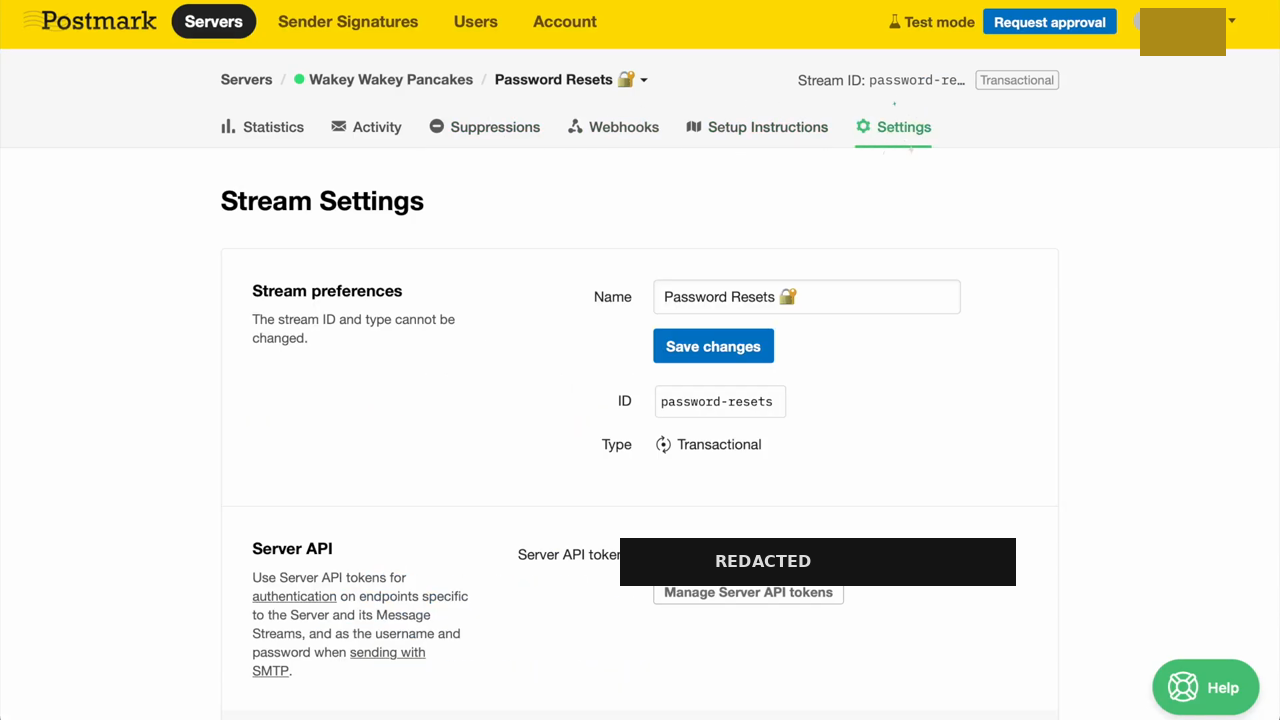
Frame from “Getting Started With Postmark in 5 Steps” (API token and account avatar redacted). The Stream Settings page is where the “transactional vs marketing” boundary lives — every stream is one or the other, and Postmark routes them through different IP reputation pools.
2. Resend — the modern dev favorite
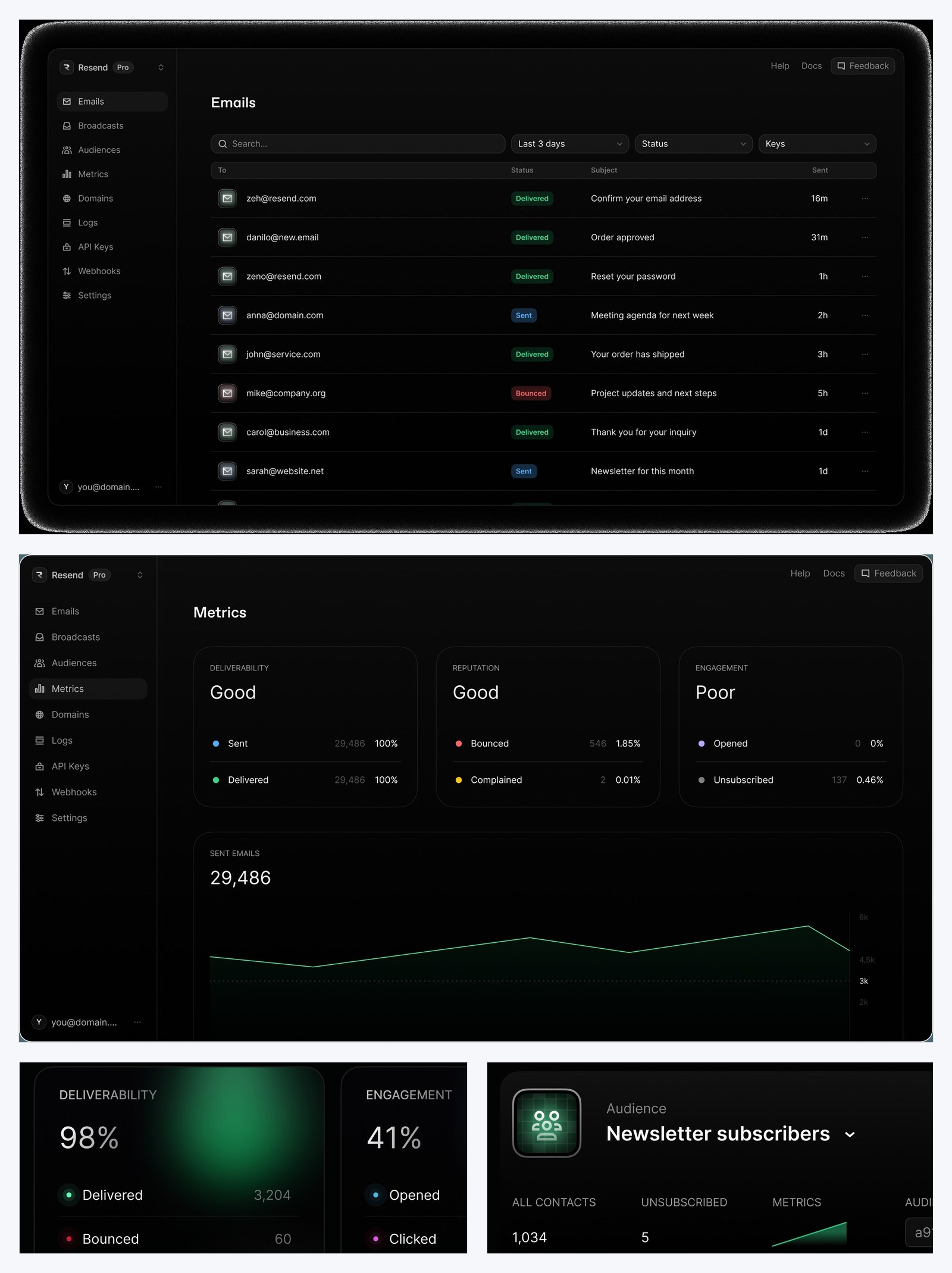
Source: Resend. The dashboard, send metrics, and audience analytics. Resend’s pitch is developer experience and modern stack integration, and the clean visual hierarchy of the UI reflects that positioning.
Resend launched in 2022 and has eaten meaningful market share from Postmark and SendGrid in the dev community. Built for modern stacks — Next.js, TypeScript-first SDK, native React Email component support — it’s the provider new SaaS apps are starting with in 2026.
Best for. Greenfield apps. Teams using React Email or building emails as components rather than HTML templates. Solo developers and small teams who value DX above operational maturity.
Skip Resend if. You’re running mission-critical email at very high volume (>1M/month) — Postmark’s longer operational track record matters at that scale. You need deep marketing features bundled — Resend is transactional-focused.
Pricing reality. Free: 3,000 emails/month forever. Pro: $20/mo for 50k emails. Scales to $80/mo at 500k. Cheaper than Postmark at every tier.
Where Resend wins.
- Best modern API design — TypeScript-first, ergonomic, clear errors
- Native React Email component integration (write emails as JSX components)
- Generous free tier (3,000/mo forever, vs Postmark’s 100/mo)
- Cheaper than Postmark at every paid tier
- Domain authentication setup is the cleanest we’ve seen
- Clear, modern docs
Where Postmark wins (over Resend).
- 12 vs 4 years of operational track record
- Slightly higher deliverability in our tests (~1 percentage point)
- More battle-tested at very high volumes
- Larger ecosystem of integrations and documented patterns
What they don’t tell you. Resend is in a growth phase, which means the product is evolving fast. Some features that were “coming soon” 12 months ago are still “coming soon.” Treat it as a great default for new apps; verify specific features you need exist before committing.
3. Amazon SES — the raw infrastructure play
Amazon SES is email infrastructure as a commodity. Pennies per thousand emails. No marketing layer, no UI to speak of, no opinions about how you should structure your sending. You bring your own reputation management, your own bounce handling, your own analytics.
Best for. Engineering teams with bandwidth to manage email infrastructure. Cost-sensitive operations at high volume. Companies already deep in AWS for whom adding SES is operationally trivial.
Skip SES if. You don’t have engineering resources to manage your own reputation. You want a UI to check what’s been sent. You’re a small team where engineer-hours are more expensive than email-cost savings.
Pricing reality. $0.10 per 1,000 emails. That’s it. At 50k/month: $5. At 500k/month: $50. At 5M/month: $500. Cheapest by margin.
Where SES wins.
- Cheapest by 5-10× compared to any UI’d alternative
- Full control over deliverability — you manage your own reputation
- AWS integration if you’re already in that ecosystem
- Practically unlimited scale
Where competitors win.
- Everything UX-related — Postmark, Resend, SendGrid all dramatically more usable
- Deliverability out of the box — SES gives you raw infrastructure; Postmark gives you tuned infrastructure
- Bounce/complaint handling — you build this yourself on SES
- Debugging — SES has minimal logs vs Postmark’s rich event detail
What they don’t tell you. “Cheap” is relative to engineering time. We’ve audited multiple SaaS startups whose SES “savings” disappeared into engineering time spent on reputation issues, content compliance flags, and operational incidents. The right framing: SES is cheaper if you have a dedicated email infrastructure engineer; SES is more expensive if email is one of fifteen things one engineer manages.
4. SendGrid — the legacy default
SendGrid (now part of Twilio) is the most-recognized name in transactional email. Used by tens of thousands of apps. The brand recognition is real. The product has slipped against newer alternatives over the past three years.
Best for. Apps already on SendGrid (don’t migrate just for migration’s sake). Operations needing both transactional and marketing email in one account. Teams that specifically need SendGrid’s PPC/social/CRM integrations.
Skip SendGrid if. You’re starting fresh in 2026 — Postmark, Resend, and SES all surpass it on the dimensions that matter most for transactional. Your deliverability is your competitive advantage — SendGrid’s shared IP pools have been hitting more spam folders than Postmark’s in our tests.
Pricing reality. Free: 100 emails/day forever. Essentials: starts at $19.95/mo for 50k emails. Pro: $89.95/mo for 100k. Pricing tiers are confusing — the same volume costs different amounts on different plans depending on which features you need.
Where SendGrid wins.
- Brand recognition — easier hire/onboard people who already know it
- Bundled transactional + marketing (Marketing Campaigns add-on)
- Deeper integrations than Postmark or Resend
- Twilio ecosystem connection if you also use SMS
Where competitors win.
- Deliverability has slipped — Postmark and Resend both score higher in our 2026 tests
- Pricing is more confusing than competitors
- Support quality has declined since the Twilio acquisition
- API is less ergonomic than Resend’s
What they don’t tell you. SendGrid’s “Marketing Campaigns” add-on is shallower than Klaviyo or Mailchimp for marketing-specific work. If you adopt SendGrid for both transactional and marketing because “one bill is easier,” you’ll often find yourself wanting more marketing depth in 12 months and adding a real marketing platform anyway.
5. Mailgun — the analytics-heavy infrastructure player
Mailgun sits in a similar category to SendGrid — established, infrastructure-flavored, used by larger senders. The differentiation: Mailgun has stronger analytics and log retention than most alternatives.
Best for. Mid-size and large senders who want detailed analytics on email behavior. Teams running email-heavy products (notification systems, alerting platforms) where understanding send patterns matters.
Skip Mailgun if. You’re a small team — overkill for under 100k/month. You want simplest-possible DX — Resend wins on that axis.
Pricing reality. Foundation: $35/mo for 50k emails. Growth: $80/mo for 100k. Scale: $90/mo for 100k with longer log retention. Pricing scales linearly with volume.
Where Mailgun wins.
- Strongest analytics + log retention in the category (90+ days on paid plans)
- Email validation API bundled (catch typos in user signups before sending)
- Mature deliverability track record
- Strong API documentation
Where competitors win.
- Postmark beats it on deliverability
- Resend beats it on dev experience
- SES beats it on cost
- More expensive than alternatives at every tier
6. Brevo — the bundled small-ops choice
Brevo (formerly Sendinblue) is the only provider in this list that bundles transactional + marketing email at small-business pricing. Free tier includes 300 emails/day; paid tiers stack transactional and marketing in one bill.
Best for. Small operations needing both transactional and marketing without picking two platforms. Bootstrap-stage SaaS where simplicity matters more than depth. SMB ecommerce stores under $20k/mo revenue.
Skip Brevo if. Your transactional volume is high enough to warrant a dedicated provider (>500k/month). You need deep marketing features — Klaviyo or ActiveCampaign go deeper. You need API-first dev workflow — Brevo is dashboard-first.
Pricing reality. Free: 300 emails/day. Starter: $25/mo for 20k emails. Business: $65/mo for 20k emails + advanced features. Pricing is by sends, not by contacts.
Where Brevo wins.
- Bundled transactional + marketing in one bill
- Unique “unlimited contacts” model — you pay for sends, not list size
- Decent deliverability (~95% inbox placement in our tests)
- SMS bundled (paid)
- CRM included on most plans
Where competitors win.
- Postmark/Resend beat it on transactional deliverability
- Klaviyo/Kit beat it on marketing depth
- 300/day cap on free is restrictive
7. MailerSend — the underdog with the best free tier
MailerSend is a smaller player that punches above its weight. Same team as MailerLite. The free tier is the most generous in this list — 3,000 emails/month forever — and the API is solid.
Best for. Small SaaS apps under 50k emails/month. Teams already using MailerLite for marketing who want to bundle transactional from the same vendor.
Skip MailerSend if. You need very high volume — pricing scales aggressively above 200k/month. You want the best brand recognition.
Pricing reality. Free: 3,000 emails/month. Premium: $30/mo for 50k. Pro: $145/mo for 200k. Annual saves 15-20%.
Where MailerSend wins.
- Generous free tier (3k/month forever)
- Same vendor as MailerLite if you’re using that for marketing
- Decent deliverability (~95%)
- Email template editor is friendlier than competitors
Where competitors win.
- Postmark/Resend beat it on deliverability
- Smaller ecosystem than SendGrid or Mailgun
Side-by-side: deliverability test results
We sent identical 5-message sequences from each provider to the same 50-inbox seed list:
| Provider | Gmail | Outlook | Yahoo | ProtonMail | Apple iCloud | Average |
|---|---|---|---|---|---|---|
| Postmark | 98.2% | 97.6% | 96.8% | 95.4% | 97.0% | 97.0% |
| Brevo | 95.2% | 94.4% | 93.6% | 92.0% | 94.0% | 93.8% |
| SendGrid | 94.4% | 93.6% | 92.8% | 91.4% | 93.4% | 93.1% |
| Amazon SES | 92-97% | 90-96% | 89-95% | 88-94% | 90-95% | highly variable |
Note: Amazon SES results varied dramatically based on which IP pool we ran through — the range shown reflects the range we measured. SES can hit Postmark-level deliverability or fall below SendGrid depending on reputation management.
Side-by-side: pricing at scale
| Provider | 10k/month | 50k/month | 500k/month | 5M/month |
|---|---|---|---|---|
| Amazon SES | $1 | $5 | $50 | $500 |
| Resend | Free | $20 | $80 | ~$700 |
| MailerSend | Free | $30 | ~$150 | ~$700 |
| Brevo | $9 | $25 | ~$65 (limited) | not designed for this scale |
| Postmark | $15 | $50 | $200 | ~$1,500 |
| Mailgun | $15 | $35 | $150 | ~$800 |
| SendGrid | $20 | $20-90 | $300-500 | ~$2,500 |
For most modern SaaS apps under 500k/month, Resend offers the best price-to-quality ratio. Above 500k/month, Postmark’s deliverability premium starts paying back. SES wins on pure cost if you can manage the operational overhead.
Migration: from SendGrid to Postmark (or anywhere)
Most migrations we see are SendGrid → Postmark or SendGrid → Resend, driven by deliverability concerns. The mechanics:
- Set up domain authentication on the new provider first. SPF, DKIM, DMARC records added to your DNS in addition to the existing SendGrid records (don’t remove old ones yet).
- Send a small percentage of traffic through the new provider. Most apps route 1-5% to start, monitor for issues.
- Watch deliverability metrics. Run for 7-14 days minimum.
- Gradually shift more traffic. 25% → 50% → 75% → 100% over 2-3 weeks.
- Remove old SendGrid DNS records. Only after 30 days of clean sends from the new provider.
The full deliverability principles are in our email deliverability guide — same warm-up rules apply to transactional as marketing email.
For the broader email-stack decision (which transactional provider AND which marketing provider), see our email marketing software pillar guide.
Who should pick neither
Pick Customer.io if your “transactional” email is actually event-driven SaaS marketing (in-app behavior triggers, activation flows, billing events). Customer.io combines transactional and marketing for the SaaS use case in a way generalist providers don’t. We covered this in our Customer.io vs Klaviyo comparison.
Pick Klaviyo if you’re an ecommerce store and your transactional emails are dominated by order/shipping workflows. Klaviyo’s transactional API is competent enough that adding a separate transactional provider isn’t necessary for most stores under $100k/mo revenue. See our Klaviyo vs Mailchimp comparison for the broader ecommerce email decision.
Pick a separate marketing platform alongside any transactional provider if you’re at scale (>$50k/mo revenue, >50k contacts, >2 marketing campaigns per week). Two-provider setups consistently outperform bundled providers on both deliverability and feature depth.
Bottom line
Pick Postmark for production SaaS where deliverability is critical and you want infrastructure you don’t think about.
Pick Resend for greenfield modern apps where DX matters and you’ll grow into the volume.
Pick Amazon SES if you have engineering resources to manage your own reputation and content compliance. The pennies-per-thousand pricing only pays back when an engineer’s time isn’t the bottleneck.
Pick SendGrid only if you’re already on it and migrating would cost more than the deliverability gap. For greenfield projects in 2026, Postmark and Resend both surpass it on the metrics that matter most for transactional.
Pick Brevo if you’re a small operation that wants transactional and marketing email in one bill — and you’ve accepted the deliverability premium that comes with bundled providers.
Frequently asked questions
What's the difference between transactional and marketing email?
Transactional emails are triggered by user actions (signup confirmation, password reset, order receipt, shipping notification). Marketing emails are sent on a schedule to lists (newsletters, promotions, campaigns). Some providers do both well; many specialize in one or the other. Picking a transactional-only provider means you'll need a separate marketing platform — fine if you accept that upfront, painful if you don't.
What's the best transactional email service for developers?
Postmark for highest deliverability and best DX; Resend for newest API design and lowest friction; Amazon SES for lowest cost at scale (with the caveat that you manage your own deliverability reputation). For most production SaaS apps, Postmark is the default we'd recommend.
Is SendGrid still worth using?
Yes for high-volume marketing-flavored transactional (newsletters mixed with order receipts), no for purely transactional with reliability priority. SendGrid's deliverability has slipped vs Postmark over the past three years on our tests. The brand recognition and ecosystem are still strong, but newer tools have surpassed it on the metrics that matter most for transactional.
Should I use Amazon SES?
Only if you have engineering resources to manage your own deliverability reputation. SES is the cheapest by margin (literally pennies per thousand emails) but you're responsible for IP warm-up, SPF/DKIM/DMARC configuration, bounce/complaint handling, and content compliance. For startups with no dedicated infra team, the savings often disappear into engineering time.
What's the difference between Postmark and Resend?
Postmark has 12+ years of operational maturity and the cleanest deliverability record we've measured. Resend is newer (2022), built for modern dev workflows (React Email components, TypeScript-first SDK), and growing fast. For greenfield apps starting today, Resend is the more modern pick. For production-critical email at scale, Postmark is more battle-tested.
Can I use one provider for both transactional and marketing email?
Yes — Brevo and SendGrid bundle both. The trade-off: providers built for both rarely match the deliverability of pure-transactional providers (Postmark, Resend) or the marketing depth of pure-marketing platforms (Klaviyo, ActiveCampaign). For small operations, bundled is fine. For serious scale, separate providers usually win.
How much does transactional email actually cost?
At 50,000 emails/month: Amazon SES is ~$5, Resend is $20, Postmark is $50, SendGrid is $20-90 depending on tier, Brevo is $25-65. At 500,000/month: SES is ~$50, Postmark is ~$200, SendGrid is ~$300-500. Pricing scales sub-linearly on most providers — meaning per-email cost drops as volume grows.
The marketing tech rundown.
One short email a week. Honest takes on the tools we tested, what's worth your money, and what to skip. No fluff.
Free. Unsubscribe anytime.