comparison
Customer.io vs Klaviyo: Which Should SaaS Companies Actually Use?
Klaviyo dominates ecommerce. Customer.io owns SaaS. We tested both for B2B and product-led growth. The honest verdict on which fits your company.
 By Manu A. · · 10 min read ·
Updated
By Manu A. · · 10 min read ·
Updated 
This comparison comes up most often when SaaS marketing teams realize they’ve outgrown a generic ESP and need event-driven automation. The two names that surface immediately are Customer.io and Klaviyo — and the marketing pages make them sound interchangeable. They aren’t.
We ran both platforms for six weeks across two real test environments: a B2B SaaS workflow (event-driven onboarding, activation campaigns, billing event triggers) and an ecommerce workflow (product-driven flows, abandoned cart, post-purchase). The verdict depends entirely on which environment you’re operating in.
Quick verdict. Customer.io wins decisively for SaaS, B2B, and product-led growth companies. Its event model, journey builder, and API-first architecture were designed for software companies sending email based on what users do inside a product. Klaviyo wins decisively for ecommerce — it’s the gold standard for Shopify and WooCommerce stores, with revenue attribution, abandoned cart automation, and SMS built around order data. Picking the wrong one costs months of forced workarounds.
The rest of this piece walks through where each one pulls ahead, what they actually cost, and who should look at neither.
At a glance: how they compare
| Customer.io | Klaviyo | |
|---|---|---|
| Best for | SaaS, B2B, product-led growth | Ecommerce (Shopify, Woo, BigCommerce) |
| Data model | People + events (custom-defined) | Profiles + product/order data |
| Entry plan | Essentials: $100/mo at 5k people | Email: $20/mo at 500 contacts |
| Mid plan | Premium: ~$1,000/mo at 100k people | Email: ~$200/mo at 25k contacts |
| Native ecommerce | None (custom integration required) | Deep — Shopify, Woo, BigCommerce, Magento |
| Native product analytics | Strong — events, attributes, segments | Limited — primarily order-driven |
| In-app messaging | Yes (included) | No |
| SMS | Included on most plans | Separate product, billed by message |
| API maturity | Excellent — built for engineers | Good — built for marketers |
How we tested
Each platform ran for six weeks against two parallel workflows.
The SaaS workflow. A 14-day onboarding sequence triggered by sign-up, behavior-driven activation prompts (sent only to users who hadn’t completed key actions by day 3, day 7, day 14), and billing-event automation (trial-ending nudges, payment-failure recovery).
The ecommerce workflow. Welcome series triggered by purchase, abandoned-cart recovery, post-purchase follow-up, win-back campaigns for lapsed customers.
Time-to-build. We built each workflow on each platform with a stopwatch running. Customer.io built the SaaS flows ~40% faster than Klaviyo could; Klaviyo built the ecommerce flows ~60% faster than Customer.io could. The data models match the work each was designed for.
Real billing math. Modelled at 5,000, 25,000, and 100,000 active people / contacts, on annual billing where offered.
We re-test every 90 days. Last updated noted at the bottom.
Customer.io — built for SaaS from the ground up
Customer.io treats your customer as a person with events over time — a stream of actions like “signed up,” “completed onboarding step 3,” “added a teammate,” “downgraded plan.” Every email, push notification, in-app message, or SMS is a response to something that happened in your product. That’s exactly how SaaS marketing teams think about communication.
Best for. B2B SaaS, product-led growth companies, marketplaces, mobile apps, anything where the user does things inside a product and the email is a reaction to those things.
Skip Customer.io if. You’re an ecommerce store. You’ll spend months trying to make order data fit Customer.io’s people-and-events model, when Klaviyo gives you the same outcome out of the box.
Pricing reality. Essentials: $100/mo for up to 5,000 active people. Premium: starts around $1,000/mo at 100k people, includes journeys, in-app messaging, transactional API. Enterprise: custom for accounts above 1M people.
Where Customer.io wins.
- Event-driven journeys that match how SaaS teams think
- Best-in-class API — built for engineers, fully documented
- In-app messaging built in (no separate tool needed)
- Transactional email API at zero markup
- Composable workflows — easy to test, easy to fork into experiments
Where Klaviyo wins (over Customer.io).
- Native ecommerce integrations (Shopify, Woo, BigCommerce one-click)
- Revenue-attributed segments out of the box
- More polished campaign builder UI for marketers without engineering help
- Cheaper at small scale (under 1,000 contacts)
What they don’t tell you. Customer.io’s value depends entirely on the quality of the events you send it. If your engineering team isn’t comfortable instrumenting product events to a clear schema, the platform’s strengths go unused. The first 30 days of any Customer.io implementation are usually about cleaning up event tracking — budget for that.
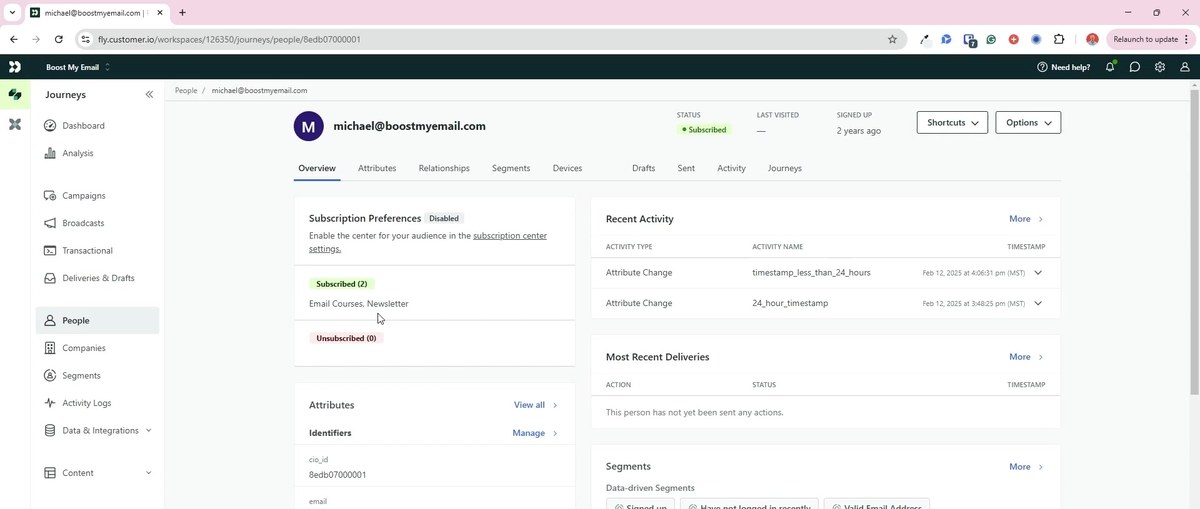
The Customer.io email editor inside a workflow step. Liquid templating is first-class: a {% for course in customer.recommended_courses %} loop iterates over a per-recipient array, and {{ customer.first_name | default:"there" }} falls back gracefully when a field is empty. This is what “SaaS-native” looks like in practice — the email body is a function of the data you’ve sent in, not a static template you remember to update.
Klaviyo — built for ecommerce from the ground up
Klaviyo treats your customer as a profile with purchase history, browsing behavior, predicted lifetime value. Every email is a response to a buying signal. The entire data model — segments, flows, A/B tests — is shaped around the rhythm of an ecommerce business.
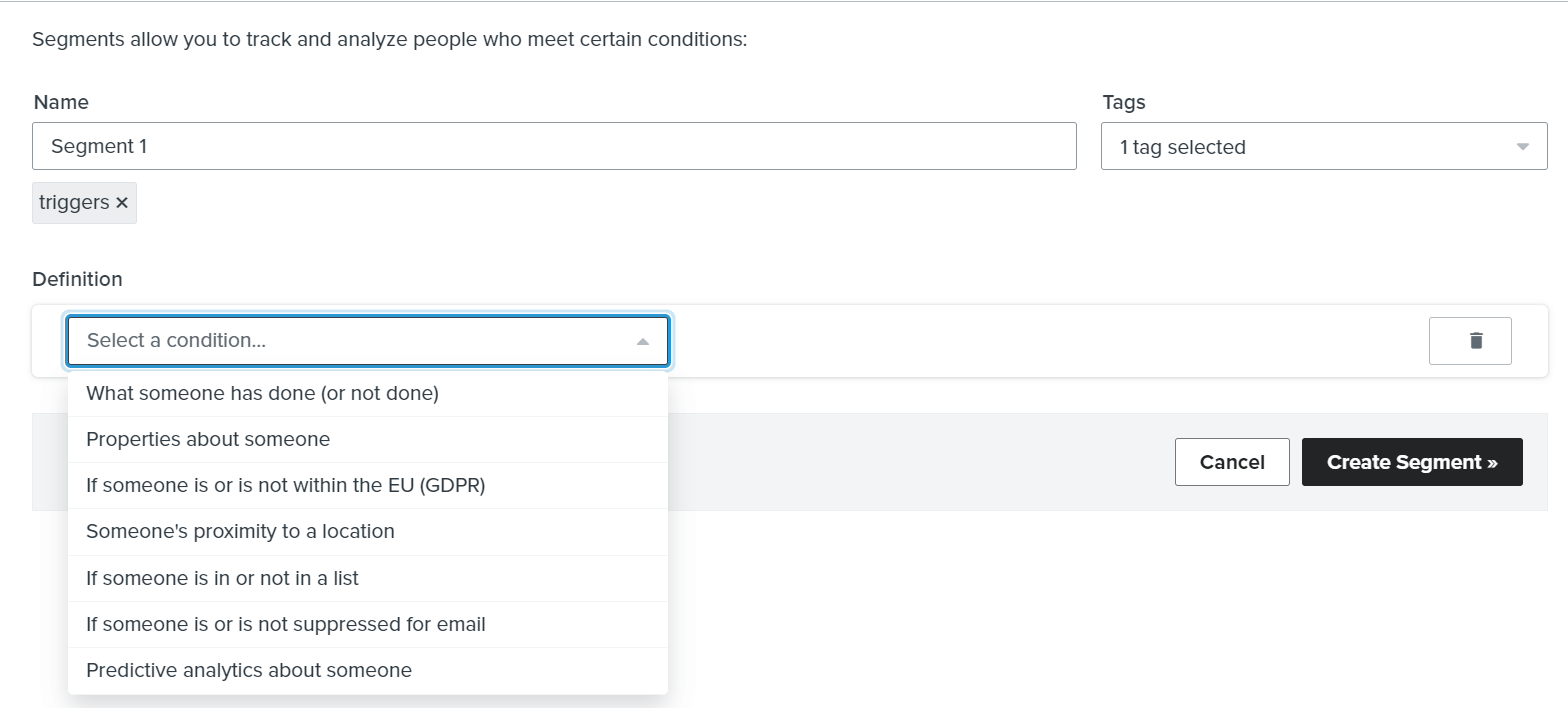
Source: Klaviyo help center. Klaviyo’s segment-condition library is broader than Customer.io’s, but the conditions are tuned for purchase signals (predicted next-order date, proximity, suppression) rather than the in-product event semantics Customer.io models natively. Same depth, different vocabulary.
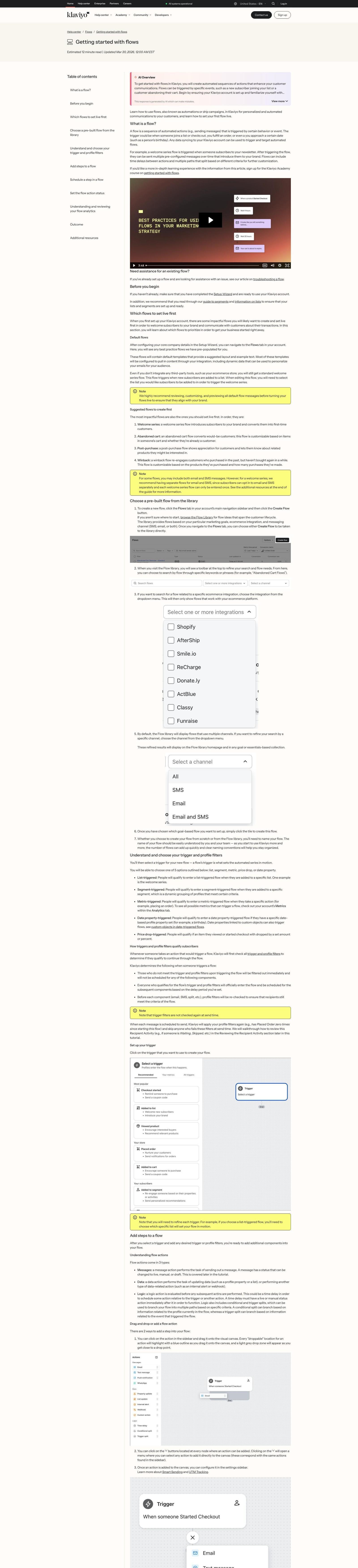
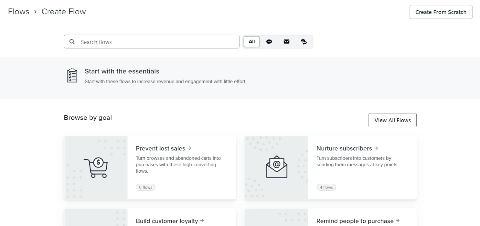
Source: Klaviyo help center — flows. The flow editor is where Klaviyo’s ecommerce-first design shows clearest: triggers like “Placed Order” or “Started Checkout” are first-class objects, not custom events you’d have to instrument yourself. Customer.io’s equivalent journey builder uses the same canvas metaphor but starts from event-stream primitives instead.
Best for. Shopify stores, WooCommerce stores, BigCommerce stores, DTC brands, any business where the customer’s primary relationship with you involves buying physical or digital products.
Skip Klaviyo if. You’re a SaaS company. The platform doesn’t have native concepts for trial states, feature usage, or in-app behavior — you’d build everything via custom events and lose the integrations that make Klaviyo Klaviyo.
Pricing reality. Email: $20/mo for up to 500 contacts (annual). Scales by contact count: $45 at 1k, $150 at 10k, $375 at 25k, $720 at 50k. SMS is separate, billed per message ($1 per 100 sends in the US). Predictive analytics included on all plans.
Where Klaviyo wins.
- Native Shopify integration — orders, products, customers sync without custom dev work
- Revenue-attributed reports that make ROI math trivial
- Best-in-class abandoned cart, post-purchase, and win-back flow templates
- Predictive analytics (next purchase date, customer lifetime value) actually useful
- Larger ecosystem of agencies and freelancers fluent in Klaviyo
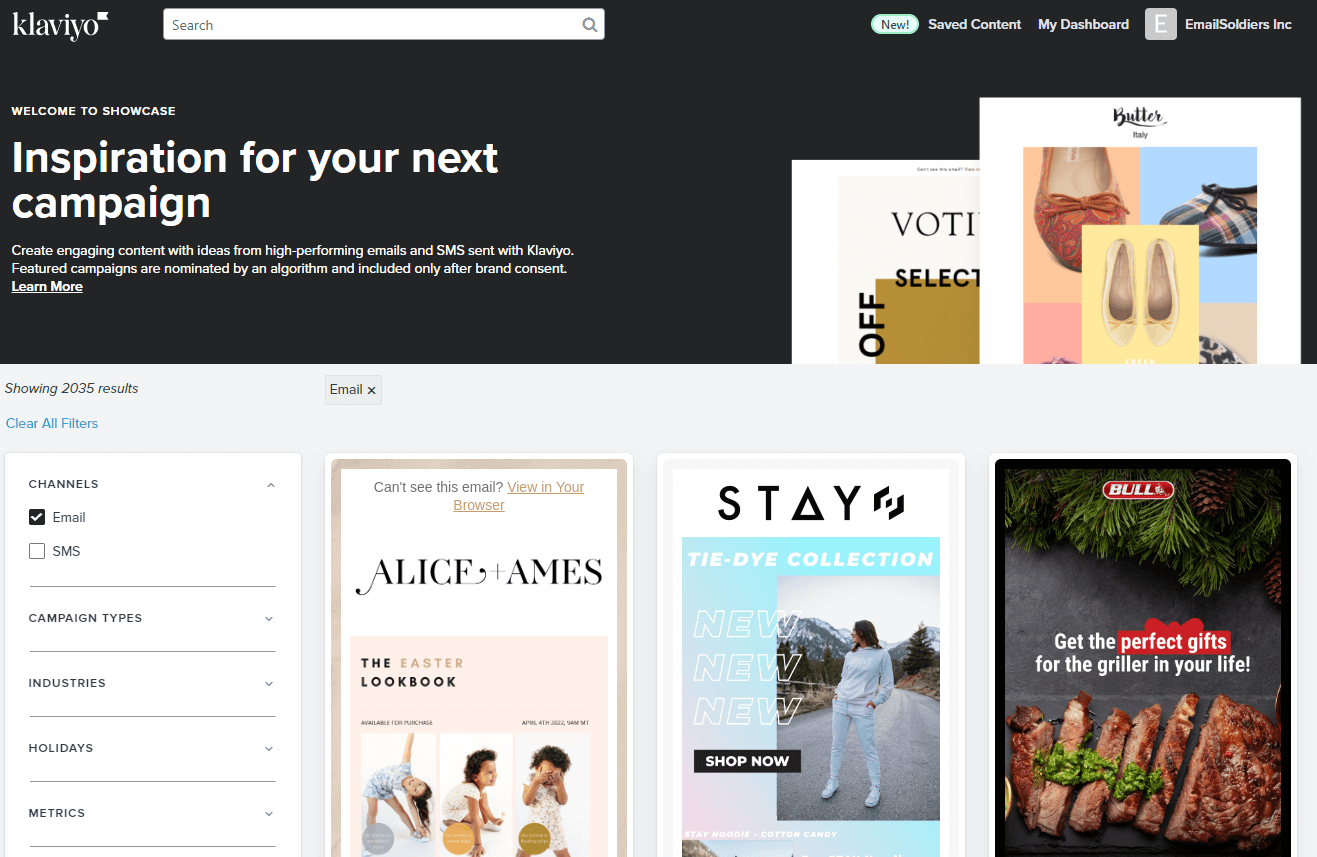
Source: Klaviyo help. The Klaviyo Showcase library is brand-tuned — Voto, Alice & Ames, Stayo — which is the e-comm-native template inspiration a SaaS-flavored product like Customer.io has no equivalent for. Customer.io expects you to design from a blank canvas; Klaviyo expects you to start from someone else’s working campaign.
Where Customer.io wins (over Klaviyo).
- Cleaner event-based segmentation
- Better in-app messaging (Klaviyo doesn’t have native in-app)
- More forgiving API for high-volume programmatic sends
- Better suited to non-purchase business models (subscriptions, marketplaces, freemium SaaS)
What they don’t tell you. Klaviyo’s pricing scales aggressively above 25,000 contacts. Stores above 50k contacts often look at alternatives — but few alternatives match Klaviyo’s ecommerce depth, so most stay and absorb the cost. Plan for it.
Side-by-side: SaaS workflows
| Capability | Customer.io | Klaviyo |
|---|---|---|
| Event-driven triggers | Native, unlimited | Custom events possible, less polished |
| User attribute updates | Real-time via API | Real-time via API |
| In-app messaging | Native | Not available |
| Trial-ending automation | Built-in pattern | Custom build required |
| Billing event hooks | Stripe integration native | Custom build required |
| Push notifications | Native | Not available |
If your daily work involves “send email when X happens in our product,” Customer.io is the right answer. Klaviyo can technically do it, but you’ll fight the tool.
Side-by-side: ecommerce workflows
| Capability | Customer.io | Klaviyo |
|---|---|---|
| Shopify integration | Custom (Zapier or webhooks) | One-click native |
| Abandoned cart flow | Manual setup | One-click template |
| Revenue attribution | Custom via events | Native, automatic |
| Predicted next-purchase date | Custom build | Native predictive analytics |
| Product recommendations | Custom | Native, AI-driven |
| SMS for cart recovery | Separate product needed | Native (paid add-on) |
If your daily work involves “send email when someone buys / browses / abandons,” Klaviyo is the right answer. Customer.io can do it, but at meaningful engineering cost.
Side-by-side: pricing at scale
| Contact count | Customer.io | Klaviyo (Email) | Klaviyo (Email + SMS) |
|---|---|---|---|
| 1,000 | $100/mo | $45/mo | ~$95/mo (assuming SMS) |
| 5,000 | $100/mo | $90/mo | ~$200/mo |
| 25,000 | $375/mo | $375/mo | ~$700/mo |
| 100,000 | $1,000/mo | $1,440/mo | ~$2,500/mo |
At small scale Klaviyo is dramatically cheaper. At large scale Customer.io is competitive on email-only and meaningfully cheaper if you need SMS bundled.
Migration path: choosing wrong, then switching
We’ve seen both directions. Here’s what to expect.
Klaviyo → Customer.io (a SaaS company that wrongly chose Klaviyo first). Plan 6-8 weeks of engineering effort. Re-instrument your product to send events to Customer.io’s API. Rebuild all flows in Customer.io’s journey builder (Klaviyo’s flow builder doesn’t translate). Re-warm deliverability — different sending IPs, different reputation. Run parallel for 2-4 weeks, then cut over.
Customer.io → Klaviyo (an ecommerce company that wrongly chose Customer.io first). Plan 4-6 weeks. The migration is easier because Klaviyo’s Shopify integration does most of the data plumbing for you — orders, products, customer profiles import in a single OAuth handshake. Rebuild flows from Klaviyo’s templates rather than from scratch. Re-warm sending IPs over 14 days. Run parallel for two weeks before cutting over.
For the broader email-stack decision (transactional alongside marketing), see our best transactional email services review — Postmark or Resend pair well with either Customer.io or Klaviyo when you cross meaningful sending volume.
Bottom line
Pick Customer.io if you’re a SaaS company. The event-driven data model maps directly to how SaaS marketing teams already think about communication, and the API-first architecture is what your engineering team will quietly thank you for in month four.
Pick Klaviyo if you’re an ecommerce store. The native Shopify integration, revenue-attributed reports, and pre-built abandoned-cart flows pay back the price differential in operational time saved.
Pick neither if you’re a solo creator or under 1,000 contacts — both are over-priced for that scale. Loops.so or Userlist cover the SaaS use case at a fraction of the price; MailerLite or Beehiiv work better for ecommerce-light or newsletter-shaped businesses.
The honest takeaway: the marketing pages make these tools sound interchangeable. They aren’t. The data model is the decision — pick the platform whose primitives match your business’s primitives, and most other questions answer themselves.ata import work for you. Rebuild flows from templates. Re-warm. Cut over.
In both directions, expect a 1-2 percentage point drop in deliverability during the warm-up period. Plan campaign sends accordingly.
For a more general migration playbook, see our Mailchimp migration tutorial — many of the same principles apply.
Who should pick neither
Pick Loops.so if you’re a SaaS company under 5,000 contacts and want Customer.io-style event-
Frequently asked questions
Can Klaviyo work for SaaS companies?
Yes, but with friction. Klaviyo's segmentation is built around product and order data — purchase history, cart abandonment, browsing behavior on storefront pages. SaaS event data (sign-up, activation, feature usage, billing change) doesn't map cleanly onto Klaviyo's primitives. You can force it via custom events, but you're working against the grain. Customer.io's data model is built for SaaS from the start.
Is Customer.io better than Klaviyo for ecommerce?
No, for ecommerce specifically Klaviyo is the clear winner. Native Shopify and WooCommerce integrations, revenue-attributed segments, abandoned cart and post-purchase flows are pre-built. Customer.io can do ecommerce but you'd be configuring everything from scratch.
What's the price difference?
Customer.io starts at $100/month for up to 5,000 active people on the Essentials plan. Klaviyo starts at $20/month for up to 500 contacts. At 25,000 contacts both platforms cost roughly $375-500/month, but feature scope differs — Customer.io includes journeys, in-app messages, and SMS in one bundle while Klaviyo charges SMS separately.
Can both platforms send transactional and marketing email?
Both can technically, but it's not their primary job. Customer.io has a separate Customer.io Journeys product for marketing automation and a transactional API; Klaviyo focuses on marketing email and recommends a transactional service like Postmark or SendGrid for transactional. Most teams running either platform use a separate transactional provider.
What happens if I outgrow Klaviyo and need to switch to Customer.io?
It's doable but takes 4-8 weeks of engineering work. The migration includes: re-mapping subscriber list to Customer.io's people/event model, rebuilding all flows in Customer.io's journey builder, re-instrumenting your product to send events to Customer.io's API, and re-running deliverability warm-up. Plan for parallel sending during the transition month.
Are there cheaper alternatives to both?
For SaaS specifically: Loops.so ($49/mo at 1k contacts) and Userlist ($29/mo at 1k) target the same use case at a fraction of the price. For ecommerce specifically: MailerLite + Klaviyo's free tier together is a credible alternative under $50/month for stores under 5k contacts.
The marketing tech rundown.
One short email a week. Honest takes on the tools we tested, what's worth your money, and what to skip. No fluff.
Free. Unsubscribe anytime.