listicle
Best CRM for Small Business in 2026: Priced at the Tier You'll Actually Use
Every 'best CRM' list quotes the $9 or $14 headline price. None of them price the plan that sends your follow-ups. We did, for 2, 5 and 10 seats, across six CRMs. The cheapest real follow-up automation costs $840 a year. The dearest costs $6,900.
 By Manu A. · · 16 min read
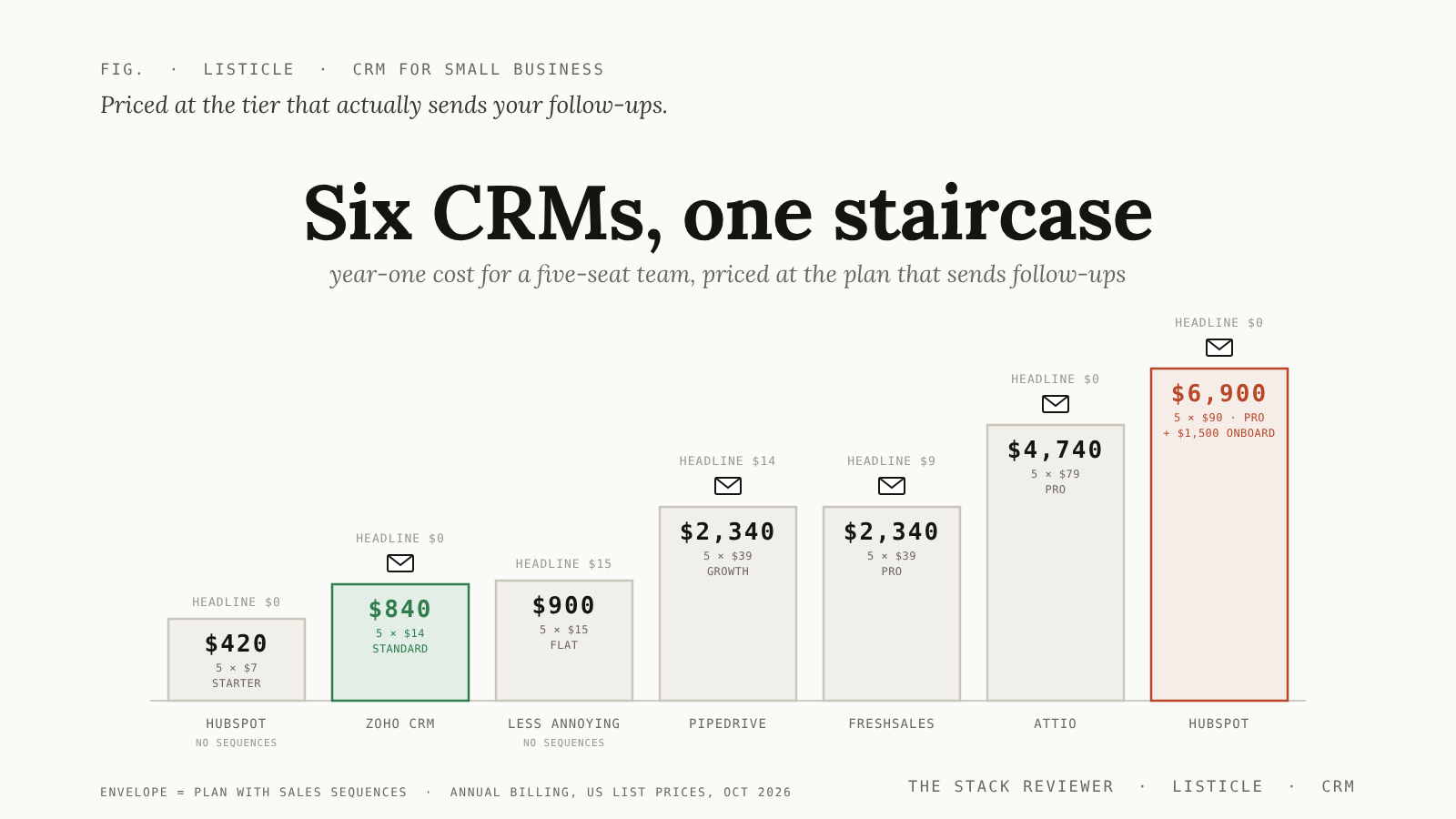
The best CRM for small business is Pipedrive if you have a sales team of three or more, HubSpot Free if you’re one or two people, and Less Annoying CRM if all you want is a clean place to keep contacts and notes. Everything else on this list wins only in a narrower situation, which we’ve spelled out for each one.
Here is the part the other “best CRM” lists skip. They quote the headline price: $9 a seat, $14 a seat, free. Then they rank the tools by features. But the headline price is almost never the price of the plan that sends your follow-ups for you, and automated follow-up is the reason most small teams buy a CRM in the first place. We priced the plan that does that, for 2, 5 and 10 seats, and the ranking changes.
Quick verdict. Pipedrive for a sales team of 3 to 15. HubSpot Free for a founder plus one. Attio if your team lives in a modern, spreadsheet-like tool and sells to companies rather than people. Freshsales if you want Pipedrive’s price with more built-in phone and chat. Less Annoying CRM if you want zero automation and zero surprises. Zoho CRM if price matters more than polish: it has the cheapest plan with real follow-up sequences we found. Prices below were read from vendor pricing pages on 14 October 2026.
At a glance
| CRM | Free plan | Cheapest plan with follow-up automation | Price per seat/mo (annual billing) | Best for |
|---|---|---|---|---|
| Pipedrive | No (14-day trial) | Growth | $39 | Sales teams of 3 to 15 |
| HubSpot | Yes, 2 users | Starter (light) / Professional (full) | $7 / $90 + $1,500 onboarding | Founder plus one; marketing and sales sharing data |
| Freshsales | 21-day trial | Pro (sequences) | $39 | Teams that want phone and chat in the CRM |
| Attio | Yes, 3 seats | Pro (sequences); Plus has workflows only | $79 | Teams selling to companies who like modern tools |
| Less Annoying CRM | 30-day trial | None (no sequences listed) | $15 flat, all features | Teams that want a simple contact system |
| Zoho CRM | Yes, 3 users | Standard (cadences) | $14 | Tight budgets; teams already in Zoho |
How we priced this (and what we didn’t test)
Two rules, held for every tool on this page:
- We priced the tier where follow-up automation lives, not the tier on the pricing page’s headline. If a vendor hides email sync or sequences one plan up, that plan is the price.
- Year-one cost includes one-time fees. A required onboarding fee is part of the price of the software.
And one honest limit: this page is built from the vendors’ own pricing pages, which we read on 14 October 2026, and from the public feature lists on those pages. We have not run a 90-day trial of all six products side by side, and we won’t pretend to. Where a number or a feature is something we could not confirm, we say so in the text. Where a pricing page shows the gate clearly, we’ve included a screenshot of it.
The real cost of a CRM, at three team sizes
Every number here is per year, billed annually, list price, before tax. We used the cheapest plan on each product that includes email sync and automated follow-up. “Light” means the plan has workflow automation but no sales sequences, according to the vendor’s own pricing page.
Two seats: a founder and one other person
| CRM | Plan | Year one |
|---|---|---|
| HubSpot | Sales Hub Free | $0 |
| Zoho CRM | Free (3 users) | $0 |
| Attio | Free (3 seats) | $0 |
| Freshsales | Growth (2 x $9) | $216 |
| Less Annoying CRM | 2 x $15 | $360 |
| Pipedrive | Growth (2 x $39) | $936 |
At two seats, free beats everything and it isn’t close. Skip the rest of this section if that’s you.
Five seats: a real sales team
| CRM | Plan | Year one |
|---|---|---|
| HubSpot | Sales Hub Starter (5 x $7) | $420 (light) |
| Zoho CRM | Standard, with cadences (5 x $14) | $840 |
| Less Annoying CRM | 5 x $15 | $900 (no automation) |
| Attio | Plus (5 x $35) | $2,100 (light) |
| Pipedrive | Growth (5 x $39) | $2,340 |
| Freshsales | Pro (5 x $39) | $2,340 |
| Attio | Pro, with sequences (5 x $79) | $4,740 |
| HubSpot | Sales Hub Professional (5 x $90) + $1,500 onboarding | $6,900 |
This is the table the other lists don’t have. Look at the spread: the same five people, the same job, a 16x difference between the cheapest and the dearest option. HubSpot appears at both ends, and that’s not a mistake. Its Starter plan is cheap and its Professional plan is not, and the ladder between them is where small teams get hurt. Attio appears twice for the same reason: its Plus plan runs workflows, but sequences start at Pro.
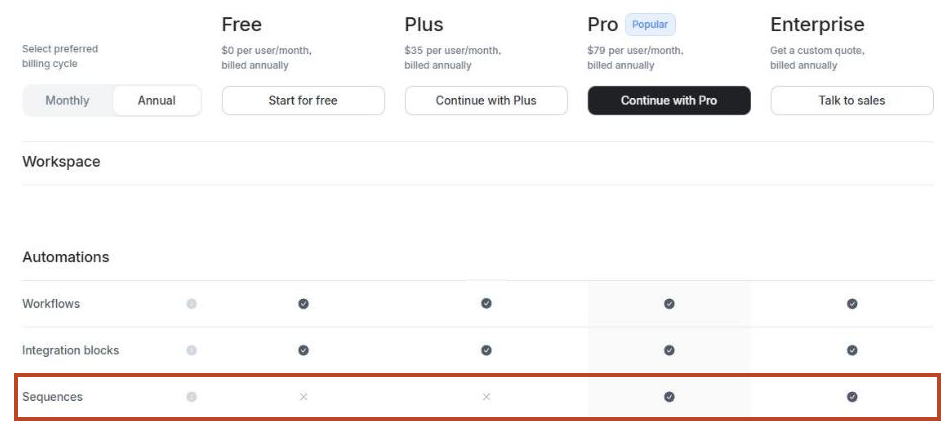 Attio’s own comparison table, read 14 October 2026. Sequences are not on Plus.
Ten seats: a team with a manager who wants reports
| CRM | Plan | Year one |
|---|---|---|
| HubSpot | Sales Hub Starter (10 x $7) | $840 (light) |
| Zoho CRM | Standard, with cadences and forecasting (10 x $14) | $1,680 |
| Less Annoying CRM | 10 x $15 | $1,800 |
| Attio | Plus (10 x $35, the seat cap on that plan) | $4,200 (light) |
| Pipedrive | Growth (10 x $39) | $4,680 |
| Freshsales | Pro (10 x $39) | $4,680 |
| Pipedrive | Premium, with lead routing (10 x $59) | $7,080 |
| Freshsales | Enterprise, with forecasting (10 x $59) | $7,080 |
| Attio | Pro (10 x $79) | $9,480 |
| HubSpot | Sales Hub Professional (10 x $90) + $1,500 onboarding | $12,300 |
Notice what happens when a manager asks for lead routing or forecasting. Pipedrive Premium, Freshsales Enterprise and Attio Pro each cost between $7,000 and $9,500 at ten seats. Zoho Standard lists sales forecasting at $14 a seat, which is why it sits so low in this table. HubSpot Professional costs $12,300 in year one. For the full head-to-head on the two most-searched names, see our HubSpot vs Pipedrive comparison.
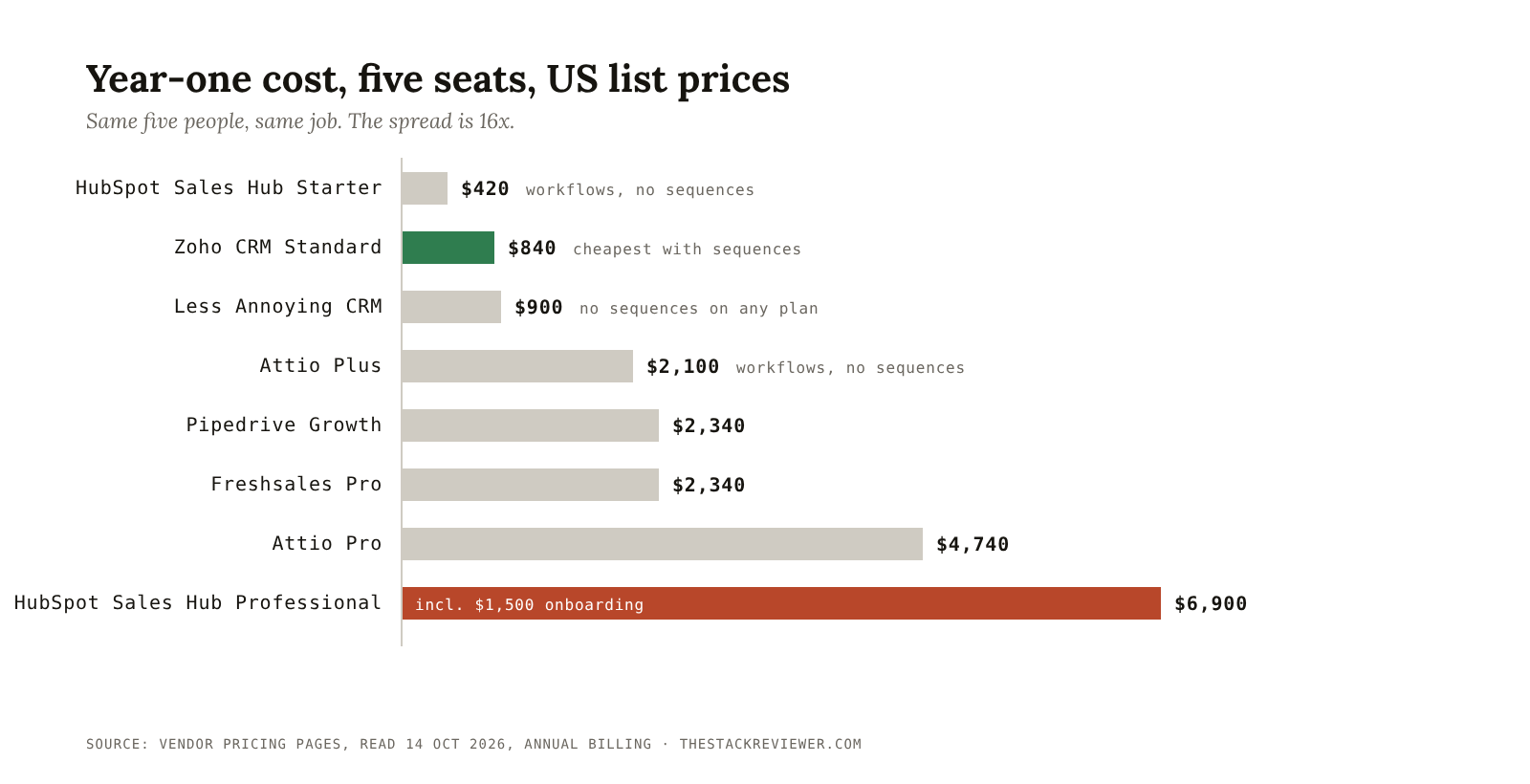 Same five people, same job. Annual billing, list prices, 14 October 2026.
The six CRMs, ranked
1. Pipedrive: best for a sales team of 3 to 15
Pipedrive is a board with deals on it. That sounds like faint praise, but it’s the entire reason it wins: reps who resent CRMs resent this one less, and a CRM nobody updates is worse than a spreadsheet somebody does.
What it costs: Lite is $14 a seat, Growth is $39, Premium is $59 and Ultimate is $79, all per month billed annually. Lite has no email sync and no automations. Both start at Growth. So the real entry price for a team that needs follow-ups is $39, not $14. Lead routing starts at Premium.
Why we rank it first: no mandatory onboarding fee, published pricing on every tier, and a team can import a spreadsheet and be working real deals inside a week.
Skip Pipedrive if marketing attribution is a number somebody gets asked about in a board meeting. You can wire it up with integrations, but HubSpot does it natively because it’s one database. Also skip it if you need a free plan. There isn’t one.
2. HubSpot: best free CRM, and the most expensive paid one
HubSpot Free is the best free CRM on the market. It’s capped at two users, it doesn’t expire, and it does real work. If you’re a founder plus one, open a free account and stop reading.
The trouble starts when you hire. Starter is $7 a seat billed annually ($20 monthly), and from the pricing page it includes workflows, 500 calling minutes and 500 HubSpot Credits. That’s a fair plan. Professional is $90 a seat billed annually ($100 monthly) and carries a required, one-time $1,500 onboarding fee. Enterprise is $150 a seat with a $3,500 onboarding fee. Neither fee is optional.
The AI features run on credits at $0.010 each. Those credits reset monthly and unused ones do not roll over. If AI drafting is part of how your reps work, the included allowance is a starting balance, not a budget.
Skip HubSpot if you’re buying it only to run a sales pipeline and you’re going to need more than two users. You’ll pay platform prices and use a third of the platform. If you’re going to be on a paid tier, price Starter and Professional both before you commit, because the gap between them is where the budget disappears.
3. Freshsales: best Pipedrive alternative with phone and chat built in
Freshsales is Freshworks’ sales CRM. Its Growth plan is $9 per seat per month billed annually and includes a Kanban view, lifecycle stages, email templates and basic workflows. Sales sequences, contact scoring, deal insights and territory management start at Pro, $39. Forecasting and field-level permissions start at Enterprise, $59. Freddy AI Agent is an add-on at $49 per 100 sessions on every tier, and branded documents are $19 a seat on top.
In plain terms: if you want sequences, you’re paying the same $39 as Pipedrive Growth, and the question becomes which interface your reps will open on Monday morning.
Our read: Freshsales is the pick when your reps spend more time on calls and chat than on email, because that’s where it’s strongest. The pricing page doesn’t state a permanent free plan, only a 21-day trial, so we’ve listed it as trial-only.
Skip Freshsales if you’d mostly be buying it for the $9 headline. At that price you get a tidy contact manager with light workflows. The sequences and scoring you probably wanted are $30 a seat higher.
4. Attio: best for teams that sell to companies and like modern tools
Attio looks and behaves like a spreadsheet crossed with a database, and you shape it to your sales process instead of adapting to someone else’s. It has a genuine free plan (up to 3 seats, 50,000 records, 3 objects, 200 outbound emails a month, up to 3 reports). Plus is $35 per seat per month billed annually ($44 monthly), capped at 10 seats and 250,000 records. It includes workflows, but not sequences. Those start at Pro, $79 annual ($99 monthly), along with unlimited seats, 1,000,000 records, 12 objects, call intelligence and advanced reporting. So the Attio price for automated follow-up is $79, not $35.
Mind the Plus seat cap too. A ten-seat team fits on Plus today; an eleventh hire pushes everyone to Pro at $79, which is a jump from $4,200 to $10,428 a year for those eleven people.
Skip Attio if your team of reps wants something they can learn in an afternoon. Flexible tools ask for setup time, and the people who like configuring a CRM are rarely the people who have to use it every day.
5. Less Annoying CRM: best for people who want no automation at all
One plan. $15 per user per month, flat. Unlimited contacts, unlimited companies, unlimited pipelines, task management, email logging, mobile access, user permissions and free upgrades. A 30-day trial with no credit card.
The pricing page lists no sequences or workflow automation, so assume you’ll be sending your own follow-ups. For a five-person team that’s $900 a year with no tiers to climb and no onboarding fee. That predictability is the whole product.
Skip Less Annoying CRM if automated follow-up or lead routing is why you’re shopping. It isn’t built for that, and it doesn’t claim to be.
6. Zoho CRM: the cheapest real follow-up automation, if you can live with the menus
Zoho CRM has a free plan for up to 3 users with contact management, workflow automation, follow-up reminders, up to 10 custom email templates, standard reports and 5,000 API calls a day. That’s more automation on a free tier than HubSpot or Pipedrive offer, but the free plan doesn’t list cadences, Zoho’s name for sales sequences.
The paid tiers are where Zoho gets interesting. Standard is $14 per user per month billed annually and lists workflows and assignment rules, cadences, reports and dashboards, and sales forecasting. Professional is $23 and adds CPQ, email intelligence and process automation. Enterprise is $40 and Ultimate $52. That makes Standard the cheapest plan on this page with real automated follow-up: $840 a year for five people, against $2,340 for Pipedrive Growth.
Two honest caveats. Zoho prices by region: the dollar figures above are what its pricing page showed us in US dollars, and the same page shows rupees to visitors in India, so check the price for your billing country. And cheap comes with a learning curve. Zoho does a lot, and it shows, in menus.
Skip Zoho CRM if you want a tool where the first hour is obvious, or your reps have already rejected one complicated CRM. Pipedrive costs more and is easier to get a team to actually use.
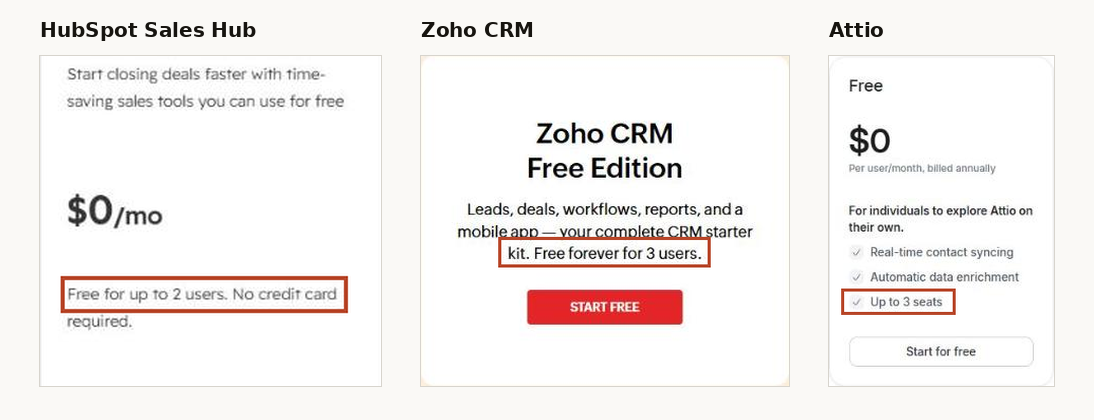 Every free CRM has a ceiling. The only question is whether it’s two people or three. From each vendor’s pricing page, 14 October 2026.
What they don’t tell you
The cliff isn’t the price. It’s the feature gate. Every lowest-priced plan on this page stops one step short of the thing you bought a CRM for.
- Pipedrive Lite ($14) has no email sync and no automations. Growth ($39) has both.
- Freshsales Growth ($9) has basic workflows. Sequences and scoring start at Pro ($39).
- HubSpot Free stops at two users. Starter ($7) is cheap but the next rung, Professional, is $90 plus $1,500.
- Attio Plus ($35) has workflows but no sequences, and stops at 10 seats. Sequences start at Pro ($79).
- Zoho CRM Free stops at 3 users and doesn’t list cadences. Standard ($14) does.
Read down that list and one pattern shows up: the price of the tier you’ll actually be on is usually 3 to 5 times the headline price (and 13 times at HubSpot, $7 to $90), except at the two vendors who skip the staircase entirely (Less Annoying CRM, with one price, and HubSpot Free, with one very visible wall).
That’s why “cheapest CRM” lists mislead. They rank the sticker. You should rank the tier your team will be on after the first quarter of use.
A second thing: the CRM you pick is a switching cost, not a subscription. Contacts and deals export cleanly from every product on this page. What doesn’t move is workflows, sequences, reports and anything marketing built on top of the contact record. If you expect your CRM and your marketing tools to share data, read our email marketing guide before you pick, because that decision interacts with this one.
Pricing reality check: what each CRM costs at five seats over three years
Annual billing, list price, no add-ons, no tax. Includes one-time fees.
| CRM and plan | Year 1 | Year 2 | Year 3 | 3-year total |
|---|---|---|---|---|
| HubSpot Starter (light) | $420 | $420 | $420 | $1,260 |
| Zoho CRM Standard | $840 | $840 | $840 | $2,520 |
| Less Annoying CRM | $900 | $900 | $900 | $2,700 |
| Attio Plus (light) | $2,100 | $2,100 | $2,100 | $6,300 |
| Pipedrive Growth | $2,340 | $2,340 | $2,340 | $7,020 |
| Freshsales Pro | $2,340 | $2,340 | $2,340 | $7,020 |
| Attio Pro | $4,740 | $4,740 | $4,740 | $14,220 |
| HubSpot Professional | $6,900 | $5,400 | $5,400 | $17,700 |
The gap between Pipedrive Growth and HubSpot Professional over three years, for five people, is $10,680. The gap between HubSpot Starter and HubSpot Professional is $16,440. Same company, same product family. That second number is the one to stare at before you click “start free.”
Add-ons change this: Pipedrive sells extras like LeadBooster and Smart Docs separately, Freshsales sells Freddy AI and branded documents, and HubSpot meters AI by credit. Budget for at least one add-on if you plan to use them.
Which one should you pick? A decision tree
Answer in order and stop at the first yes.
- Are you two people or fewer, and staying that way this year? HubSpot Free.
- Are you exactly three, and want a free tool? Zoho CRM Free or Attio Free. Pick Attio if you like clean modern tools and Zoho if you want more built-in automation and a cheap paid tier to grow into.
- Do you want no automation and one predictable price? Less Annoying CRM.
- Does marketing report which campaign produced which closed deal, and does leadership look at it? HubSpot Professional. Budget the $1,500.
- Do your reps live on calls and chat more than email? Freshsales Pro.
- Do you sell to companies, and does your team enjoy configuring tools? Attio. Plus if workflows are enough, Pro if you need sequences, and watch the 10-seat cap on Plus.
- Is budget the deciding factor, and can your team handle a busier interface? Zoho CRM Standard.
- Otherwise: a sales team that sells, follows up and reports to a manager? Pipedrive Growth. Move to Premium when someone asks for lead routing.
If you’re still unsure, start a Pipedrive trial. It’s easier to outgrow Pipedrive and move up than to discover in month eight that you’re paying $6,900 for a pipeline.
Who shouldn’t buy a CRM at all (yet)
A spreadsheet is fine while one person owns every deal and you have fewer than about 30 active ones. You need a CRM when two people touch the same contact, when follow-ups slip because nobody was reminded, or when someone asks for a forecast and the answer is “let me scroll.”
If your real problem is newsletters, not sales follow-up, you want an email platform, not a CRM. Start with the best free email marketing tools. And if your problem is getting found in the first place, that’s a different stack: our SEO tools for small business guide is where to begin.
Bottom line
Pipedrive is the best CRM for most small sales teams. HubSpot Free is the best CRM for a founder plus one. Everything else is a specific answer to a specific situation. The thing to do before you buy anything is price the plan that includes follow-up automation for your team size, not the headline price. For five people, that exercise swings the bill from $420 to $6,900 a year, and the cheapest plan with real sequences is $840.
If you take one habit away from this page, make it this: when a vendor shows you a price, ask what tier it takes to send an automated follow-up. That’s the real price.
All pricing was read from vendors’ own pricing pages on 14 October 2026: Pipedrive, HubSpot Sales Hub, Freshsales, Attio, Less Annoying CRM and Zoho CRM. Vendors change prices without notice, and we check every price on this page every 60 days. If you’re reading this later, check before you budget.
Read next: HubSpot vs Pipedrive for the head-to-head, the email marketing software guide for what to pair with your CRM, and best free email marketing tools if budget is the constraint.
Frequently asked questions
What is the best CRM for a small business?
For a sales team of three to fifteen people, Pipedrive. It is a pipeline with fields attached, a team can run real deals inside a week, and the plan that includes email sync and automations (Growth) is $39 per seat per month billed annually. For one or two people, HubSpot's free CRM. For a team that wants a plain, cheap contact database with no automation, Less Annoying CRM at a flat $15 per user. Prices read from each vendor's pricing page on 14 October 2026.
What is the best free CRM for a small business?
HubSpot Free if you are one or two people, because it is the most complete free product. Zoho CRM Free and Attio Free both allow three users, which matters if you are a team of three. Every free plan has a hard seat cap, so the free CRM you pick is the one you will outgrow on your third or fourth hire.
How much does a CRM cost for a small business?
At five seats, the range we found was $420 a year (HubSpot Sales Hub Starter at $7 per seat, workflows but no sequences) to $6,900 in year one (HubSpot Sales Hub Professional at $90 per seat plus a required $1,500 one-time onboarding fee). The cheapest plan with real follow-up sequences was Zoho CRM Standard at $840 a year. Pipedrive Growth and Freshsales Pro both land at $2,340, and Attio Pro, where Attio's sequences start, is $4,740.
Do I need a CRM or is a spreadsheet enough?
A spreadsheet is enough while one person owns every deal and you have fewer than about 30 active ones. You need a CRM when two people touch the same contact, when follow-ups slip because nobody was reminded, or when someone asks for a forecast and you answer by scrolling.
Which CRM has the best free plan?
HubSpot's, for features, and Attio's and Zoho's for seat count. HubSpot Free is capped at two users. Zoho CRM Free and Attio Free allow three. Attio Free also caps outbound email at 200 a month and reports at three.
Should my CRM also be my email marketing tool?
Usually not. Most small teams are better off with a CRM for one-to-one sales follow-up and a separate email platform for newsletters and campaigns. The exception is when marketing attribution (which campaign produced which closed deal) is a number someone is asked about, and then HubSpot's single database is the argument for paying more.
The marketing tech rundown.
One short email a week. Honest takes on the tools we tested, what's worth your money, and what to skip. No fluff.
Free. Unsubscribe anytime.