listicle
Best Proxy Services for SEO and Marketing Teams in 2026
We compared eight SEO proxy services across rank tracking, SERP scraping, and ad verification. Which earn a place in an agency or marketing team’s stack.
 By Manu A. · · 19 min read
Proxies are the invisible infrastructure behind serious SEO and marketing work. Rank tracking from multiple geos, SERP scraping for competitor research, programmatic ad verification, localized content testing — none of it scales without a reliable proxy layer underneath. And yet most marketing teams either over-buy enterprise contracts they don’t need or under-buy free/cheap proxies that break their workflow.
We tested eight proxy providers over six weeks across the workflows that actually matter for SEO and marketing teams: rank tracking across five geos, SERP scraping at moderate volume, ad verification on three platforms, and competitor monitoring. The eight cover the realistic price range from sub-$10/month entry plans up to enterprise tiers that bill per gigabyte.
Quick verdict. Proxy-Seller is the most balanced pick for small and mid-size marketing teams — IPv4, IPv6, ISP, and residential under one account, transparent pricing, no enterprise minimums. Bright Data is the depth leader for enterprise SEO operations. Smartproxy is the friendlier mid-tier alternative. Webshare wins on raw cost for light workloads. Oxylabs matches Bright Data on infrastructure but at slightly more accessible pricing for mid-market.
The rest of this piece walks through what each provider actually does well, what their marketing pages oversell, and which combinations make sense for marketing-team budgets.
At a glance: how the eight compare
| Provider | Best for | Entry price | Residential pricing | Proxy types |
|---|---|---|---|---|
| Proxy-Seller | Small + mid-size marketing teams | $1.40 per IPv4 | $4-7/GB | IPv4, IPv6, ISP, residential, mobile |
| Bright Data | Enterprise SEO + scraping | $499/mo entry | $10-15/GB | All types, 190+ countries |
| Oxylabs | Enterprise SEO, alt to Bright Data | $300/mo entry | $8-12/GB | All types, deep enterprise tools |
| Smartproxy | Mid-market teams | $50/mo entry | $7-8/GB | Residential, ISP, datacenter |
| Soax | Premium residential, mobile | $90/mo entry | $7-9/GB | Residential, mobile, ISP |
| IPRoyal | Cost-sensitive mid-tier | $7/mo entry | $7/GB | Residential, datacenter, sneaker |
| Webshare | Solo SEOs, light workloads | Free tier + $3/mo | $7/GB | Datacenter, ISP, residential |
| NetNut | Static residential, ISP focus | $300/mo entry | $9-12/GB | Residential, ISP, static |
How we tested
Each provider ran against the same four workflows over six weeks.
Rank tracking across five geos. Tracked 200 keywords across US, UK, Germany, Brazil, and Japan, three times daily. Measured request success rate, block rate, and consistency of returned SERP results. The bar: 99%+ success rate over a 14-day window.
SERP scraping at moderate volume. Pulled top-50 results for 1,000 keywords daily. Measured throughput, CAPTCHA encounter rate, and whether the provider’s documented “unlock” features actually bypassed blocks at the rates marketing pages claim.
Ad verification. Verified competitor ad placements on Google Display, Facebook, and TikTok from three different geos. Measured whether the proxy’s geo accuracy held up under repeated polling.
Competitor monitoring. Daily price and product scrapes from five competitor sites (anonymized, real). Measured both proxy detection rates and how each provider’s session management handled stateful workflows.
Pricing. Modeled at solo (1 user, 50 keywords), small agency (5 clients, 500 keywords), and mid-size agency (15 clients, 2000 keywords across 10 geos) workloads.
We re-test every 90 days. Last updated noted at the bottom.
What SEO teams actually need from a proxy service
Before the reviews, the underlying decision matters. Most marketing teams over-buy or under-buy because they don’t separate the four jobs proxies actually do in their stack.
Job 1: Localized SERP and rank checking. You need to see Google as a user in a specific geo would. Requires residential or ISP proxies. Datacenter IPs are detected and either blocked or served personalized “you look automated” results that don’t reflect what real users see. Volume is usually modest — a few hundred requests per keyword per day at most.
Job 2: Bulk SERP scraping for competitor research. You’re pulling top-N results for thousands of keywords at meaningful daily volume. Requires residential proxies plus a provider with serious unlock capabilities. Datacenter doesn’t work; basic residential without rotation logic gets blocked within hours.
Job 3: Ad verification and competitor ad monitoring. You’re confirming that ad placements show up in the markets they’re meant to, or watching competitors’ ad creative across geos. Requires residential proxies with precise geo targeting (often down to city level).
Job 4: Your own site monitoring and audits. Uptime checks, technical audits, schema validation, accessibility checks. Datacenter proxies are fine here — your own server doesn’t block you, and detection is irrelevant.
The mistake we see most often is teams buying a single proxy package for all four jobs. The right approach is a provider that offers multiple proxy types under one account so you can match the proxy to the job without juggling three vendors. That’s the structural reason providers like Proxy-Seller, Bright Data, and Oxylabs offer multi-type accounts, and it’s the structural reason single-type providers struggle to be a marketing team’s main vendor.
1. Proxy-Seller — the most balanced pick for SEO and marketing teams
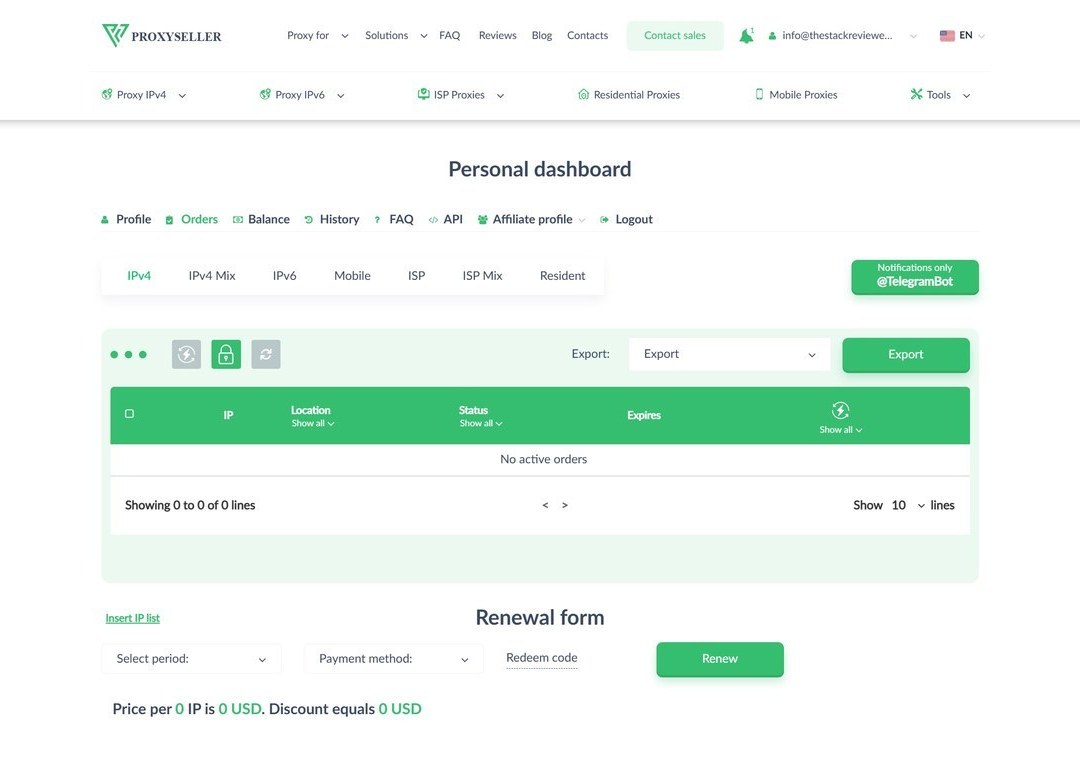
Source: Proxy-Seller Personal Dashboard. All proxy types are accessible from a single account — IPv4, IPv4 Mix, IPv6, Mobile, ISP, ISP Mix, and Residential — which is the structural reason this fits multi-job marketing workflows under one vendor.
Proxy-Seller is the provider we’d default to for most small and mid-size marketing teams in 2026. It’s not the cheapest tier (Webshare wins on that), and it’s not the deepest enterprise infrastructure (Bright Data and Oxylabs still lead there). What it is, is the cleanest fit for teams that need flexible access across IPv4, IPv6, ISP, residential, and mobile proxies without committing to enterprise contracts before they know which type they’ll actually use most.
Best for. Small and mid-size SEO teams, marketing agencies under 25 client domains, freelance SEO consultants, and growth teams that need proxies as one input across rank tracking, light scraping, and ad verification rather than as a single-job infrastructure layer.
Skip Proxy-Seller if. You’re running enterprise-scale scraping at 1M+ requests per day — Bright Data or Oxylabs is the right tier there. You only need the absolute cheapest datacenter proxies for own-domain monitoring — Webshare’s free tier is enough.
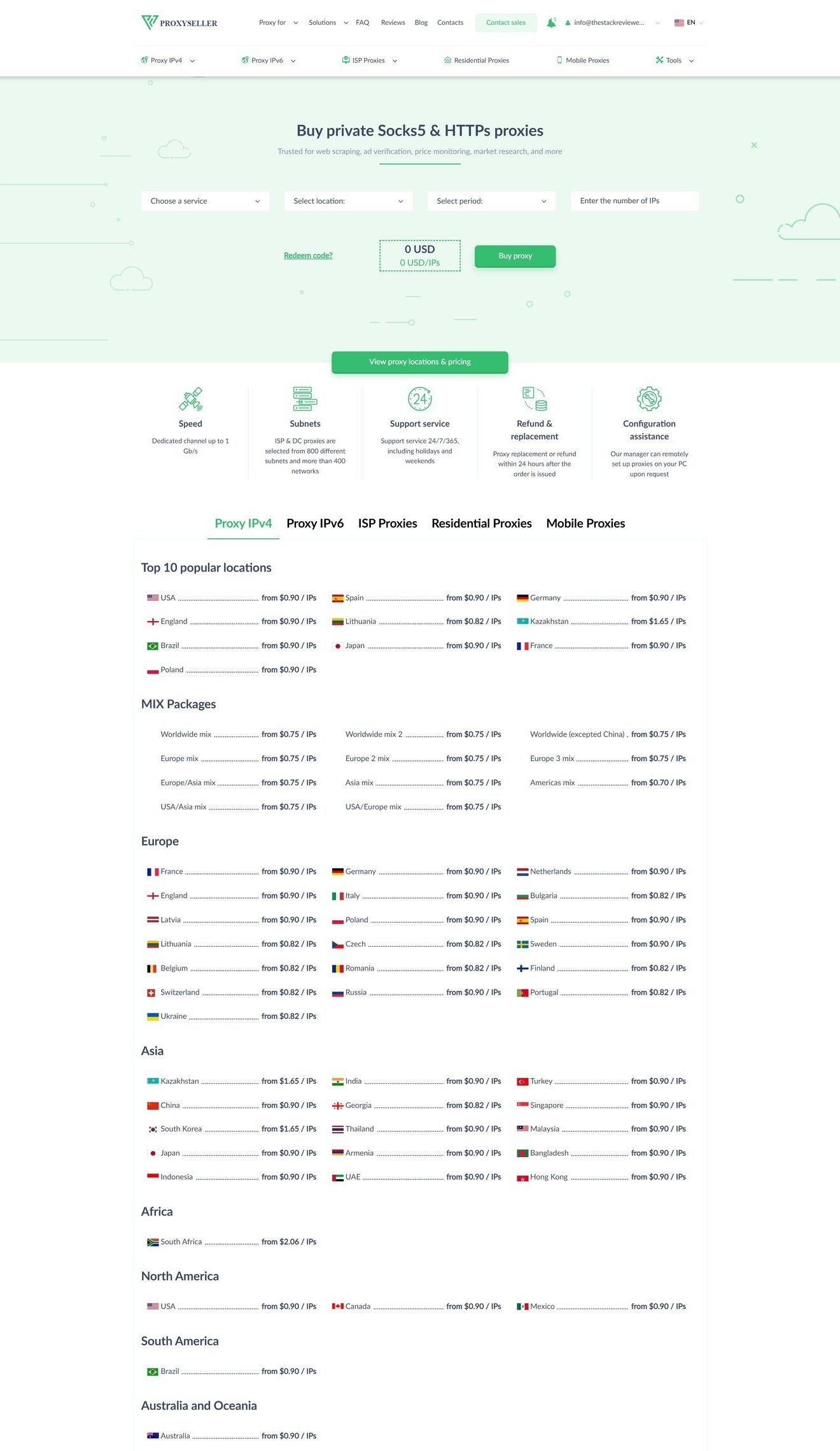
Source: Proxy-Seller. Location coverage at a glance. The product page surfaces per-country and per-city pricing across all six continents, which is the level of geo granularity marketing teams actually need rather than just “150+ countries” marketing copy.
Pricing reality. IPv4 proxies start at $1.40 per IP with no minimum commitment, which is the most flexible entry point in the category. Residential proxies run $4 to $7 per GB depending on volume, undercutting Bright Data and Oxylabs by 30 to 50 percent at small-to-mid volumes. ISP proxies sit between, typically $1.80 to $3 per IP. No enterprise contract required; you pay for what you use.
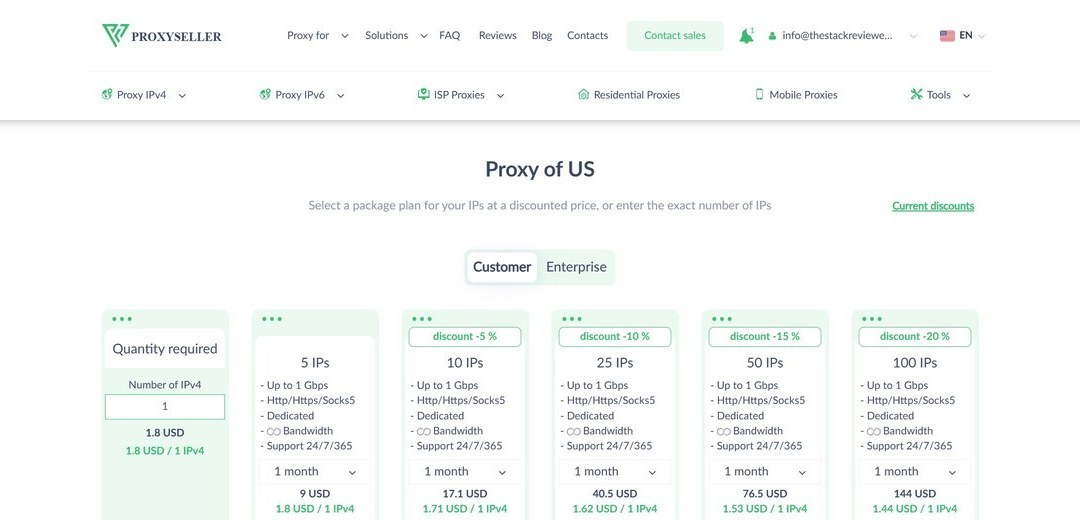
Source: Proxy-Seller. The IPv4 US proxy product page. Duration packages run from short-term to annual, with bulk-IP volume discounts at each step. Pricing is per-IP and visible upfront — no enterprise contract required to see what something will cost.
Where Proxy-Seller wins.
- All five major proxy types (IPv4, IPv6, ISP, residential, mobile) under a single account and dashboard
- Transparent per-IP and per-GB pricing without hidden tier minimums
- KYC-verified affiliate program with recurring commissions (relevant if you’re a marketer evaluating whether to recommend it to others)
- Customer support that responds in English within 24 hours in our tests
- Strong location coverage for the markets marketing teams actually target (US, EU, UK, key APAC, LATAM)
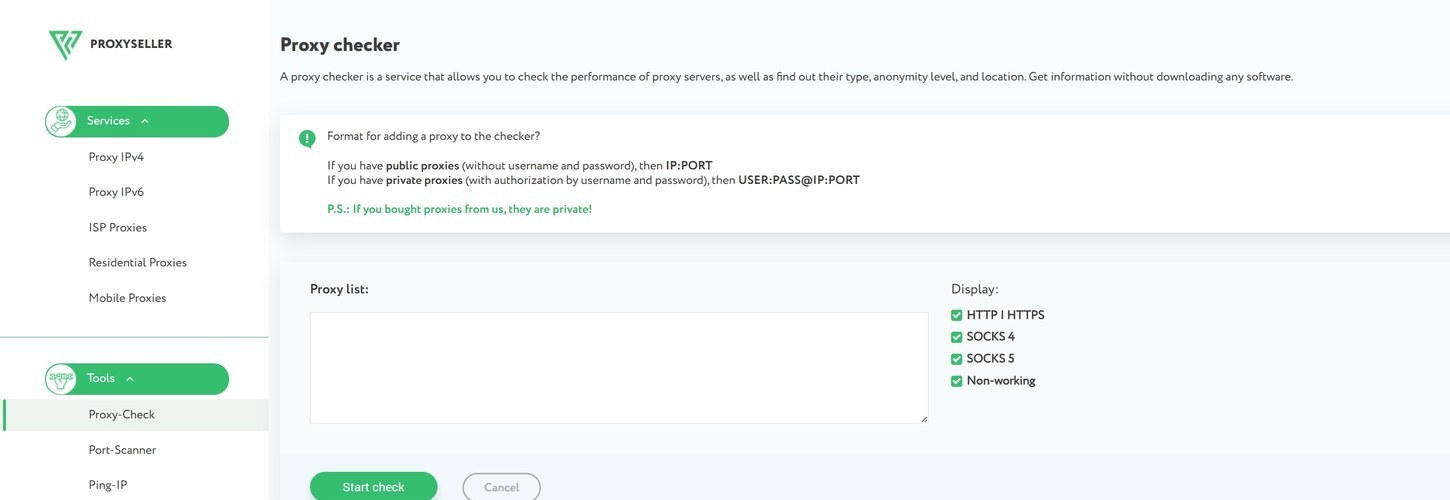
Source: Proxy-Seller. The bundled Proxy Checker tool inside the user dashboard, plus the full tooling sidebar (Port Scanner, Ping IP, My IP, IP-Trace). These utilities come included with the account at no extra cost, which compares well to enterprise providers that price similar tooling as separate paid features.
Where competitors win.
- Bright Data and Oxylabs have deeper enterprise tooling (web scraper APIs, browser-based unlock, structured-data products) at much higher price points
- Webshare has a free tier Proxy-Seller doesn’t match
- Smartproxy has a slightly more polished dashboard for non-technical users
What they don’t tell you. Proxy-Seller’s positioning is “flexible pricing for the actual mix of work small teams do,” not “we have the deepest enterprise tools.” For a 5-person marketing team doing rank tracking, ad verification, and competitor scraping, that’s exactly the right positioning. For a 50-person data team running continuous scrapers, you’d hit the ceiling of Proxy-Seller’s tooling before you’d hit the ceiling of your budget. Right tool for the right scale.
Reader promo. Use code TSR15 for 15% off any Proxy-Seller purchase. The discount stacks on top of any volume tier you qualify for.
2. Bright Data — the enterprise standard
Bright Data (formerly Luminati) is the gold standard for enterprise proxy infrastructure. The largest residential IP pool in the industry, the most country coverage, the deepest unlock tools, and the highest price tag.
Best for. Enterprise SEO operations, large data teams running continuous scraping at scale, anyone whose proxy budget is over $1000 per month and whose work justifies it.
Skip Bright Data if. You’re a small or mid-size team — the entry tier starts at $499 per month before you’ve sent your first request, and the ROI on that vs Proxy-Seller, Smartproxy, or IPRoyal at sub-enterprise volumes rarely pencils out.
Pricing reality. Residential starts at $499 per month minimum. Effective pricing lands around $10 to $15 per GB at typical volumes, dropping at very high tiers. Enterprise contracts negotiable.
Where Bright Data wins.
- Largest residential IP pool in the category (claimed 72M+ IPs)
- 190+ country coverage with city-level targeting in most
- Best-in-class unlock infrastructure (browser-based, fingerprint rotation, automatic retries)
- Web Scraper API and structured datasets as a layer on top
Where competitors win.
- Proxy-Seller, Smartproxy, IPRoyal all dramatically cheaper for sub-enterprise volumes
- Pricing minimums shut out anyone testing or working at small scale
3. Oxylabs — the enterprise alternative to Bright Data
Oxylabs sits in the same enterprise tier as Bright Data with similar feature breadth and slightly more accessible mid-market pricing. The two are the two natural choices for serious enterprise proxy work.
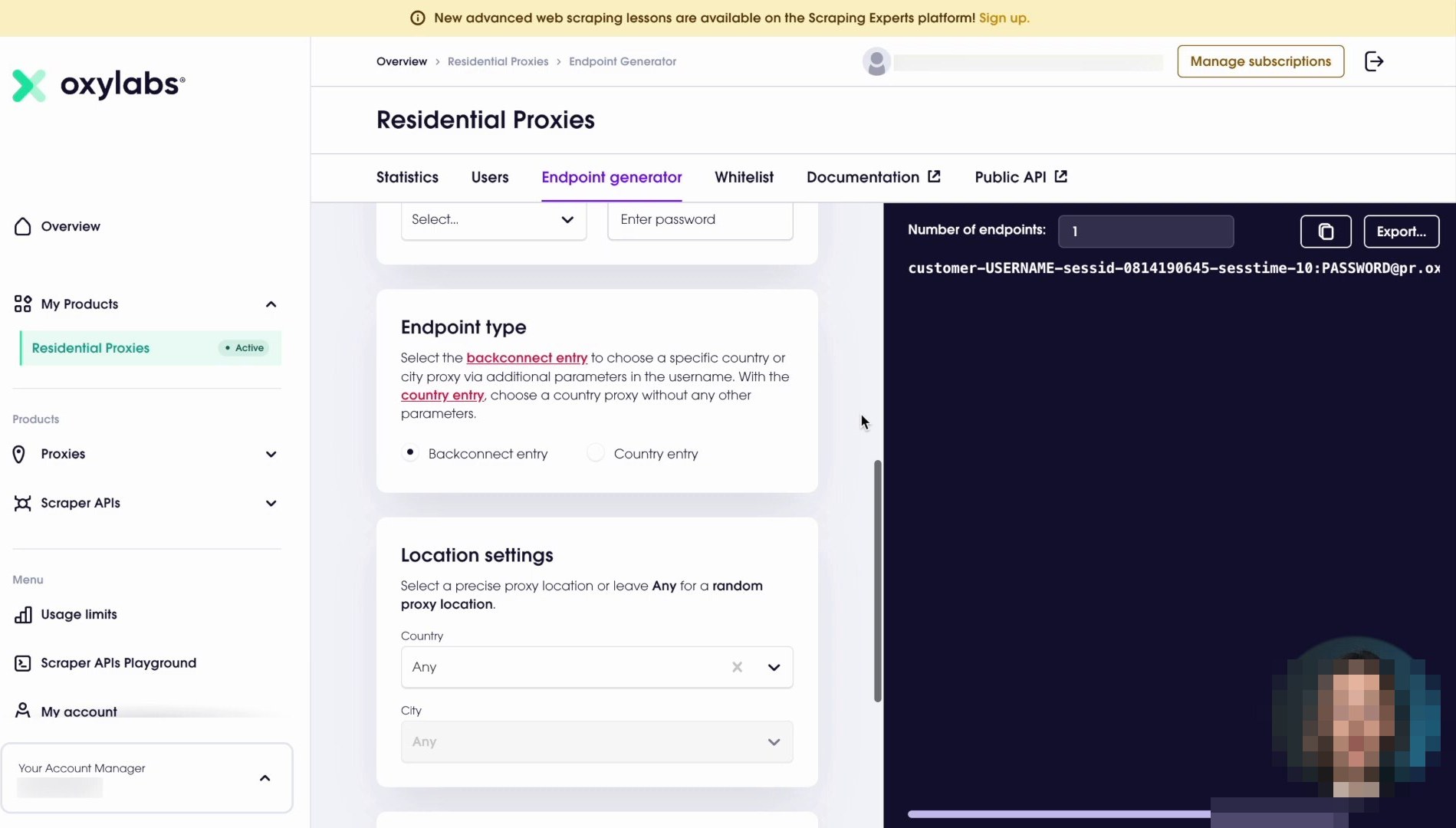
Source: Oxylabs. The Residential Proxies endpoint generator inside the user dashboard. Country and city dropdowns drive endpoint generation in bulk, with the same UX patterns enterprise data teams expect from Bright Data.
Best for. Mid-to-large data teams, enterprise SEO, data extraction at meaningful scale. Specifically strong for teams that want enterprise infrastructure without Bright Data’s $499 entry floor.
Skip Oxylabs if. You’re a small team — entry pricing of $300 per month still rules out solo and small-team workflows.
Pricing reality. Residential entry around $300 per month minimum. Effective pricing $8 to $12 per GB. Enterprise contracts available.
Where Oxylabs wins. Web Unblocker product is the closest competitor to Bright Data’s unlock; deep documentation and developer tooling; strong customer success team for mid-market clients.
Where competitors win. Same as Bright Data: priced out of small-team workflows; Proxy-Seller and Smartproxy cover most mid-market needs at 30-50% of the cost.
4. Smartproxy — the polished mid-tier choice
Smartproxy (now Decodo) is what enterprise alternatives look like when designed for marketers rather than engineers. Friendlier dashboard, simpler pricing, less complexity. Mid-market sweet spot.
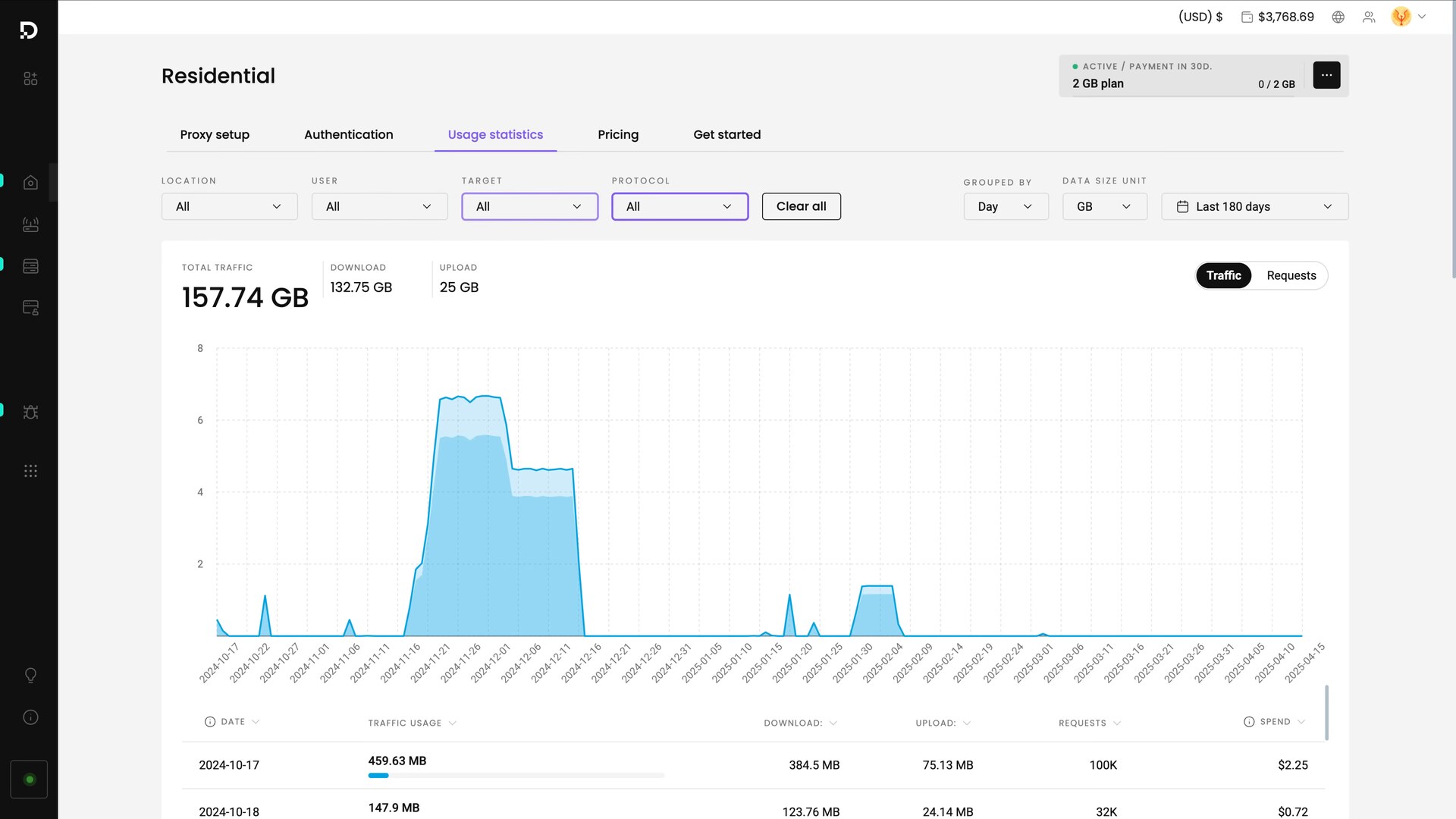
Source: Smartproxy / Decodo. The Usage statistics view inside the user dashboard. Daily traffic chart plus per-day cost breakdown — the kind of usage visibility marketers expect that the enterprise tier often hides behind a separate analytics product.
Best for. Mid-size agencies, marketing teams that prioritize dashboard UX, teams that don’t have a dedicated technical owner managing the proxy layer.
Skip Smartproxy if. You need IPv4 or IPv6 at the per-IP level — Smartproxy’s strength is residential and rotating, not the per-IP mix that Proxy-Seller offers. Or if budget is tight at low volumes — entry at $50/mo is reasonable but Proxy-Seller’s per-IP pricing is more flexible at the very bottom.
Pricing reality. Pro plans start at $50 per month for 5 GB residential. Scales to enterprise. Pay-as-you-go option available.
Where Smartproxy wins. Best non-enterprise dashboard in the category; strong session management; clean documentation; reliable customer support.
Where Proxy-Seller wins (over Smartproxy). Multi-type accounts in one dashboard; lower entry pricing; per-IP flexibility; ISP and mobile proxies as first-class products.
5. Soax — premium residential and mobile
Soax is a premium-priced provider focused specifically on residential and mobile proxies. Less broad than Bright Data, but the depth on residential and mobile is real.
Best for. Teams whose primary work is residential or mobile-flavored — competitor monitoring on mobile apps, ad verification on mobile ad networks, social media automation.
Skip Soax if. Your work is mostly desktop SERP or datacenter-flavored — Soax doesn’t compete on those use cases.
Pricing reality. Residential entry around $90 per month, effective pricing around $7 to $9 per GB. Mobile pricing is premium.
Where Soax wins. Mobile proxy quality and rotation; clean residential network; targeting precision down to ISP and carrier.
Where Proxy-Seller wins (over Soax). Broader proxy-type coverage; lower entry pricing; better fit for teams that don’t need mobile as their primary use case.
6. IPRoyal — the cost-sensitive mid-tier
IPRoyal sits in the “good enough at a lower price” tier. Solid residential, solid datacenter, fewer bells and whistles than the enterprise providers.
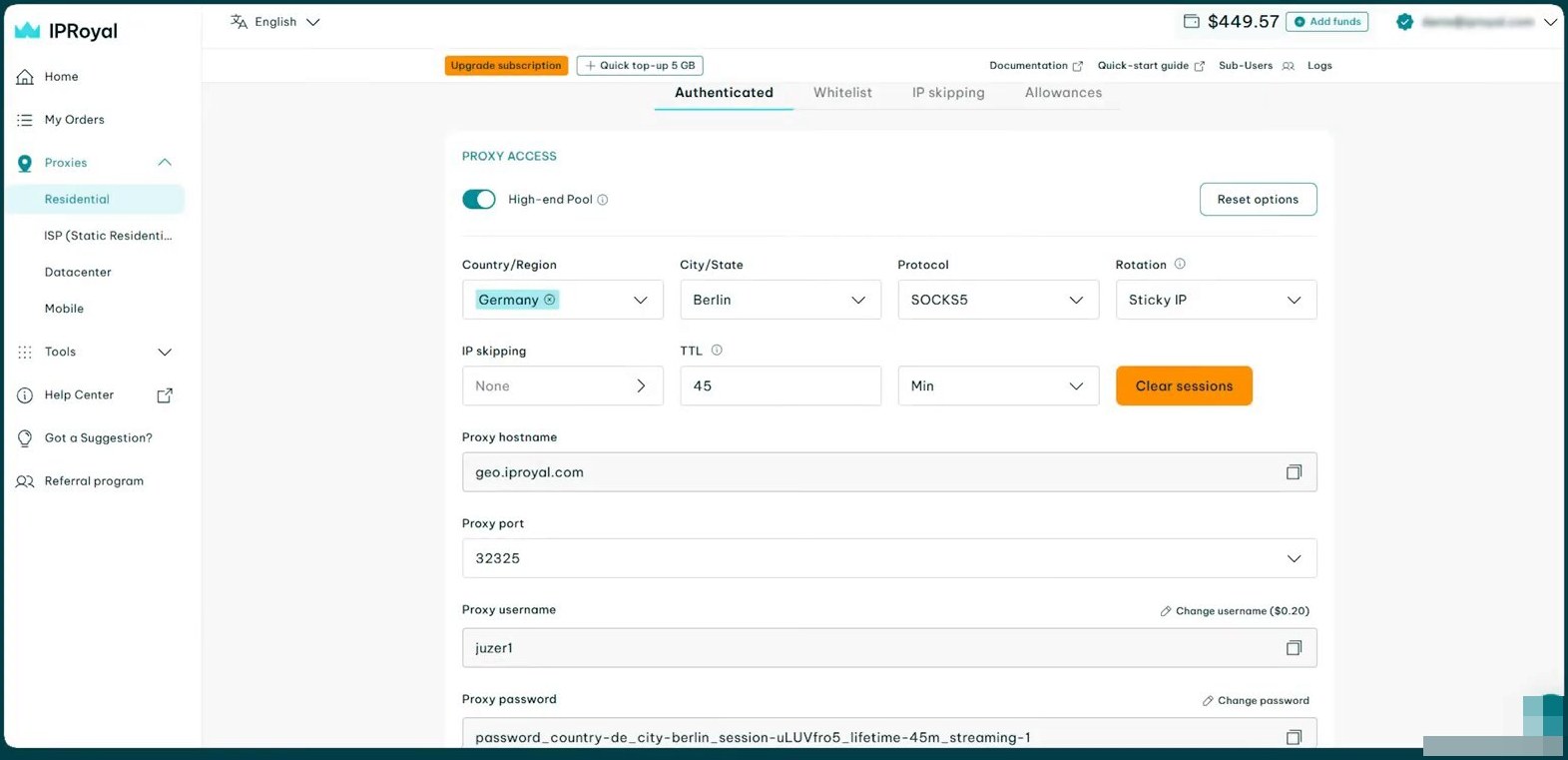
Source: IPRoyal. The Proxy Setup form with city-level country/state/city targeting, lifetime period option, and per-account quantity scaling up to 30,000 IPs. Country and city granularity is competitive with the enterprise tier at a fraction of the cost.
Best for. Small agencies and SEO consultants who want serviceable residential proxies without enterprise minimums. Sneaker resellers and other cost-sensitive niches (IPRoyal famously markets to that audience).
Skip IPRoyal if. You need premium mobile or deep enterprise unlock features.
Pricing reality. Residential at $7/GB. Datacenter packages start at $7/month. Pay-per-use available.
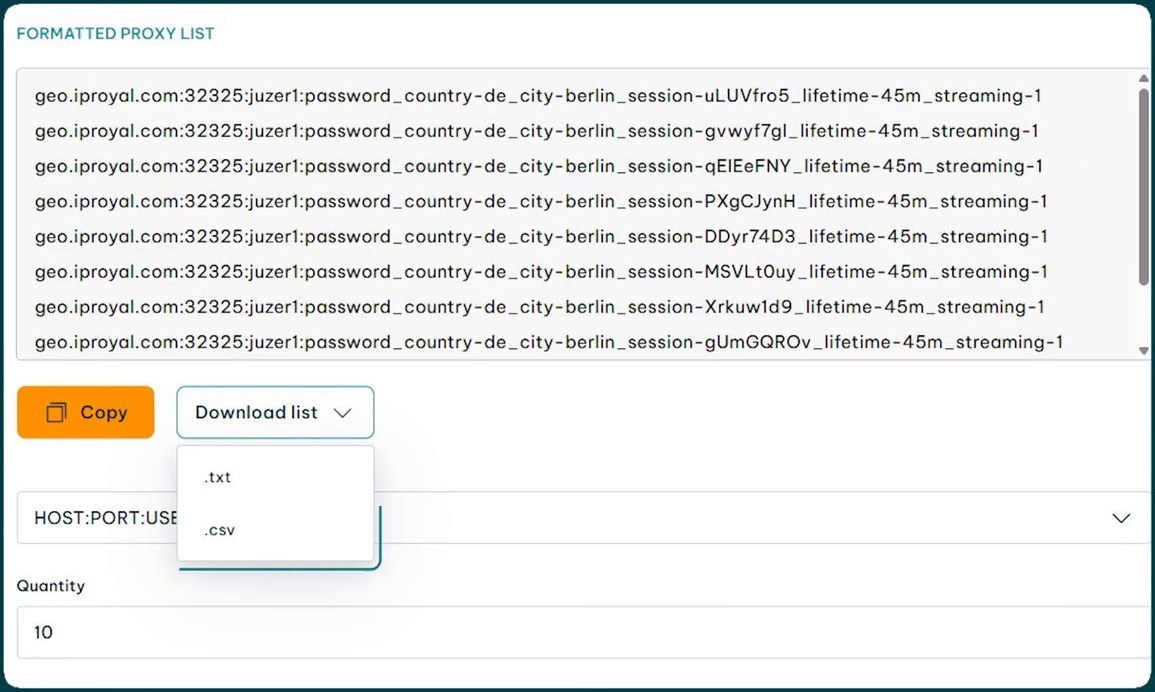
Source: IPRoyal. The Formatted Proxy List export view. Bulk endpoint generation in the format most marketing teams already work in (IP:PORT:USER:PASS), with city, session, and rotation metadata baked into each endpoint string.
Where IPRoyal wins. Competitive residential pricing at low volumes; reasonable dashboard; no minimum commitments.
Where Proxy-Seller wins (over IPRoyal). Multi-type coverage in one account; ISP proxy quality (a category IPRoyal underinvests in); customer support response times in our tests.
7. Webshare — the budget winner for light workloads
Webshare is the entry point for solo SEOs and individuals who need proxies occasionally rather than as core infrastructure. The free tier of 10 datacenter proxies is the most generous in the category.
Best for. Solo SEO consultants, freelance marketers, technical writers and bloggers who occasionally need to spoof a geo or check a SERP from another country. Anyone whose proxy needs are measured in hundreds of requests per day, not thousands.
Skip Webshare if. You’re running rank tracking or scraping at agency volume — the residential network and unlock capabilities don’t compete with the enterprise tier or with mid-market providers like Proxy-Seller.
Pricing reality. Free tier: 10 datacenter proxies, limited bandwidth. Paid tier starts around $3 per month for shared proxies. Residential at $7/GB.
Where Webshare wins. Free tier; the cheapest paid entry in the category; clean self-serve onboarding.
Where Proxy-Seller wins (over Webshare). Anything past hobby-scale usage — Webshare’s residential network and tooling don’t scale to agency workloads.
8. NetNut — static residential and ISP focus
NetNut specializes in static residential and ISP proxies, which is a niche but valuable category for workflows that need sticky sessions and consistent IPs over long periods.
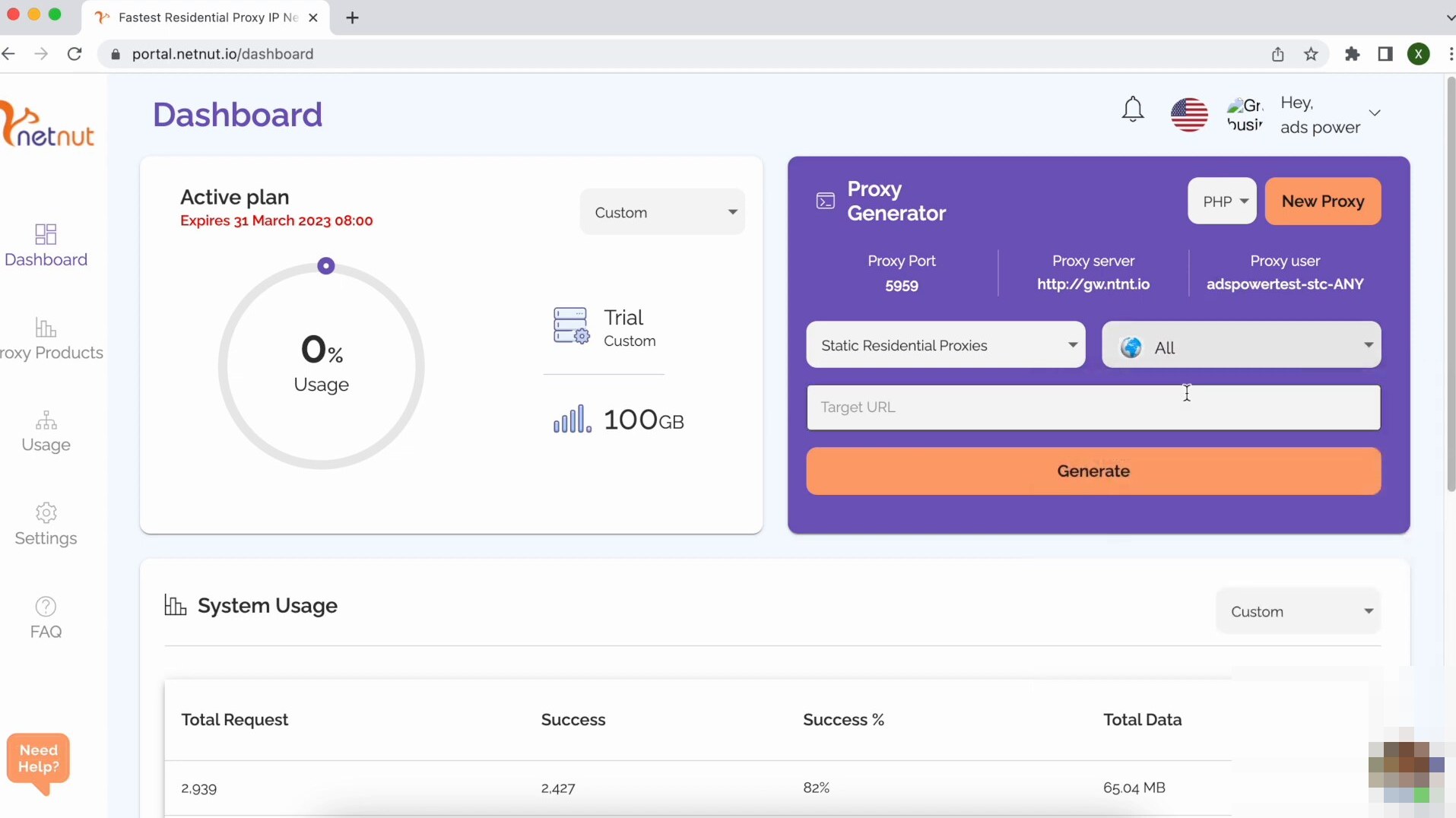
Source: NetNut. The Active plan dashboard with Proxy Generator. NetNut’s static residential and ISP positioning means the Proxy Generator emphasizes consistent IPs and sticky sessions rather than the high-volume rotation patterns of competitors.
Best for. Teams running stateful scraping (logged-in sessions, cart workflows), social media management at scale, market research that requires long-duration consistent IPs.
Skip NetNut if. Your work is short-duration request-based (typical SEO and SERP scraping) — rotating residential from other providers is cheaper and equally effective.
Pricing reality. Entry around $300 per month for static residential. ISP plans in similar range.
Where NetNut wins. Static residential and ISP quality; ISP P2P routing for low detection rates.
Where Proxy-Seller wins (over NetNut). Mix of proxy types; lower entry pricing; broader use-case coverage.
Side-by-side: residential proxy pricing
| Provider | $50-volume (~7GB) | $300-volume (~50GB) | $1000-volume (~150GB) |
|---|---|---|---|
| Webshare | $7/GB = $49 | $7/GB = $350 | Not designed for this scale |
| IPRoyal | $7/GB = $49 | $7/GB = $350 | $6/GB = $900 |
| Proxy-Seller | $7/GB = $49 | $5/GB = $250 | $4/GB = $600 |
| Smartproxy | $50 for 5GB | $7/GB = $350 | $6/GB = $900 |
| Soax | $90 entry | $8/GB = $400 | $7/GB = $1050 |
| Oxylabs | $300 minimum | $300 base | $10/GB = $1500 |
| Bright Data | $499 minimum | $499 base | $12/GB = $1800 |
For SEO and marketing teams at small to mid scale (the $50 to $300/month band), Proxy-Seller, IPRoyal, and Webshare are the rational picks. Above $1000/month volumes, the enterprise tier (Bright Data, Oxylabs) starts being cost-competitive.
Side-by-side: location coverage
| Provider | Country count | City-level targeting | Mobile coverage |
|---|---|---|---|
| Bright Data | 195 | Most countries | Full mobile network |
| Oxylabs | 188 | Most countries | Strong mobile |
| Soax | 195 | City + ISP + carrier | Premium mobile |
| Proxy-Seller | 90+ | Major markets | Available |
| Smartproxy | 195 | Major markets | Limited mobile |
| NetNut | 50+ | Limited | Limited |
| IPRoyal | 195 | Limited city | Available |
| Webshare | 50+ | Limited | Not core focus |
For most marketing teams targeting 20-40 actual markets rather than every country in the UN, Proxy-Seller’s 90+ country coverage is more than enough. The “more countries” framing only matters at enterprise scale where you genuinely need 150+ markets.
Bottom line
Pick Proxy-Seller if you’re a small or mid-size marketing team that needs flexible access across IPv4, IPv6, ISP, and residential proxies without enterprise contracts. The multi-type single-account structure plus transparent per-IP and per-GB pricing makes it the most balanced default pick. Use code TSR15 for 15% off any plan.
Pick Bright Data if you’re running enterprise-scale scraping or data operations and need the deepest infrastructure in the category. The $499 minimum is real, but at $1000+/month volumes the price gap closes.
Pick Oxylabs as the enterprise alternative to Bright Data — similar depth, slightly more accessible mid-market pricing.
Pick Smartproxy if you’re a mid-size agency that wants the friendliest dashboard in the category and doesn’t need IPv4/IPv6 at the per-IP level.
Pick Soax if your work is primarily residential or mobile-flavored — competitor monitoring on mobile apps, ad verification on mobile networks.
Pick IPRoyal if you want competitive residential pricing at low volumes without enterprise minimums.
Pick Webshare if you’re a solo SEO or individual who only needs proxies occasionally — the free tier of 10 datacenter proxies covers hobby-scale work.
Pick NetNut if your workflow needs static residential or ISP proxies specifically (logged-in sessions, stateful scraping, long-duration consistent IPs).
For most readers of this site — solo SEOs, small agencies, marketing teams under 25 client domains — Proxy-Seller is the answer. The flexibility of running IPv4, IPv6, ISP, and residential under one account, with no enterprise commitment, is the structural fit that the enterprise tier and the budget tier both miss.
We re-test every 90 days. Last updated: May 13, 2026.
Frequently asked questions
What's the best proxy service for SEO and marketing teams in 2026?
Proxy-Seller is the most balanced pick for small and mid-size marketing teams. Transparent pricing, flexible mix of IPv4, IPv6, ISP, and residential proxies, and an entry tier low enough to start without committing to enterprise contracts. For pure enterprise scale, Bright Data still leads on infrastructure depth. For the cheapest viable option, Webshare's free tier covers light workloads.
What kind of proxies do SEO teams actually need?
Most rank tracking and SERP scraping needs residential or ISP proxies to avoid detection, since search engines aggressively flag datacenter IPs. Localized ad verification needs residential proxies in the specific target geo. Site monitoring and your own-domain audits can run on cheap datacenter proxies. The mistake we see most often is teams buying datacenter packs for work that needs residential, then wondering why their rank tracker keeps returning blocked results.
How much should an SEO team budget for proxies?
For a solo SEO consultant or small agency under 10 client sites, $30 to $80 per month covers most workflows on a provider like Proxy-Seller or IPRoyal. Mid-size agencies tracking 50+ client domains across multiple geos typically spend $200 to $500 per month. Enterprise SEO operations doing continuous scraping at scale spend $1000+ monthly on residential proxy bandwidth alone.
Are free proxies worth using for SEO work?
No. Free proxies are unreliable, slow, and frequently compromised. They also commonly leak the requests they route, which is a serious privacy and compliance issue if you're handling client data. Webshare's free tier of 10 datacenter proxies is the exception worth knowing about, but only for testing or learning, not production work.
What's the difference between datacenter, residential, and ISP proxies?
Datacenter proxies come from data center IP ranges, are fast and cheap, but are easily detected and blocked. Residential proxies route through real consumer ISPs and IPs, look like genuine users, but are slower and 5 to 10 times more expensive. ISP proxies are hosted in data centers but use IP ranges registered to real ISPs, offering speed close to datacenter with detection resistance closer to residential. For most SEO work in 2026, ISP proxies are the sweet spot if your provider offers them.
Can I use a VPN instead of a proxy service for SEO work?
VPNs work for ad-hoc localization checks (open a SERP from a single geo) but break down for any automated workflow. VPNs route all your traffic through a single endpoint, can't rotate IPs, and don't handle the concurrent connections rank trackers and scrapers need. For one-off checks a VPN is fine. For repeated work, you need a real proxy service with rotation and concurrency.
What's the cheapest proxy service that still works?
Webshare's paid tier starts at around $3 per month for shared datacenter proxies, and IPRoyal's entry plans start around $7 per month. Proxy-Seller starts at $1.40 per IPv4 with no minimum commitment, which makes it the most flexible bottom-tier paid pick. For residential, Proxy-Seller and IPRoyal compete on price (around $4 to $7 per GB), undercutting Bright Data and Oxylabs by 30 to 50 percent at small volumes.
Which proxy service has the best location coverage?
Bright Data leads on raw country count (190+ countries with sub-city targeting in most), Oxylabs is close behind. For marketing teams that need 20 to 40 key markets rather than every country on Earth, Proxy-Seller, Smartproxy, and Soax all offer enough coverage at a fraction of the enterprise price. The right question isn't 'who has more locations' but 'who has the locations my workflow actually needs'.
The marketing tech rundown.
One short email a week. Honest takes on the tools we tested, what's worth your money, and what to skip. No fluff.
Free. Unsubscribe anytime.