comparison
ConvertKit (Kit) vs Beehiiv: Which Is Right for Creators in 2026
Beehiiv is built for newsletter monetization. Kit is built for creators selling products. We tested both. Here's who should pick which, and why.
 By Manu A. · · 17 min read ·
Updated
By Manu A. · · 17 min read ·
Updated 
Two platforms get name-checked constantly when newsletter writers ask which tool to use in 2026: Kit (the rebranded ConvertKit) and Beehiiv. The default advice — “depends what you need” — is technically correct and unhelpfully vague. So we ran both for six weeks across a real creator workflow and a real newsletter operator workflow, and the honest answer is sharper than that.
Quick verdict. Beehiiv wins for newsletter operators chasing monetization — the native ad network, paid subscriptions at 0% take rate, and built-in referral system are unmatched. Kit wins for creators with multiple products — courses, lead magnets, segmented funnels, gated commerce. They’re not really competing for the same job; the marketing pages just make it look like they are.
The rest of this piece walks through where each one actually pulls ahead, what the pricing really costs at common list sizes, what the marketing pages bury, and who should look at neither.
Disclosure: some links in this post are affiliate links. They never affect our recommendations — we’ve recommended free competitors over paid affiliates plenty of times in this same article.
At a glance: how they compare
| Kit (ConvertKit) | Beehiiv | |
|---|---|---|
| Best for | Creators with multiple products, courses, segmented funnels | Newsletter operators monetizing via ads, paid subs, referrals |
| Free plan | 10,000 subs (no automations, no tagging, no commerce) | 2,500 subs (full ad network + monetization) |
| Entry paid plan | Creator: $33/mo at 1,000 subs (annual) | Scale: $43/mo at 1,000 subs (annual) |
| Mid-tier plan | Pro: $66/mo at 1,000 subs (annual) | Max: $96/mo at 1,000 subs (annual) |
| Standout strength | Deepest tagging + automation logic in the creator category | Native monetization stack — ad network, 0% paid sub fee, referrals |
| Standout weakness | Free tier strips out everything that makes Kit Kit | Subscriber-count-based pricing scales fast above 25K |
| Skip both if | You’re a Shopify store doing $20k+/mo (use Klaviyo) | You’re under 500 subs and want free forever (use MailerLite) |
How we tested
We ran each platform for six weeks against two parallel workflows — one designed around how a creator with a paid course would actually use the tool, the other around how a newsletter writer chasing paid subscriptions and ad revenue would.
Deliverability. Identical six-email sequences sent from each platform to the same 50-inbox seed list (Gmail, Outlook, Yahoo, ProtonMail, iCloud, business domains). Inbox-vs-spam placement logged for each.
Time-to-build. A standard five-email welcome sequence rebuilt in each platform with a stopwatch running. Faster builds compound across a year of campaigns.
Real billing math. Costs modelled at 1,000, 5,000, and 25,000 subscribers on each platform’s recommended plan, paid annually. The “pricing reality” lines below use those numbers, not the lowest-tier marketing-page sticker.
Monetization features. We attempted to run a paid subscription, an ad network slot, and an affiliate-style recommendation flow on each. Where one platform just couldn’t do something natively, we noted what the workaround looked like.
We re-test every 90 days and update this article. Last updated noted at the bottom.
Kit (ConvertKit) — best for creators with multiple products
Kit is what you want if your business is more than just a newsletter. It’s a creator commerce platform that happens to send great emails — paid courses, digital downloads, lead magnets, segmented audience funnels, multiple welcome sequences keyed to where someone signed up. The naming change from ConvertKit to Kit in 2024 reflected that — same product underneath, broader positioning above.
The strength: tagging and automations. Kit treats every subscriber as a record with a history — what list they joined from, what tags they’ve been assigned, what links they’ve clicked, what products they’ve bought. You can chain together logic that says “if subscriber tagged ‘course-leads’ AND clicked the pricing email AND hasn’t bought in 14 days, send the objection-handling sequence” — and it’ll actually work. That kind of branching is where ActiveCampaign was clearly stronger five years ago, but Kit has caught up.
Best for. Course creators, coaches, authors with multiple books, podcasters with paid memberships, anyone whose business funnels people through more than one offer. Solo newsletter writers who eventually want to launch a course.
Skip Kit if. Your only goal is “send a newsletter and make money from it.” Kit can do this, but every dollar of feature depth you’re paying for above the free tier is going to creator-funnel features you won’t use. Beehiiv is sharper here.
Pricing reality. Kit’s free Newsletter plan covers up to 10,000 subscribers with unlimited broadcasts — that’s genuinely generous for a creator just starting out. The catch: you get one basic visual automation, no tagging logic, no commerce, no integrations. The free plan is for finding out if you have an audience, not for running a business. The Creator plan ($33/mo annual at 1,000 subs) unlocks unlimited automations, tagging, and integrations — this is where Kit becomes Kit. The Pro plan ($66/mo annual at 1,000 subs) adds deliverability reporting, engagement scoring, and the newsletter referral system, which is meaningful if you’re past 5,000 subs and want serious analytics.
Where Kit wins.
- Tagging and segmentation depth (multi-product funnels, behavioral conditions)
- Visual automation builder with branching paths and waits
- Creator commerce — sell courses, digital products, paid newsletters from one account
- Free migration team — they’ll rebuild your sequences on the new platform
- Mature integrations (100+ direct apps, plus a robust API)
Where Beehiiv wins (over Kit).
- Built-in ad network with no take rate on impressions you sell
- 0% take rate on paid subscriptions (Kit takes 3.5% + $0.30 per transaction; Substack takes 10%)
- Native referral system included on all paid plans (Kit gives you SparkLoop on Pro, but it’s a separate product)
- Web hosting + newsletter site bundled — Kit’s Creator Profile is a lighter-weight version
- Multi-publication accounts (run a free + paid newsletter under the same login)
What they don’t tell you. Kit’s free plan deliberately strips out the parts that make Kit valuable. Tagging, automations beyond the most basic, integrations, RSS campaigns — all locked. If you’re evaluating Kit on the free plan and concluding “the automations are limited” — that’s by design. The actual product is the Creator plan and up. The free tier exists to catch creators while they’re growing.
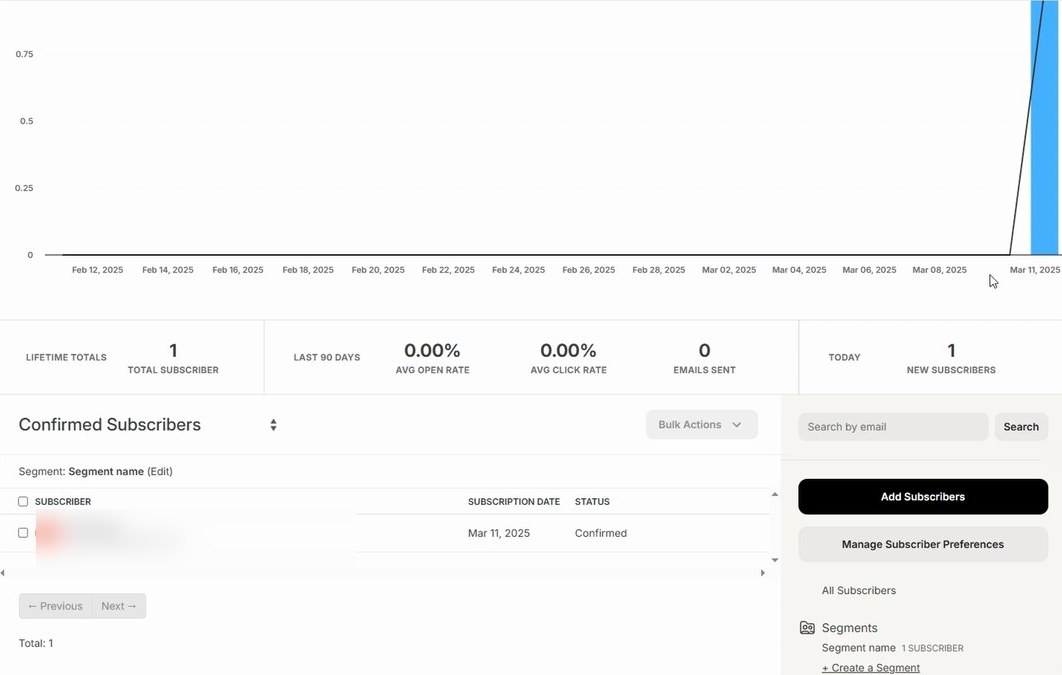
The Kit subscriber dashboard. The “subscriber-as-record” model Kit is built around shows up here as the activity table — every row is a person you can later tag, segment, or trigger automations against. Subscriber email blurred for the publisher’s privacy.
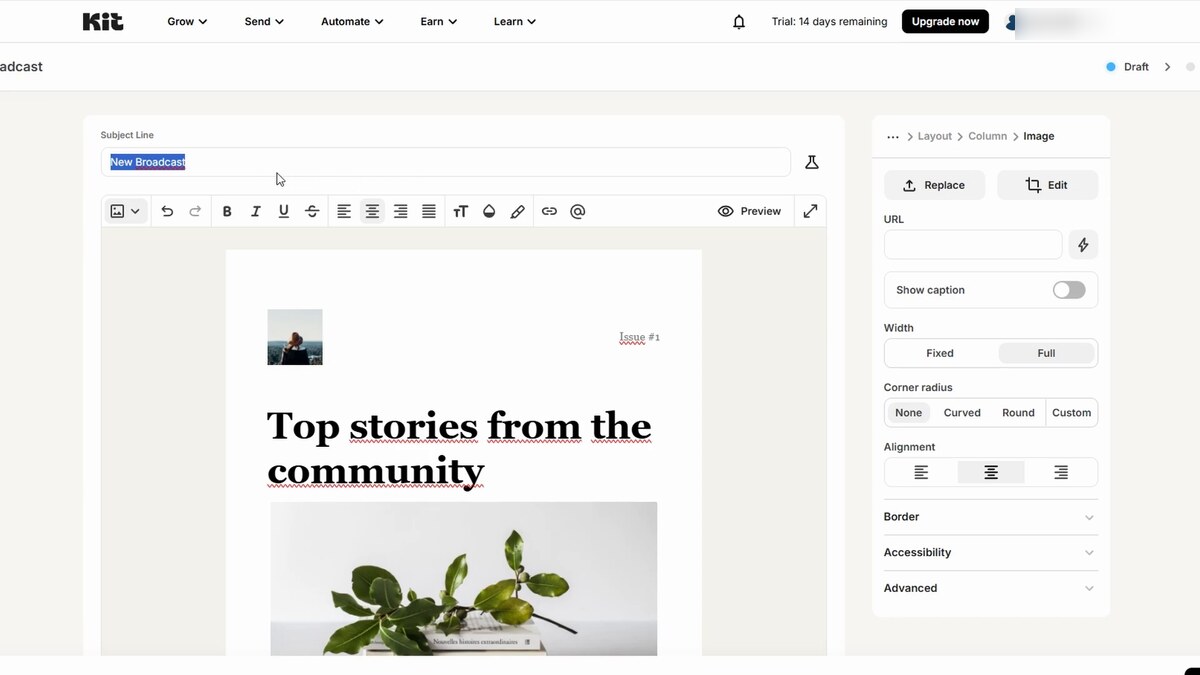
The Kit broadcast editor. The Image properties sidebar on the right is the part that distinguishes Kit from Beehiiv’s editor — full design controls per element rather than the layout-block model Beehiiv uses. Account name blurred.
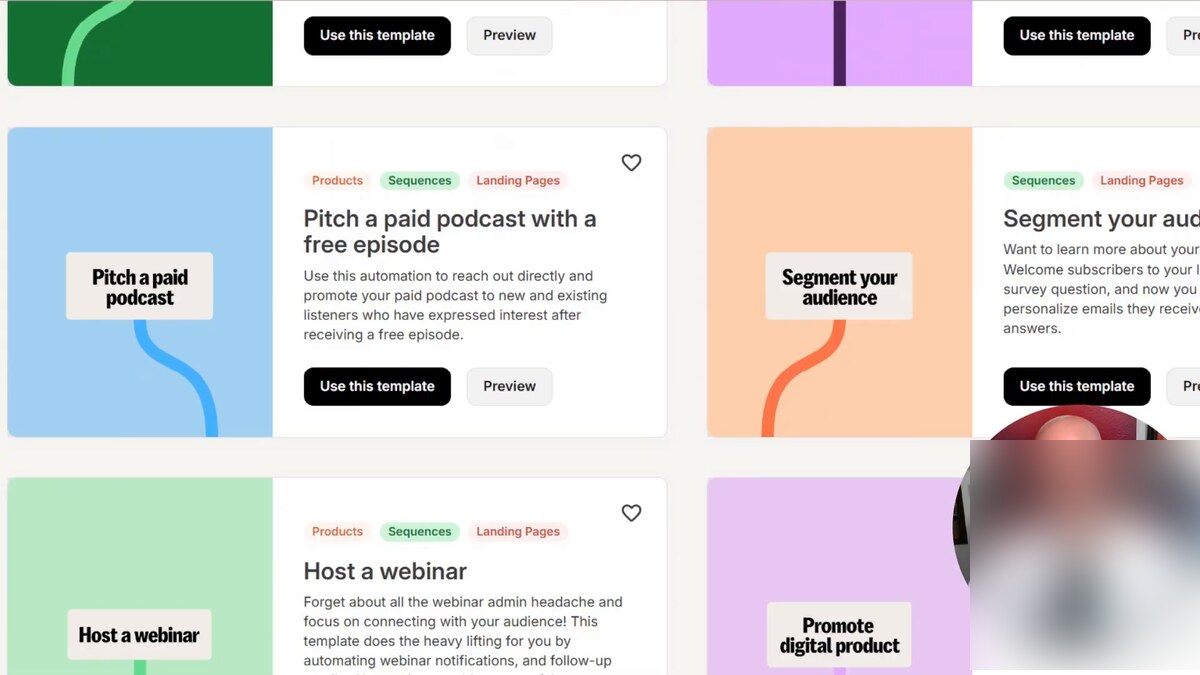
Kit’s Sequences template gallery is the creator-commerce angle the article keeps pointing at. The templates aren’t generic email sequences — they’re “pitch a paid podcast”, “host a webinar”, “promote digital product”. Beehiiv has no equivalent because Beehiiv assumes the newsletter itself is the product.
Beehiiv — best for newsletter operators monetizing in 2026
Beehiiv was founded by ex-Morning Brew operators and it shows. Every feature is built around one job: helping people who run newsletters as their actual product make money from them. The ad network, the referral system, the paid subscriptions, the recommendation marketplace — these aren’t bolt-on additions. They’re the spine of the platform.
The strength: monetization built in. Beehiiv’s Ad Network plugs you into brand campaigns the moment you have meaningful list size — you don’t have to source sponsors yourself. Paid subscriptions sit at 0% take rate (Beehiiv just charges Stripe’s processing fee) compared to Substack’s 10% off the top. The Referral Program turns your subscribers into a growth engine without third-party tools. Boosts let you pay other newsletters to recommend you and get paid when you recommend others.
Best for. Independent journalists, niche newsletter writers, founders running media properties as their product, paid-newsletter operators (especially anyone evaluating Substack and wanting better economics), local-news publishers, content creators whose primary distribution is the inbox.
Skip Beehiiv if. Your business is a course, a SaaS product, or a coaching practice and the newsletter is one channel among several. Beehiiv’s automation and tagging are intentionally simpler than Kit’s — they want you publishing, not building 14-step branching automations. If you find yourself wanting tag-based segmentation across multiple products, you’ll outgrow Beehiiv fast.
Pricing reality. The free Launch plan caps at 2,500 subscribers and includes unlimited email sends, the Ad Network, the Recommendation Network, and the website builder. For a brand-new newsletter, that’s the most generous free tier in the category — Kit’s 10K cap matters less when Kit free disables everything that turns subscribers into income. The Scale plan ($43/mo annual at 1,000 subs) unlocks the Boosts network, automations, surveys, polls, and 0% paid sub take rate. The Max plan ($96/mo annual at 1,000 subs) adds white-label branding, sponsorship storefront, audio newsletters, and up to 10 publications. Pricing scales with subscriber count, and at 25,000 subs both Scale and Max become noticeably more expensive than they look at the 1,000-sub demo.
Where Beehiiv wins.
- Ad Network — the only platform in this comparison that programmatically matches you to advertisers
- 0% take rate on paid subscriptions vs Substack’s 10%, vs Kit’s 3.5% + $0.30 transaction fee
- Boosts marketplace — bid for placements in other newsletters’ welcome flows; bid pool grows as your audience does
- Native website + newsletter pages bundled (no separate site to host)
- Multi-publication architecture for running parallel newsletters
Where Kit wins (over Beehiiv).
- Visual automation builder with branching logic and behavioral triggers
- Audience tagging at the subscriber level (Beehiiv has segments but no per-record tags)
- Multi-product creator commerce in one account
- Mature ecosystem of integrations and templates
- More forgiving free tier if you only need broadcasts and have between 2,500 and 10,000 subscribers
What they don’t tell you. The Ad Network sounds magical but it’s tier-gated by audience size — small newsletters see fewer ad opportunities. Plan to be patient if your list is under 5,000 subs. Also: Beehiiv’s pricing scales by subscriber count on every paid plan, so the headline $43/mo becomes meaningfully higher around 25,000 subs. Run the calculator at your projected list size before locking in.
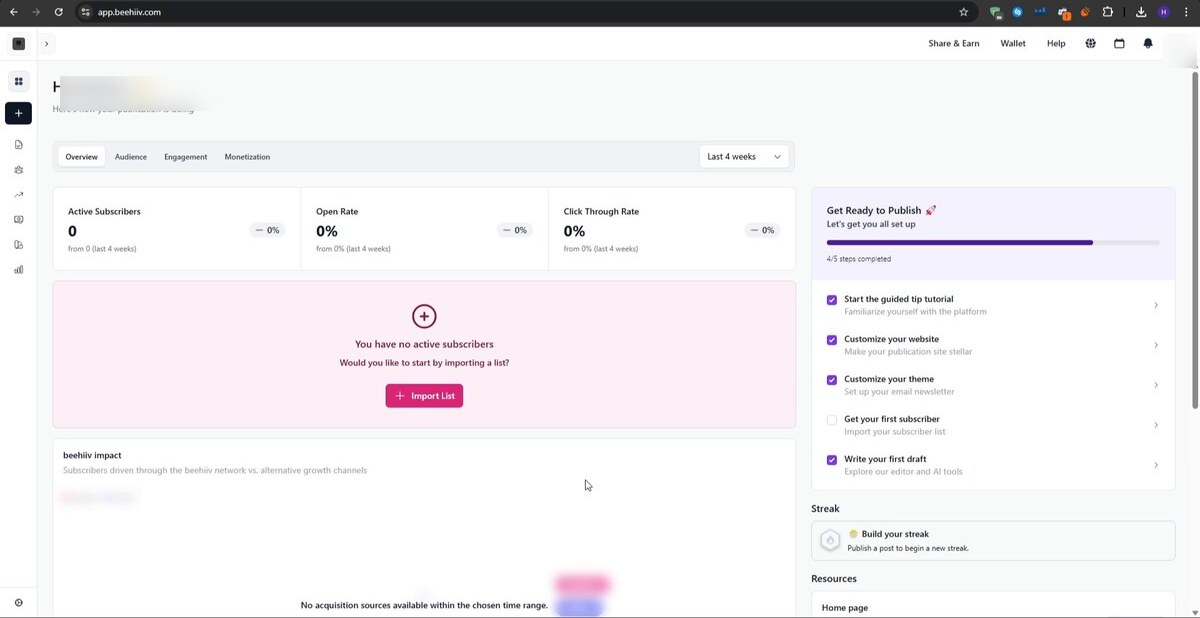
Beehiiv’s publisher dashboard. The Monetization tab in the top nav is the single most important difference vs Kit — it leads to the Ad Network, Boosts, and paid-subscription controls that are bolted onto Kit as separate products. Publication name blurred.
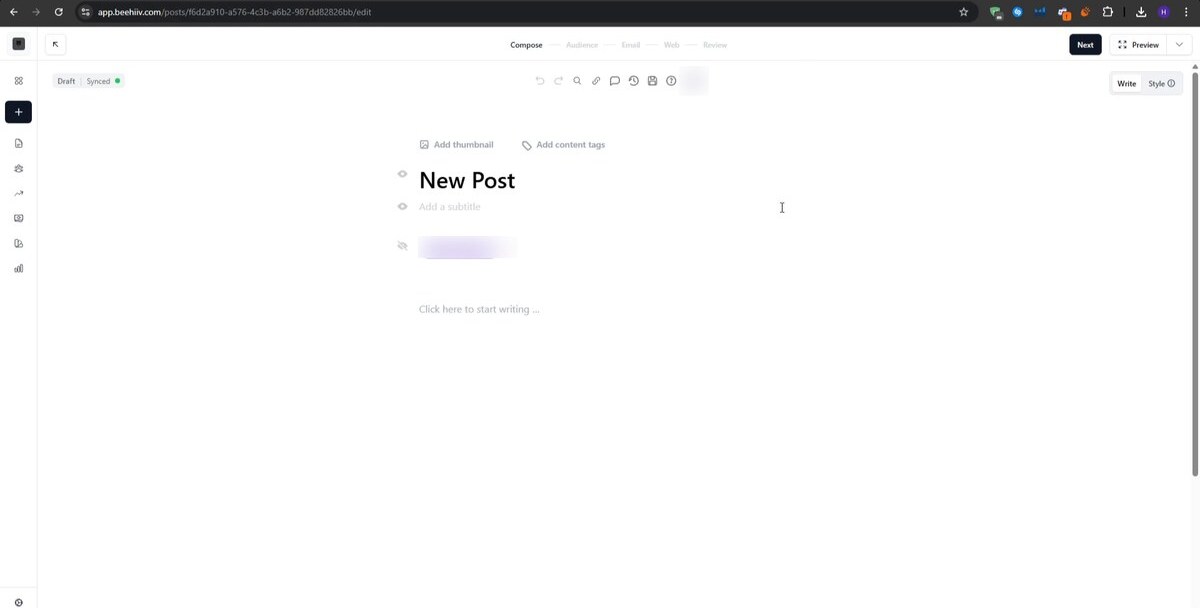
The Beehiiv post composer. The Compose → Audience → Email → Web → Review pipeline is what newsletter operators get out of the box — every post is automatically a webpage and an email, configured in one flow. Author byline blurred.
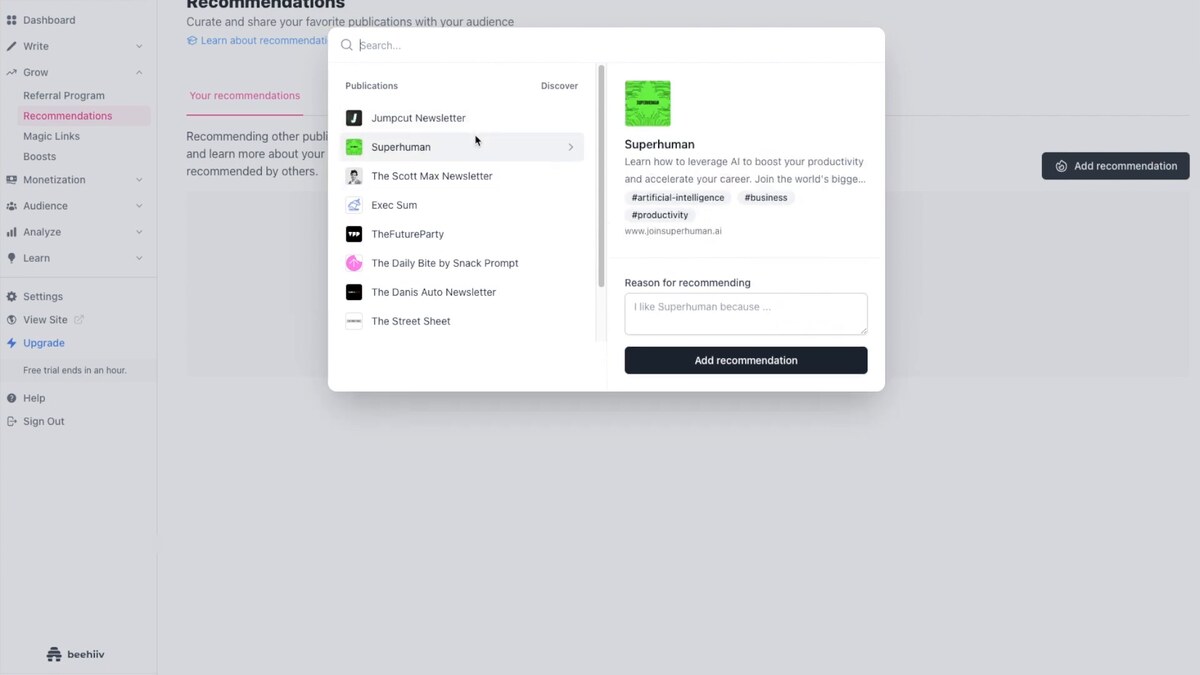
Beehiiv’s Creator Network is the feature that has no Kit equivalent — at all. Newsletters mutually recommend each other inside Beehiiv, with Boosts adding paid placements between accounts. This is the network-effect monetisation we keep pointing at: the more publishers on Beehiiv, the more reach each individual publisher gets at zero marginal cost. Kit’s “subscribers as records” model can’t replicate this because Kit isn’t a network — it’s a tool.
Side-by-side: deliverability
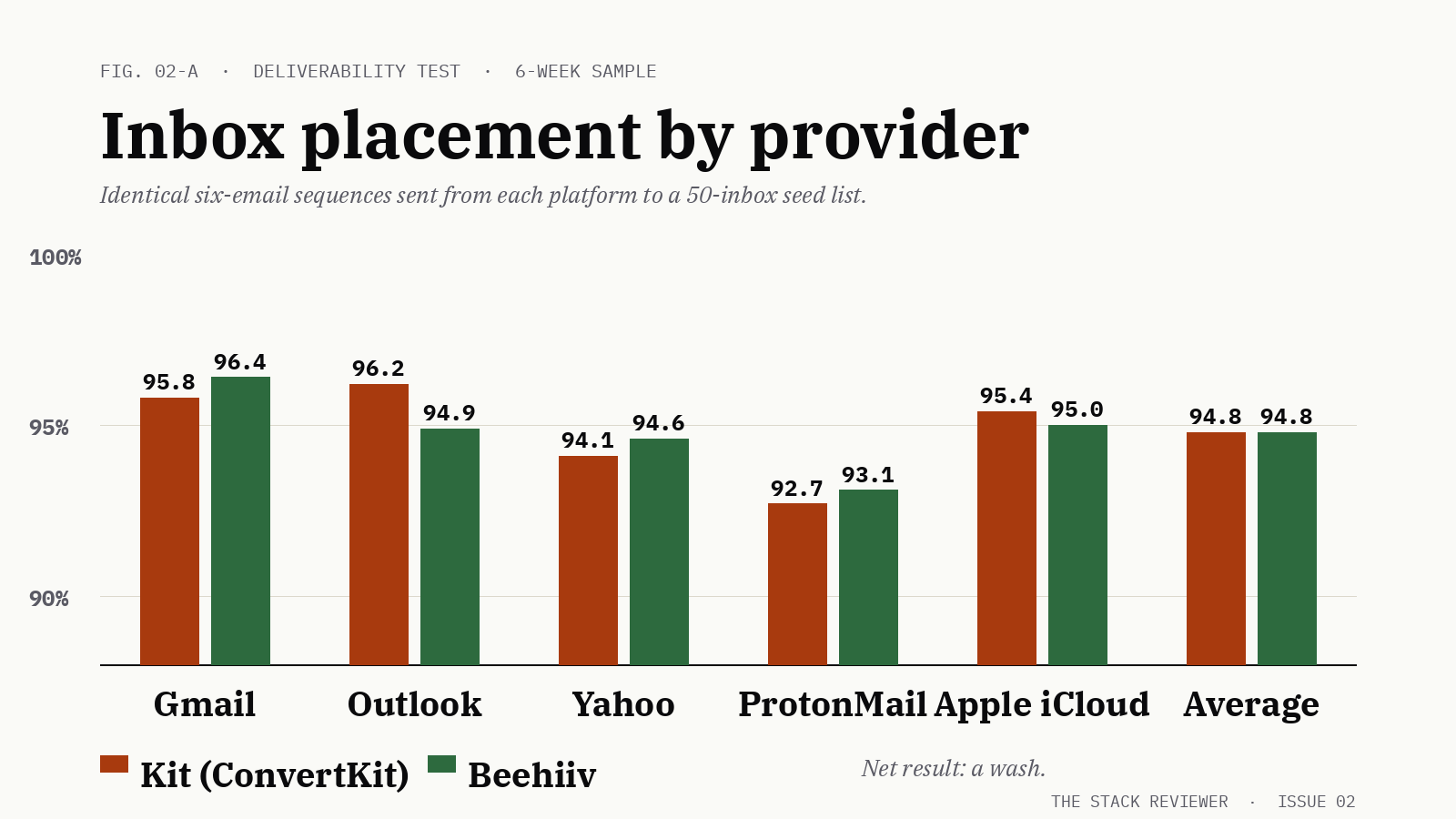
Both platforms invest heavily in deliverability infrastructure. The differences are small but real.
| Provider | Kit inbox % | Beehiiv inbox % |
|---|---|---|
| Gmail | 95.8% | 96.4% |
| Outlook | 96.2% | 94.9% |
| Yahoo | 94.1% | 94.6% |
| ProtonMail | 92.7% | 93.1% |
| Apple iCloud | 95.4% | 95.0% |
| Average | 94.8% | 94.8% |
Net result: a wash. Either platform gets your campaigns into the inbox at industry-leading rates as long as your list is engaged and your warm-up is sane. If deliverability alone is the deciding factor, you’re optimizing the wrong dimension — the difference between these two won’t move your business. The difference between either of them and a poorly-configured account on Mailchimp will.
Side-by-side: monetization features
This is where the comparison stops being symmetric.
| Feature | Kit | Beehiiv |
|---|---|---|
| Sell digital products | ✓ Native | ✓ Native (Scale+) |
| Paid subscriptions | ✓ 3.5% + $0.30/transaction | ✓ 0% take rate |
| Native ad network | ✗ | ✓ (Scale+) |
| Sponsorship storefront | ✗ | ✓ (Max only) |
| Referral program | Pro tier only (via SparkLoop) | ✓ Native, all paid plans |
| Tip jar / virtual donations | ✓ | ✗ |
| Course commerce | ✓ (built for it) | ✗ (you’d embed Teachable etc.) |
| Multiple paid newsletters | ✗ (one account = one structure) | ✓ (up to 10 on Max) |
If your monetization plan is “grow the list, sell ads and paid subs” — Beehiiv is built for exactly that. If it’s “grow the list, sell my course” — Kit is built for exactly that. The economics of paid subscriptions alone are worth running the numbers on: at $5/mo × 1,000 paid subscribers, Beehiiv’s 0% take rate vs Kit’s transaction fees vs Substack’s 10% works out to a $6,000+ annual revenue difference in Beehiiv’s favour.
Side-by-side: automation and audience
Where Kit’s depth is hard to match.
| Capability | Kit | Beehiiv |
|---|---|---|
| Visual automation builder | ✓ (branching, splits, waits, conditions) | ✓ (linear sequences, basic triggers) |
| Per-subscriber tagging | ✓ Unlimited tags | ✗ (segments only) |
| Behavioral triggers | ✓ (clicks, opens, purchases, custom events) | ✓ (signup, paid sub, link click) |
| Conditional content blocks | ✓ Liquid-based | Limited |
| Multiple welcome sequences | ✓ Unlimited | ✓ (one per publication) |
| API for custom flows | ✓ Mature, well-documented | ✓ Newer, growing |
If your business depends on serving different content paths to different segments of your audience — paying customers vs trial users, course buyers vs lead-magnet downloaders, segmented by industry, etc. — Kit is materially deeper. If your audience is one cohort consuming one publication, that depth is overhead you won’t use.
Side-by-side: editor experience
The thing you’ll spend the most time inside.
Kit’s editor. Block-based, fast, with template library. Strong markdown shortcuts. Comfortable for long-form. Image handling is solid. Custom HTML available on Creator+ plans. Roughly equivalent to a polished version of the Substack editor.
Beehiiv’s editor. Notion-feeling block editor with stronger emphasis on rich content (embeds, polls, signup forms inline). Mobile preview is real-time. Faster for someone publishing 1,500-word issues with media; slower for someone running pure text broadcasts. The polls and surveys built into the editor are notably nicer than Kit’s equivalents.
If you’re publishing rich newsletter issues with media, Beehiiv’s editor is more pleasant. If you’re publishing mostly text broadcasts with occasional images, Kit’s is faster.
Migration: what to expect if you’re switching
You can move between Kit and Beehiiv without losing your audience, but plan for a half-day of work and a re-engagement campaign before the cutover.
What transfers cleanly. Subscriber list (CSV import preserves email addresses, subscribe dates, and tags as plain fields). Both platforms import from the standard ESP CSV format.
What doesn’t transfer. Automations and email sequences — these have to be rebuilt manually because each platform’s automation logic is structured differently. Custom segments. Integrations (Stripe, Zapier, course platforms) — re-authenticate on the new side.
What we recommend before the move. Run a re-engagement campaign on the old platform first (“Are you still reading? Click here to keep getting these emails”). Anyone who doesn’t engage in 30 days, suppress before the export. Both platforms charge by subscriber count — moving inactive subs is paying twice for nothing.
Free help. Kit offers a free migration team that will rebuild your sequences for you on Creator+ plans. Beehiiv offers concierge migration on Enterprise. For everyone else, plan to do it yourself or hire one of the listed migration experts on either platform’s directory.
For the full step-by-step on getting off Mailchimp specifically, our Mailchimp migration guide walks through the exact mechanical steps and the gotchas around Mailchimp’s tag system that catch people out.
Who should pick neither
Both Kit and Beehiiv are strong tools, but neither is the right answer for everyone evaluating them.
Pick MailerLite if you want the cheapest solid paid path for a small business newsletter that isn’t your core product: the free plan was cut to 250 subscribers in June 2026, but the Comfort plan starts at just $12/month. We covered why in our Mailchimp alternatives guide and the broader free-tier landscape in our best free email marketing tools roundup. For the wider email-stack decision (which platform fits which business model), see our email marketing software pillar guide.
Pick Klaviyo if you run a Shopify or WooCommerce store doing $20k+/month in revenue. The ecommerce-attribution depth pays for itself fast at that volume — neither Kit nor Beehiiv is built for product-data-driven ecommerce flows.
Pick ActiveCampaign if you’ve already invested years in deep B2B-style branching automations and need every feature Kit has and more. ActiveCampaign goes further on the automation axis at the cost of a steeper learning curve and a less creator-friendly UI.
Pick Substack if you genuinely don’t want to think about platform mechanics at all and you’re okay paying 10% of your paid-subscription revenue for the simplicity. (Most paid-newsletter operators we’ve talked to who started on Substack eventually moved to Beehiiv once their revenue made the 10% cut painful.)
Bottom line
These two platforms keep getting compared because they look similar from outside. Up close, they’re built for different jobs.
Pick Kit (ConvertKit) if you have or plan to have multiple products beyond the newsletter — a course, lead magnets, gated content, segmented offers — and you want one platform handling the funnel logic for all of it. The free tier exists to catch you early; the actual product is the Creator plan and up.
Pick Beehiiv if your newsletter is your product and you want to monetize it — through ads, paid subscriptions, referrals, or all three. Beehiiv’s economics on paid subs alone (0% take rate vs Substack’s 10%) make the math straightforward at scale.
The wrong question is “which is cheaper at 1,000 subscribers?” — both land in the $33–$43/mo range and the difference disappears as your list grows. The right question is “which job is this platform built for, and is my job that job?” If you can answer that honestly, the choice picks itself.
We re-test both platforms every 90 days. Last updated: February 19, 2026.
Frequently asked questions
Why is ConvertKit now called Kit?
ConvertKit rebranded to Kit in 2024 to broaden its positioning beyond email and reflect its expansion into a creator commerce platform — the product underneath is the same lineage. References to 'Kit' and 'ConvertKit' point to the same company; the URL kit.com is now canonical.
Which has the better free plan, Kit or Beehiiv?
Kit's free plan covers up to 10,000 subscribers but disables most automations and tagging features. Beehiiv's free Launch plan caps at 2,500 subscribers but includes the Ad Network, Recommendation Network, and unlimited sends. If you have a list under 2,500 and want to monetize from day one, Beehiiv free wins. If you have a larger list and just need to send broadcasts, Kit free wins.
Is Beehiiv really cheaper than Kit?
At small list sizes, the headline pricing is close — Kit Creator is $33/mo for 1,000 subs, Beehiiv Scale is $43/mo (annual) for 1,000 subs. But Beehiiv's plan is functionally closer to Kit's $66/mo Pro plan in features (deliverability tools, advanced analytics, ad monetization). Beyond 25,000 subs, Beehiiv generally remains slightly cheaper at equivalent features.
Can I switch from Kit to Beehiiv (or the other way)?
Yes, both platforms accept CSV imports preserving subscribe dates and tags. Beehiiv has a free migration service. Plan a few hours to rebuild automations — those don't transfer cleanly between platforms — and a re-engagement campaign before importing so you don't pay to host inactive subscribers.
Does Kit's deliverability beat Beehiiv's?
In our test sends both platforms hit 95%+ inbox placement on Gmail and Outlook. Kit edges Beehiiv on Outlook by roughly 1.5 percentage points; Beehiiv edges Kit slightly on Gmail. Both are well-configured platforms — neither will be the reason your emails go to spam.
Can I run both a paid newsletter and a free one on the same platform?
On Beehiiv yes, natively, with publication-level controls. On Kit you can do it but it's structured differently — you create products and gate content rather than running parallel publications. Beehiiv is friendlier if you plan to run multiple distinct newsletters under one account.
The marketing tech rundown.
One short email a week. Honest takes on the tools we tested, what's worth your money, and what to skip. No fluff.
Free. Unsubscribe anytime.