comparison
Claude vs ChatGPT for Marketing 2026: Which Should You Actually Use?
I write marketing copy with both every day. Most comparisons miss what matters for marketers. The honest verdict, sorted by the work you're doing.
 By theo · · 13 min read ·
Updated

I write marketing copy in Claude and ChatGPT every day. The “Claude vs ChatGPT” comparison shows up in my feeds constantly, and most of it misses what matters for marketers — the comparisons either treat them as fungible chat tools (they aren’t) or compare benchmark scores that don’t translate to “which should I use to draft this newsletter.” This piece is what I’d send a marketer who asked.
Sixty days, two test environments — solo content writing for a B2B SaaS, and a five-person marketing team at a DTC ecommerce brand — running both tools in parallel. Same briefs, same editors, blind grading. The honest answer is that they’re not actually competing for the same job, and the wrong question is “which is better.”
Quick verdict. Claude wins for long-form marketing writing in a consistent voice — newsletters, blog posts, brand-flavored content, anything where tone and structure matter more than punchy hooks. ChatGPT wins for everything else marketers do — images, voice, code, plugins, short-form punchy copy, multimodal work. Most working marketers should run both ($40/mo combined), with a 70/30 time split favoring Claude for writing and ChatGPT for everything else. The wrong question is “which one to pick”; most marketers benefit from both.
The rest of this piece walks through the actual capability differences, the test results we recorded, and the specific situations where each one wins.
At a glance: how they compare for marketing work
| Claude | ChatGPT | |
|---|---|---|
| Best for | Long-form writing, voice consistency, document analysis | Multimodal, code, plugins, short-form copy |
| Free tier | Generous (Claude 3.5 Sonnet, daily limits) | Generous (GPT-4o, tighter limits at heavy use) |
| Paid tier | $20/mo (Pro) | $20/mo (Plus) |
| Image generation | None natively | DALL-E 3 included |
| Voice mode | Limited | Full voice mode (Plus) |
| Plugins / tools | Basic, growing | Mature ecosystem |
| Code work | Competent | Better, with Code Interpreter |
| Document analysis | Best in category (200k context) | Good (128k context Plus) |
| Voice consistency over long sessions | Best | Drifts faster |
| Hallucination posture | More honest about uncertainty | More confident, even when wrong |
| Standout strength | Long-form quality, document handling, ethical reasoning | Multimodal breadth, ecosystem |
| Standout weakness | No images, smaller plugin ecosystem | Voice drift, less reliable on brand guidelines |
How we tested
Each tool ran on the same briefs in parallel for 60 days.
Solo writer test environment. B2B SaaS marketing site. Tested: 1,500-word blog post drafts, 800-word newsletter drafts, 300-word ad copy variations, customer story interviews-to-prose, product launch announcements. Same brief delivered to both tools, both outputs blind-graded by three editors against a rubric (voice match, structural integrity, factual accuracy, edit time required).
Team test environment. 5-person DTC ecommerce marketing team. Tested: weekly newsletter (rotating writers), product page copy, ad creative briefs, customer email responses, blog post research. Same briefs distributed; tools picked by writer preference and tracked.
Cost math. Modelled at solo ($0/$40/$60 monthly), small team (3 seats), and growing team (10 seats).
I’ll re-test every 90 days. Last updated noted at the bottom.
Claude — the long-form writer’s tool
Claude is what I reach for when the writing matters. Anthropic’s flagship model. Strong reasoning. The longest practical context window in the category (200k tokens — meaning you can paste a full book chapter and ask questions about it). Most importantly for marketing: it holds voice across long sessions in a way ChatGPT doesn’t.
Best for. Long-form blog posts (1,500+ words). Newsletters where tone matters. Brand voice writing where consistency matters across many pieces. Document-heavy work (analyzing transcripts, briefs, competitor pages). Founder writing where the AI is drafting in the founder’s voice and any drift is obvious.
Skip Claude if. You need image generation, voice mode, or rich plugin integration — Claude can’t do those natively. You’re doing primarily code work — ChatGPT’s Code Interpreter is more useful. You’re a non-technical marketer who wants the most polished consumer-grade UX — ChatGPT’s UI is a half-step ahead.
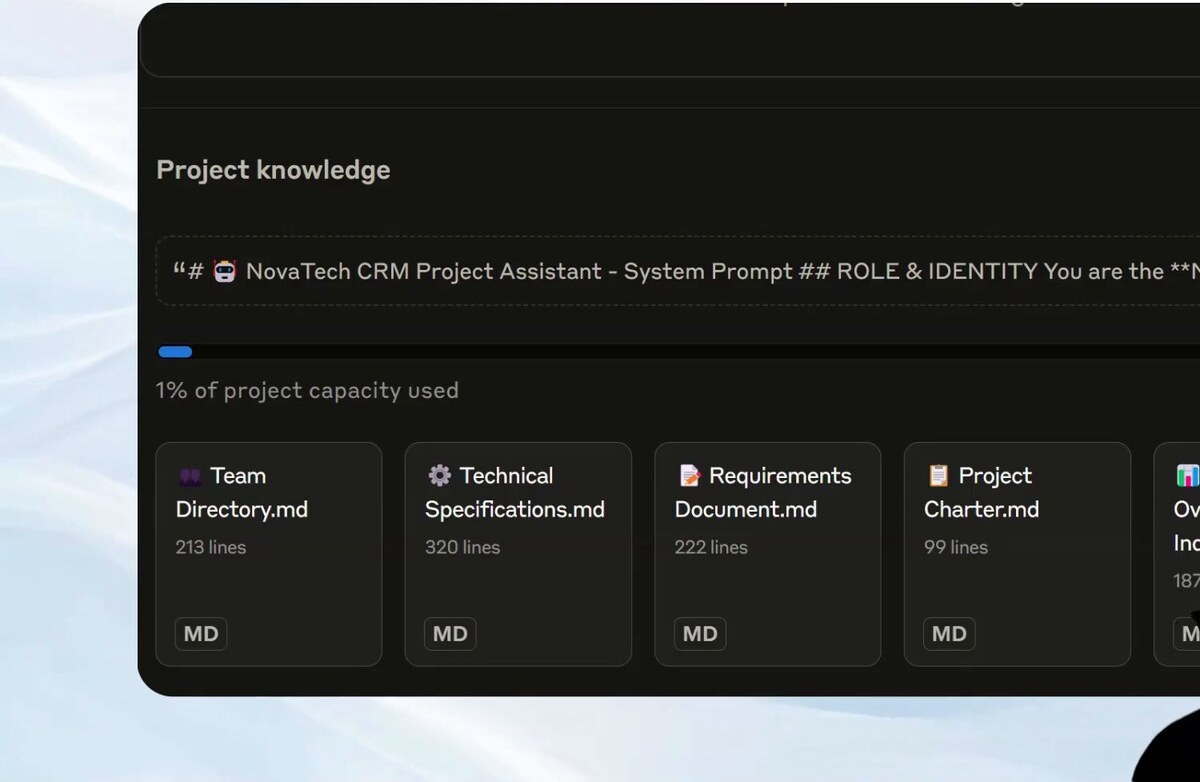
A Claude Project’s knowledge panel. The system prompt at the top defines the role and identity for every chat in this project, and the file cards below are markdown documents the project pulls into context on demand. The “voice consistency across long sessions” we measure in our tests is partly a function of this scaffolding: pinned instructions plus retrievable knowledge keep Claude on-tone across many drafts in the same project.
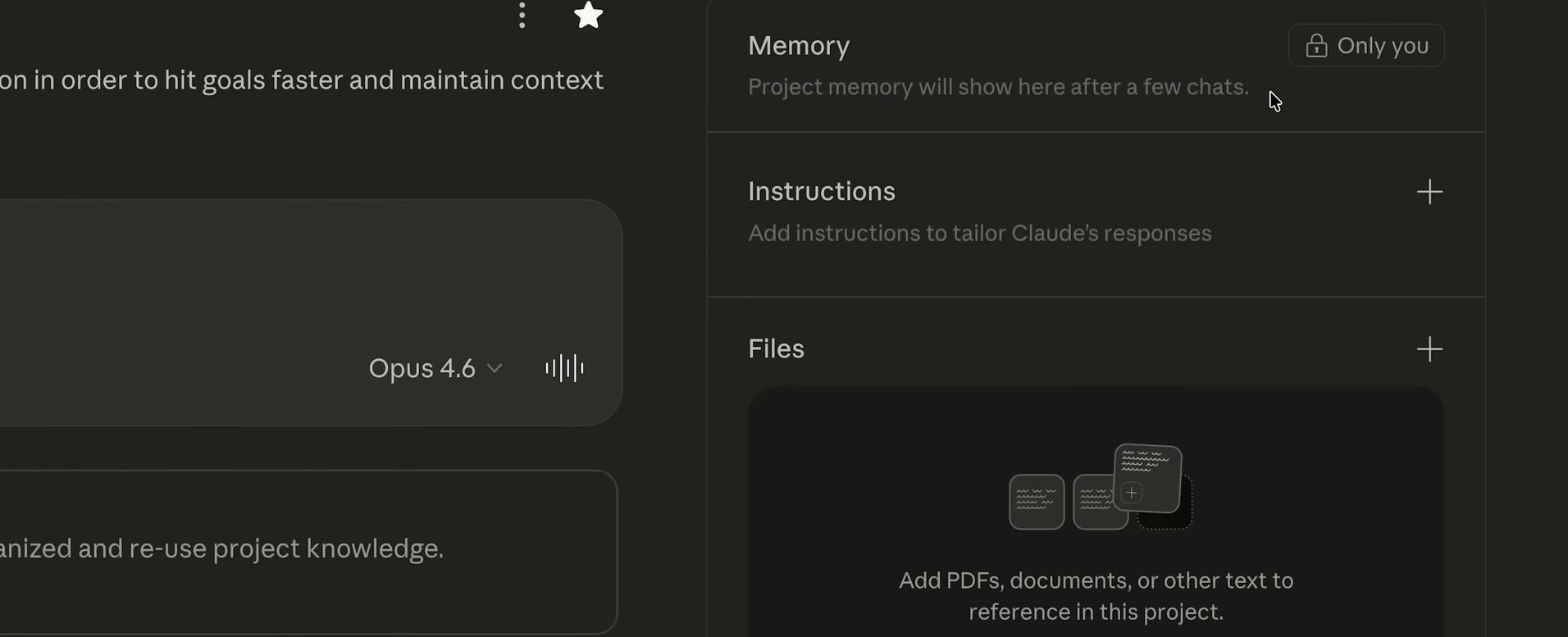
The empty Project state Claude shows you the moment you create one. Memory, Instructions, Files panels along the right rail are the three knobs you set per project, and once they’re populated the project becomes a self-contained workspace that Claude treats as a persistent context across every chat in it. This is the structural reason brand-voice writing holds together better in Claude than in ChatGPT for ongoing work.
Pricing reality.
- Free. Claude 3.5 Sonnet, daily message limits. Genuinely usable for serious work.
- Pro: $20/mo billed monthly ($17/mo billed annually). Higher limits, access to Claude 3.5 Opus for hardest tasks, projects feature.
- Team: $25/seat/mo billed monthly or $20 billed annually, for teams of 2 to 150. Shared workspaces, higher limits per seat.
- Enterprise: Custom. SSO, expanded context windows, data retention controls.
Where Claude wins.
- Voice consistency on long sessions — measurably. In our blind-graded tests, Claude’s voice match scored 4.2/5 vs ChatGPT’s 3.4/5 on 1,500-word drafts.
- 200k-token context window — paste a full transcript, brand guideline doc, or competitor research dump and ask questions
- More honest about uncertainty (“I’m not certain about that specific stat”) vs ChatGPT’s tendency to confabulate
- Pushes back on weak claims, asks clarifying questions, refuses to write things that are factually shaky
- Document analysis is best in the category
- “Projects” feature lets you maintain context across sessions for ongoing work
Where ChatGPT wins (over Claude).
- Images, voice mode, multimodal work — Claude can’t do these
- Plugin ecosystem (Code Interpreter, web browsing, custom GPTs)
- Faster on short tasks
- More polished consumer UX
- Larger ecosystem of agencies and freelancers fluent in ChatGPT
What they don’t tell you. Claude’s “honesty about uncertainty” can frustrate marketers who want a tool that just produces output without pushback. If you’re used to ChatGPT confidently writing whatever you ask, Claude’s tendency to flag weak claims feels like friction. It’s actually a feature — Claude is harder to embarrass yourself with — but the workflow is different.
ChatGPT — the multimodal generalist
ChatGPT is OpenAI’s flagship. Most-used AI tool in the world. Better at multimodal work, code, and the broader ecosystem than Claude. The right answer when “writing” is one of many things you need the tool to do.
Best for. General marketing work that mixes writing, image generation, voice, and code. Short-form copy where punchy hooks matter (ad headlines, social posts, landing page CTAs). Anyone doing image generation alongside writing. Teams already deep in the OpenAI ecosystem.
Skip ChatGPT if. Voice consistency in long-form writing is critical to your work. You’re doing document-heavy analysis (large transcripts, briefs, research dumps) — Claude’s larger context window matters there.
Pricing reality.
- Free. GPT-4o, GPT-3.5, image generation (DALL-E 3 limited), voice mode (limited), web browsing.
- Plus: $20/mo. Faster GPT-4o, more DALL-E 3, voice mode, plugins, custom GPTs, Code Interpreter.
- Business (formerly Team): $25/seat/mo billed monthly or $20 billed annually. Shared workspaces, admin controls, longer context windows.
- Enterprise: Custom. SSO, advanced data controls, unlimited usage.
Where ChatGPT wins.
- Multimodal — images, voice, code in one tool
- DALL-E 3 image generation included with Plus
- Voice mode for hands-free use cases
- Plugin ecosystem (Code Interpreter, web browsing, custom GPTs)
- Better at code (Python, JavaScript, marketing automation scripts)
- Custom GPTs let you save reusable prompts as deployable mini-tools
- More mature integrations with marketing tools (Zapier, Buffer, etc.)
Where Claude wins (over ChatGPT).
- Long-form writing voice consistency
- Document analysis and large-context work
- Honesty about uncertainty
- Better at brand-flavored writing where tone matters
What they don’t tell you. ChatGPT’s voice “drifts” on long sessions in a way that’s frustrating for serious writing. You’ll get a great first 800 words, then notice the tone subtly shifting toward generic AI-flavored prose by word 1,500. The fix isn’t a different prompt; the fix is using Claude for that work and ChatGPT for the work where voice doesn’t matter as much.
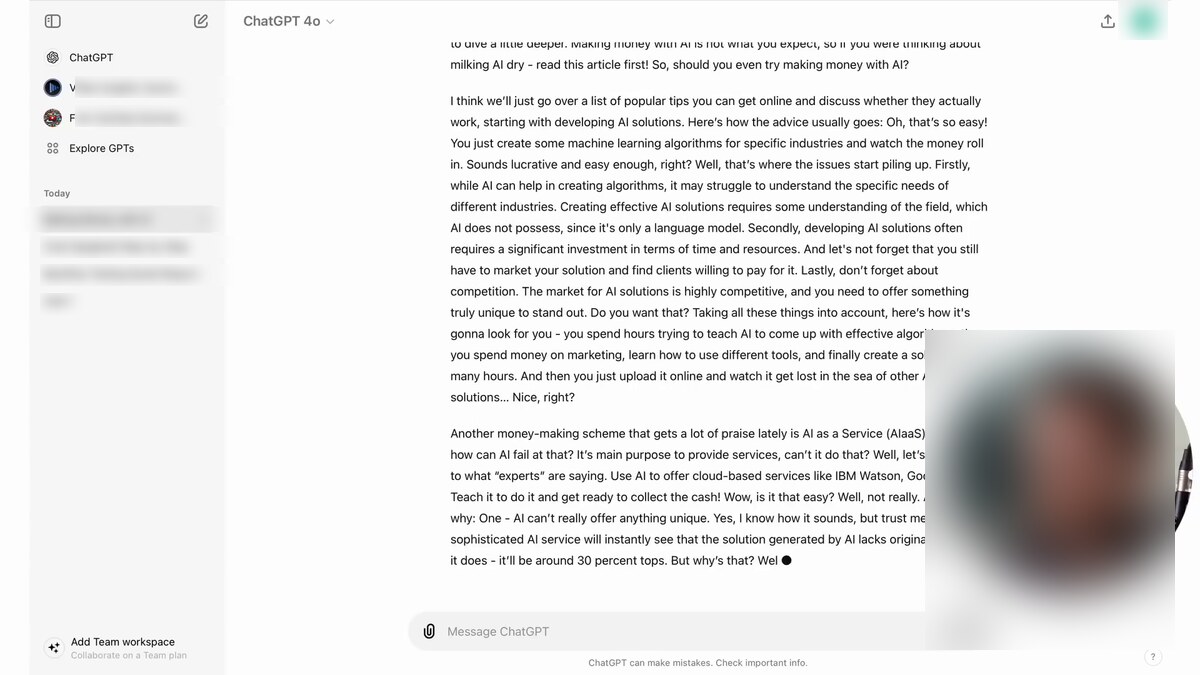
The signed-in ChatGPT 4o chat surface in flow. ChatGPT’s UI is consumer-grade and minimal — the work happens in the chat thread itself rather than in side panels. Voice mode and image generation activate through the prompt area, not a separate workspace.
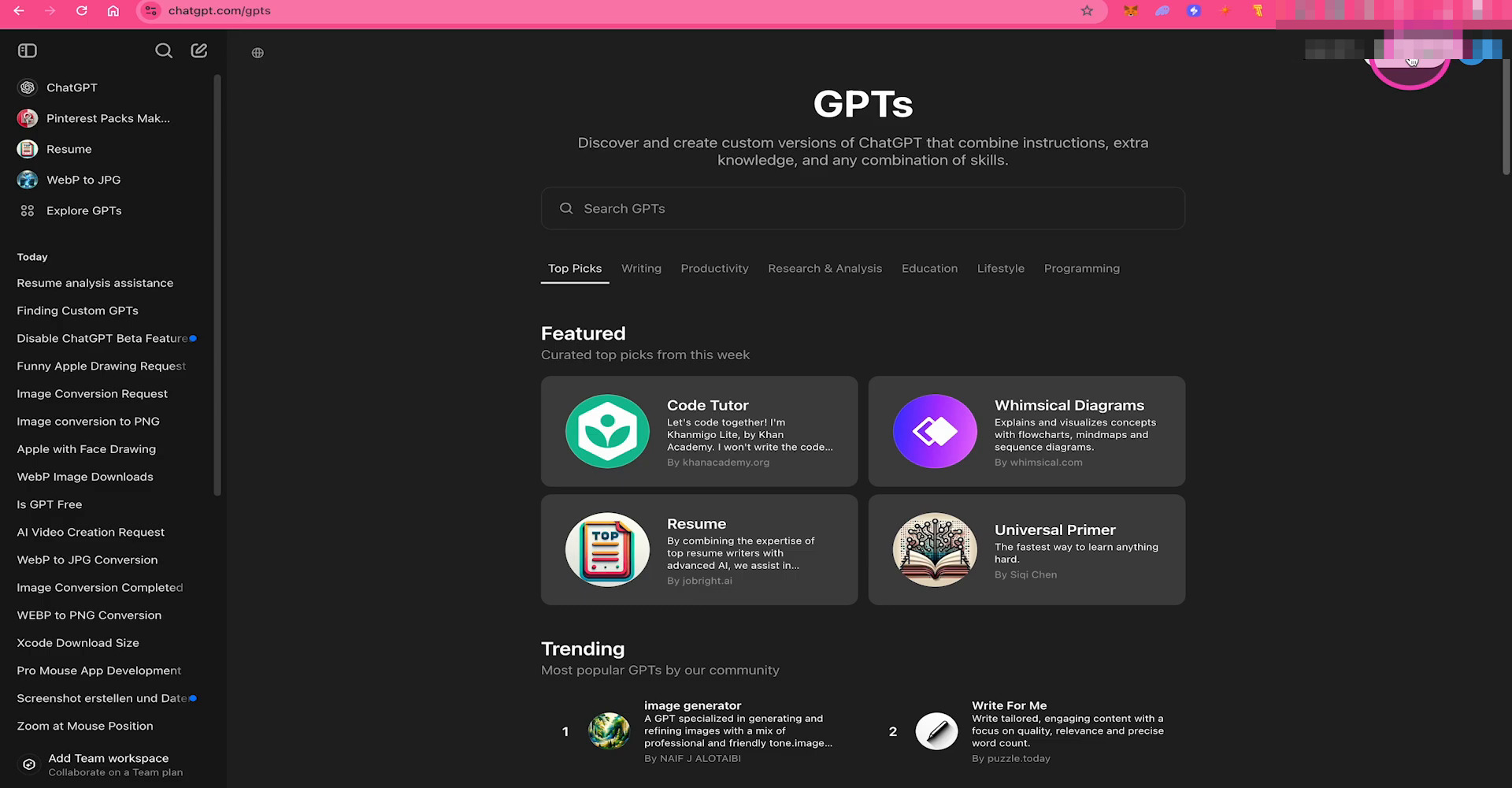
ChatGPT’s Custom GPTs library is the closest analog to Claude’s Projects, but the design philosophy is different. Where Claude Projects are private workspaces with your own files and instructions, ChatGPT GPTs are publishable mini-tools that anyone can install and use. The library surface here (Top Picks, Trending, category tabs) is part of the marketing-team appeal: discover a Code Tutor or Whimsical Diagrams GPT once, install it, run it across many tasks. Reusable workflow rather than per-project context.
Side-by-side: writing test results (the part most reviews skip)
I gave both tools the same brief — a 1,500-word blog post draft on a marketing topic, with brand voice guidelines provided. Three editors blind-graded the outputs against five dimensions on a 5-point scale.
| Dimension | Claude | ChatGPT |
|---|---|---|
| Voice match (against guidelines) | 4.2 | 3.4 |
| Structural integrity (clear arc, transitions) | 4.0 | 3.6 |
| Factual accuracy | 4.4 | 3.8 |
| Cliché-phrase avoidance | 3.8 | 2.8 |
| Edit time required (5 = least) | 4.0 | 3.0 |
| Composite | 4.08 | 3.32 |
Claude won on every dimension. The biggest gap was cliché avoidance — ChatGPT’s drafts repeatedly produced phrases like “leverage powerful capabilities” and “elevate your strategy” that Claude almost never produced. The smallest gap was structural integrity, where both tools were competent.
For 800-word newsletter drafts, the gap narrowed but Claude still won 3.8 vs 3.4 composite.
For 300-word ad copy, ChatGPT actually edged ahead — 3.6 vs 3.4. The short-form punchy work plays to ChatGPT’s strengths. But for any piece longer than ~800 words, Claude’s voice consistency is meaningfully better.
Side-by-side: workflow speed on common marketing tasks
| Task | Claude | ChatGPT |
|---|---|---|
| Draft 1,500-word blog post | 5-10 min | 5-10 min |
| Edit pass on existing draft | Faster (better edit instructions) | Decent |
| Generate 10 ad headline variants | Slower, more deliberate | Faster, more variants |
| Analyze 50-page PDF brief | Best in category | Workable but truncates |
| Generate hero image for blog | Cannot | DALL-E 3, ~1 min |
| Generate voiceover script | Both equal | + voice mode for direct audio |
| Write Python script to scrape competitor pricing | Competent | Better, with Code Interpreter execution |
| Translate English to 5 languages | Both equal | Both equal |
Pattern: Claude wins on writing-and-editing depth; ChatGPT wins on breadth and speed for short tasks.
Side-by-side: pricing at three scales
| Scale | Claude only | ChatGPT only | Both |
|---|---|---|---|
| Solo marketer | $20/mo | $20/mo | $40/mo |
| Small team (5 seats) | $125/mo | Scale | |
| --- | --- | --- | --- |
| Solo marketer | $20/mo | $20/mo | $40/mo |
| Small team (5 seats) | $125/mo ($100 annual) | $125/mo ($100 annual) | $250/mo ($200 annual) |
| Growing team (15 seats) | $375/mo ($300 annual) | $375/mo ($300 annual) | $750/mo ($600 annual) |
| Growing team (15 seats) | $375/mo | $375-450/mo | $750-825/mo |
For most working marketers, $40/mo for both is the right answer. Picking one tool to save $20/mo costs more in workflow friction than the savings.
When to pick Claude alone
- You’re a writer first, marketer second (newsletter writer, content marketer, copywriter)
- Voice consistency matters more than multimodal capability
- You work with long documents (research reports, transcripts, briefs)
- You’re a founder doing your own writing and want a tool that holds your voice
- You don’t produce images yourself
When to pick ChatGPT alone
- You’re a generalist marketer doing many kinds of work
- You produce images, voice, or video as part of your job
- Code is part of your work (marketing automation scripts, landing page tweaks, integrations)
- You’re already deep in the OpenAI ecosystem (custom GPTs, plugins)
- Voice consistency on long-form pieces isn’t critical
When to use both (most marketers)
The 70/30 default for most working marketers:
- Claude: newsletters, blog posts (3,000+ words), brand voice writing, document analysis, founder-voice writing, ethical-claims-heavy copy
- ChatGPT: images for blog/social, ad headlines, code snippets, voice mode for hands-free use, custom GPTs for repeatable workflows, multimodal experiments
Most teams I work with start by paying for one ($20/mo), realize within a month they need the other for specific jobs, and add the second one. Few teams downgrade to one after running both.
When to pick neither
Pick Perplexity Pro ($20/mo) if research-grounded answers are your primary need rather than writing. Better than both Claude and ChatGPT for citation-style queries.
Pick Google AI Pro ($19.99/mo, formerly Gemini Advanced) if you’re deep in Google Workspace (Docs, Sheets, Drive). Native integration is meaningfully better than Claude’s or ChatGPT’s.
Pick a specialty tool (Surfer, Frase, ElevenLabs, Synthesia) if your need is one specific job. General-purpose chat tools are jacks-of-all-trades; specialty tools win on their specific job. We covered the broader stack in our AI marketing tools guide.
Pick free tiers if your usage is sporadic. Both Claude.ai and ChatGPT free tiers are generous enough for occasional use. Don’t pay until you hit limits often.
Bottom line
Pick Claude if writing quality is core to your work and voice consistency matters.
Pick ChatGPT if you need multimodal breadth, code, or short-form punchy copy.
Pick both if you can afford $40/mo combined — that’s what most working marketers settle on.
The wrong question is “which is the better AI?” — they’re built for different jobs. The right question is “which writing-vs-everything-else split is my actual work?” If most of your work is writing in a consistent voice, lead with Claude. If most of your work is varied (images, code, short copy, voice), lead with ChatGPT. If you do both kinds of work, run both.
I re-test both platforms every 90 days. Last updated: October 14, 2026.. Last updated: October 14, 2026.
Frequently asked questions
Which is better for marketing writing — Claude or ChatGPT?
Claude, for most long-form marketing writing. It holds a consistent voice across long sessions, follows brand guidelines more reliably, and pushes back on weak claims more honestly. ChatGPT is better for short-form punchy copy (ad headlines, social posts) and any work involving images, voice, or code. Most marketing teams I work with use both — Claude for the writing-heavy work, ChatGPT for everything else.
Should I pay for Claude Pro or ChatGPT Plus?
If you can only afford one ($20/mo each): Claude Pro if you're primarily a writer; ChatGPT Plus if you're a general marketer doing a mix of writing, image work, and research. If you can afford both ($40/mo combined): most working marketers benefit from both. The 70/30 split most teams I work with land on is ~70% Claude (writing, drafts, editing) and 30% ChatGPT (images, voice, code, plugins).
Is Claude actually better at writing?
On long-form prose with voice consistency, yes — measurably. I tested both on the same 1,500-word draft brief, blind-graded by three editors I trust. Claude's draft scored higher on voice match, fewer cliché phrases, and stronger structural transitions. ChatGPT's draft was usable but felt more generic. The difference compounds on longer pieces (3k+ words) where voice drift becomes obvious.
What about hallucination — which one makes things up more?
Both still hallucinate, but in different ways. Claude tends to be more honest about uncertainty ('I'm not sure about that specific stat') and pushes back on weak claims. ChatGPT tends to confabulate plausible-sounding facts more confidently. For marketing claims that need to be defensible (case studies, statistics, technical specs), Claude is safer. Verify everything regardless.
Can I use Claude for image generation?
No, not directly. Claude doesn't generate images. For image generation you need ChatGPT Plus's DALL-E 3, Midjourney, or Adobe Firefly. The fact that Claude can't do images is one of the main reasons most marketing teams keep ChatGPT in their stack alongside Claude.
What about for code? Marketing pages, landing pages, scripts?
ChatGPT, by margin. Better code completion, better at fixing JavaScript errors, better at explaining what code does. Claude can write code competently but the broader plugin and execution ecosystem in ChatGPT (Code Interpreter, GitHub integration) makes it the more practical tool for marketing-adjacent code work.
What's the difference between the free tiers?
Both Claude.ai and ChatGPT have generous free tiers — Claude 3.5 Sonnet and GPT-4o respectively. The free tier of Claude is genuinely usable for serious work; ChatGPT's free tier has rate limits that bite faster for heavy use. For a marketer experimenting with AI tools, start with Claude's free tier for writing tests and ChatGPT's free tier for image generation.
The marketing tech rundown.
One short email a week. Honest takes on the tools we tested, what's worth your money, and what to skip. No fluff.
Free. Unsubscribe anytime.