opinion
Did Mailchimp Raise Prices in 2026? Here's the Damage (and When to Switch)
Mailchimp raised legacy plan prices 11-13% in April 2026, after January's free plan cuts. Real numbers at every list size, and when to stay or switch.
 By Manu A. · · 10 min read ·
Updated

If you opened this article, the answer you’re looking for is yes — Mailchimp raised prices in 2026. Twice, actually. In January they cut features from the free plan. In April they raised grandfathered legacy plans 11-13%, effective on the first billing cycle after April 13. If you’ve been on Mailchimp since before 2019 and your invoice just got fatter, that’s why.
The bigger question is whether to stay or switch. The honest answer depends on what you actually use Mailchimp for, and most users don’t use most of what they’re paying for.
Quick verdict. If you’re on a legacy plan that just got hit: the 11-13% increase is a signal, not the destination. Mailchimp has done multiple price-related changes per year since the Intuit acquisition. Switch if your renewal price crossed a threshold — it’ll only get worse. If you’re on a current plan: ignore the news cycle, but audit your stack — most small businesses are paying for Mailchimp’s CRM, ads, and transactional features they don’t touch. MailerLite costs roughly 30-60% less than Mailchimp Standard at the same list size for the email-campaign-and-automation use case.
What changed in April 2026
On April 13, 2026, Mailchimp ended the grandfathered pricing on legacy plans. Accounts that were created before May 2019 and stayed on those original tiers (rather than migrating to today’s Essentials, Standard, or Premium) had their pricing increased by an average of 11-13%, applied at the start of the first billing cycle after April 13.
The increase wasn’t uniform. Lower-tier legacy plans saw closer to 11%; higher tiers (Premium-equivalent legacy) saw the full 13%. The exact dollar impact depends on which legacy SKU you were on — Mailchimp emailed affected customers individually with their specific old → new numbers about 30 days before the change.
If your account was created after May 2019, you’re already on current pricing and this change didn’t affect you. The April increase was specifically about migrating the long-tail of legacy users onto present-day pricing — closing out a multi-year grace period that Mailchimp had quietly let run.
What changed in January 2026
The April increase wasn’t the year’s first change. In January 2026, Mailchimp cut features from the free plan:
- Send limits dropped for the free tier
- Audience limits got tighter (you can hold fewer contacts before being forced to upgrade)
- Email-builder features were gated behind paid plans (some templates and a couple of automation tools moved up the ladder)
The January cuts hit everyone on the free plan — meaning the broad audience of new users, hobby projects, and small lists that Mailchimp historically catered to. The April increase hit a narrower slice (legacy paid accounts), but the pattern matters more than either change individually. Mailchimp has run a steady cadence of price-related changes since Intuit acquired it in 2021 — multiple rounds of free-tier tightening, contact-counting changes, and tier-level adjustments. The trajectory is one direction.
What Mailchimp actually costs now
Here’s what current Mailchimp pricing looks like at common list sizes — useful both for budgeting and for comparing against alternatives.
| Contacts | Essentials | Standard | Premium |
|---|---|---|---|
| 500 | $13/mo | $20/mo | $350/mo |
| 1,000 | $26.50/mo | $45/mo | $350/mo |
| 5,000 | $75/mo | $100/mo | $350/mo |
| 10,000 | $110/mo | $135/mo | $350/mo |
| 25,000 | $270/mo | $310/mo | $620/mo |
| 50,000 | $385/mo | $450/mo | $815/mo |
List prices, billed monthly (Mailchimp has no annual plan), verified October 2026. Promotions run; we quote list prices.
A few things to note. Premium has a hard floor of $350/mo even at small list sizes: that one price covers everything up to 10,000 contacts, and it doesn’t scale down. Standard is the plan most small businesses end up on after they hit a feature wall on Essentials. The cliff most people complain about comes right after 10,000 contacts: Standard goes from $135/mo to $230/mo the moment you pass 10,000 (going from 5,000 to 10,000 only adds $35).
These are headline list-size numbers. The actual bill is usually higher because of:
- Pay-as-you-go credits for additional sends past the monthly cap (most plans cap monthly sends at 10x contact count)
- Add-on tools like transactional email (SES wrapping at premium markup), SMS, and dedicated IPs
- Inactive contact charges — Mailchimp counts unsubscribed and bounced contacts in your billable count unless you manually clean them every month
The “I thought I was on the $45/mo plan” problem usually turns out to be one of those three.
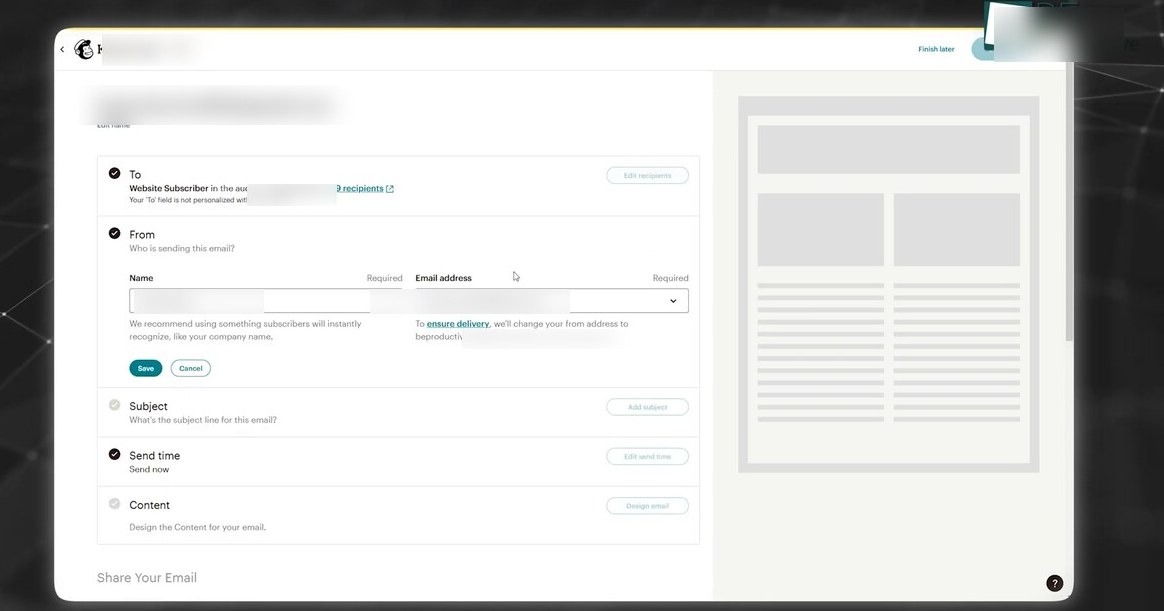
The Mailchimp campaign builder, with the checklist-style flow that’s the same surface paying customers spend most of their time in. Account name, audience reference, From name and email address blurred for the publisher’s privacy.
What the alternatives cost at the same tiers
The honest comparison. Here’s what the leading alternatives charge at the same contact tiers — for the email-campaigns-and-automation use case, not Mailchimp’s broader stack.
| Contacts | MailerLite Comfort | Klaviyo | Kit Creator | Beehiiv Lite |
|---|---|---|---|---|
| 500 | $12/mo | $20/mo | $39/mo | $59/mo |
| 1,000 | $19/mo | $30/mo | $39/mo | $59/mo |
| 5,000 | $49/mo | $100/mo | $89/mo | $109/mo |
| 10,000 | $89/mo | $150/mo | $139/mo | $139/mo |
| 25,000 | $179/mo | $400/mo | $199/mo | $199/mo |
| 50,000 | $319/mo | $720/mo | $379/mo | $299/mo |
List prices on each tool’s cheapest plan with automations, billed monthly, verified October 2026. Kit and Beehiiv have no 500 tier, so their 1,000 price applies. Kit’s free plan covers up to 10,000 subscribers and Beehiiv’s up to 2,500, but neither free plan includes automations. Annual billing takes 10% off MailerLite, 17% off Kit (Creator is $33/mo at 1,000 and $166/mo at 25,000) and up to 20% off Beehiiv; Klaviyo has no annual discount.
The pattern at every list size: MailerLite costs 30-60% less than Mailchimp Standard at equivalent contact counts (half or less at 1,000 to 5,000). Beehiiv is the cheapest option here at 50,000 contacts if your business is a newsletter. Klaviyo matches or undercuts Mailchimp Standard up to 5,000 contacts and costs more from 10,000 up ($720 vs $450 at 50,000), but pays for itself fast for ecommerce stores doing real revenue (the segmentation and revenue attribution data is in another league).
The full comparison with feature-by-feature differences and “skip if” conditions lives in our 7 Mailchimp Alternatives roundup — including a sortable comparison matrix and a pricing calculator that lets you slide your subscriber count.
Should you stay or switch?
Three honest questions.
Question 1: Are you on a legacy plan that just got hit? If yes, the 11-13% increase is a leading indicator, not the final word. Mailchimp has demonstrated a clear pattern of price escalation since the Intuit acquisition. The legacy grandfathering ending in April closes the last “promise” tying Mailchimp to its pre-2021 customer base. If your renewal pricing crossed a threshold this month, switch — the next change won’t go your way either.
Question 2: Do you actually use Mailchimp’s broader stack? Mailchimp is no longer just an email tool — it’s a marketing platform with CRM, paid ads, transactional email, surveys, and content optimization. If you use those features (especially the ads platform that connects to your contact data), the integration cost of switching is real. If you only use email campaigns + automations, you’re paying a Mailchimp tax for capabilities you don’t touch. Audit honestly: log in, look at which navigation items you’ve clicked in the past 90 days, and decide.
Question 3: How fast is your list growing? Mailchimp’s pricing curve gets meaningfully steeper past 10,000 contacts, where Standard jumps from $135/mo to $230/mo. If you’re at 6,000 today and growing 200/month, you’ll hit the cliff in 20 months. If you’re at 12,000 already and growing slowly, the math is different. The cheaper alternatives (MailerLite, Brevo) have flatter pricing curves, so the savings compound at scale.
The general decision matrix:
- Stay on Mailchimp if: you use the CRM, ads, or transactional email features; your list is under 1,000 contacts and stable; you’re billing client work and need Mailchimp’s brand recognition for proposals.
- Switch to MailerLite if: you use email campaigns + automations only; your list is 1,000-25,000 contacts; you want a cleaner editor and stronger feature-per-dollar (50 automations on the Comfort plan, unlimited on Power).
- Switch to Klaviyo if: you run a Shopify, WooCommerce, or BigCommerce store doing $20k+/month in revenue. The revenue attribution alone justifies the higher price.
- Switch to Kit (ConvertKit) if: you’re a creator selling courses, paid newsletters, or coaching products. The tagging-based segmentation is built for that workflow.
- Switch to Beehiiv if: the newsletter is the product. Native ad network, 0% take rate on paid subscriptions, built-in referral system.
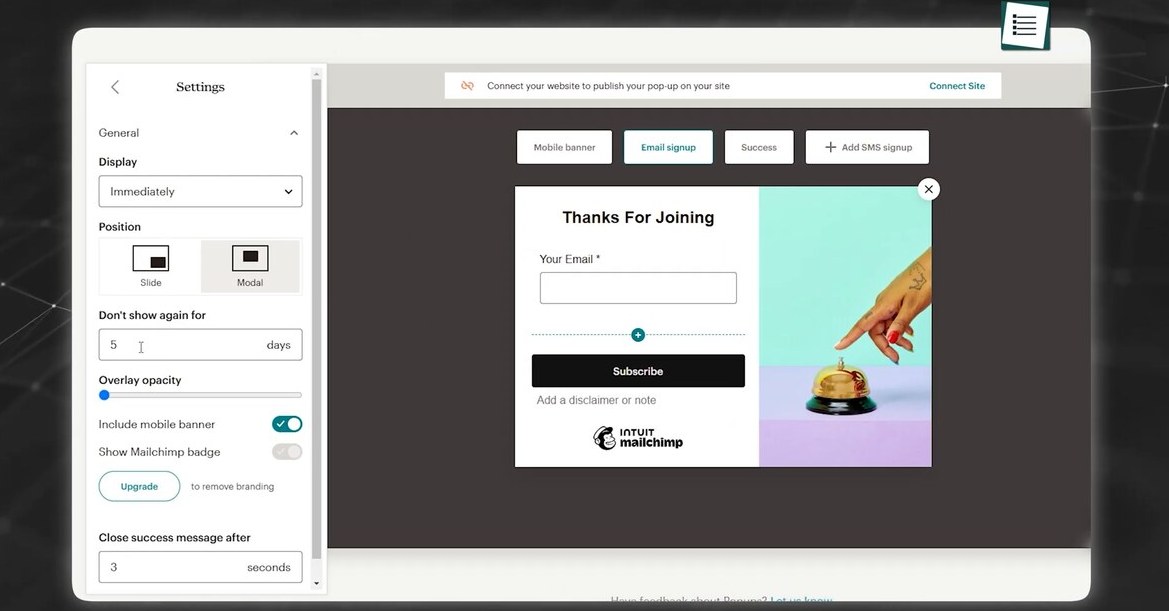
The Mailchimp pop-up form builder. The Settings panel is also where you’ll find the “Show Mailchimp badge” toggle that’s locked off on the free plan — Mailchimp’s “remove branding” upsell is one of the small frictions you stop paying for the moment you switch to MailerLite or Beehiiv, both of which let you brand pop-ups your way on every paid tier.
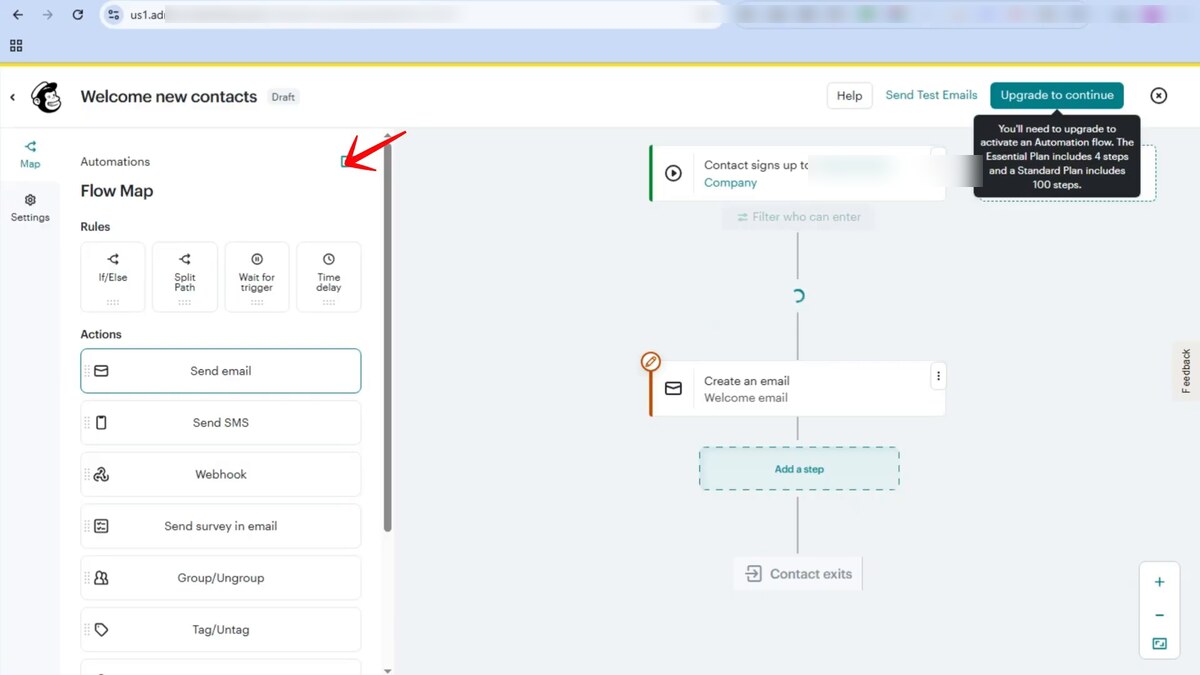
Mailchimp’s Customer Journey builder — and the upsell tooltip that quietly tells you the real story. Building anything beyond a four-step flow on the Essentials plan means upgrading to Standard. This is exactly the Mailchimp tax we mentioned earlier: every meaningful automation is one tier above where most small businesses think they’re shopping.
How to switch (without breaking anything)
The migration mechanics aren’t the hard part — every alternative imports a Mailchimp CSV cleanly. What breaks people is forgetting to rebuild automations (those don’t transfer), failing to warm up the new sending IP, or skipping the re-engagement campaign that should happen before the export.
We wrote a step-by-step migration tutorial that covers the full playbook — including the parts most other guides skip (deliverability warm-up, parallel-running both platforms for 2 weeks, what to do with automations).
The realistic timeline for a typical small business migration: 4-6 hours of focused work spread across 1-2 weeks. Most of that is rebuilding automations on the new platform — the actual list export and import takes minutes.
Bottom line
Yes, Mailchimp raised prices in 2026. The pattern matters more than any single change: Mailchimp has been steadily restructuring pricing in their favor since Intuit acquired them in 2021, and the trajectory is one direction.
The honest move:
- If you’re on a legacy plan that got hit: switch now, before the next change. Read our Mailchimp alternatives roundup and pick based on your use case.
- If you’re on a current plan: audit what you actually use. If it’s just email + automations, MailerLite is roughly 30-60% cheaper than Mailchimp Standard at every list tier we tested on its June 2026 Comfort pricing.
- If you’re a creator or newsletter operator: look at Kit or Beehiiv first. Mailchimp was never designed for that business model.
- If you’re an ecommerce store doing serious revenue: Klaviyo will pay for itself within two months.
The price increases aren’t going to stop. The decision worth making is when you’re going to stop being affected by them.
We re-test every 90 days. Last updated: October 14, 2026.
Frequently asked questions
Did Mailchimp raise prices in 2026?
Yes, twice. In January 2026 Mailchimp cut features from the free plan (lower send limits, fewer audiences). In April 2026 they raised legacy plans (grandfathered accounts created before May 2019) by an average of 11-13%, taking effect on the first billing cycle after April 13.
Does the April 2026 increase affect everyone on Mailchimp?
No, only legacy/grandfathered accounts created before May 2019 that never migrated to current Essentials, Standard, or Premium plans. If your account is on a current plan, your bill didn't change in April. But the January 2026 free plan cuts hit everyone on the free tier.
How much does Mailchimp cost now in 2026?
Essentials starts around $13/month for 500 contacts. Standard runs roughly $20/month at 500 contacts and scales up sharply. Premium starts at $350/month and that price covers up to 10,000 contacts; that's where most of the small business sticker shock lives. Pricing scales with contact count and gets meaningfully more expensive past 10,000.
Should I switch from Mailchimp because of the price increase?
If you're on a legacy plan and your renewal pricing crossed your psychological threshold, almost certainly yes — that increase signals more to come. If you're a current-plan user, the question is whether you actually use Mailchimp's CRM, ads, or transactional features. If you only use email campaigns + automations, MailerLite is roughly 30-60% cheaper than Mailchimp Standard at the same list size.
What's the cheapest Mailchimp alternative in 2026?
MailerLite for most small businesses. Its Comfort plan (renamed from Growing Business in June 2026) is $49 at 5,000 contacts against Mailchimp Standard's $100, so almost exactly half. Sender is even cheaper at the lowest tiers but the platform feels less polished. Brevo is the cheapest if your contact count is huge but your monthly send volume is modest.
Will Mailchimp keep raising prices?
The pattern since Intuit's 2021 acquisition strongly suggests yes. Multiple price-related changes per year is now the norm — free plan cuts, legacy migrations, and tier-level adjustments. The acquisition thesis was that Mailchimp's customer base was undermonetized, so price increases are the playbook, not an exception.
The marketing tech rundown.
One short email a week. Honest takes on the tools we tested, what's worth your money, and what to skip. No fluff.
Free. Unsubscribe anytime.